
Work Motivation Hierarchy Test
How the Scales are Structured
Who Usually Takes This Test?
See How You Compare
Below is a preview of how scores are typically distributed across each scale.
Example Questions From the Test
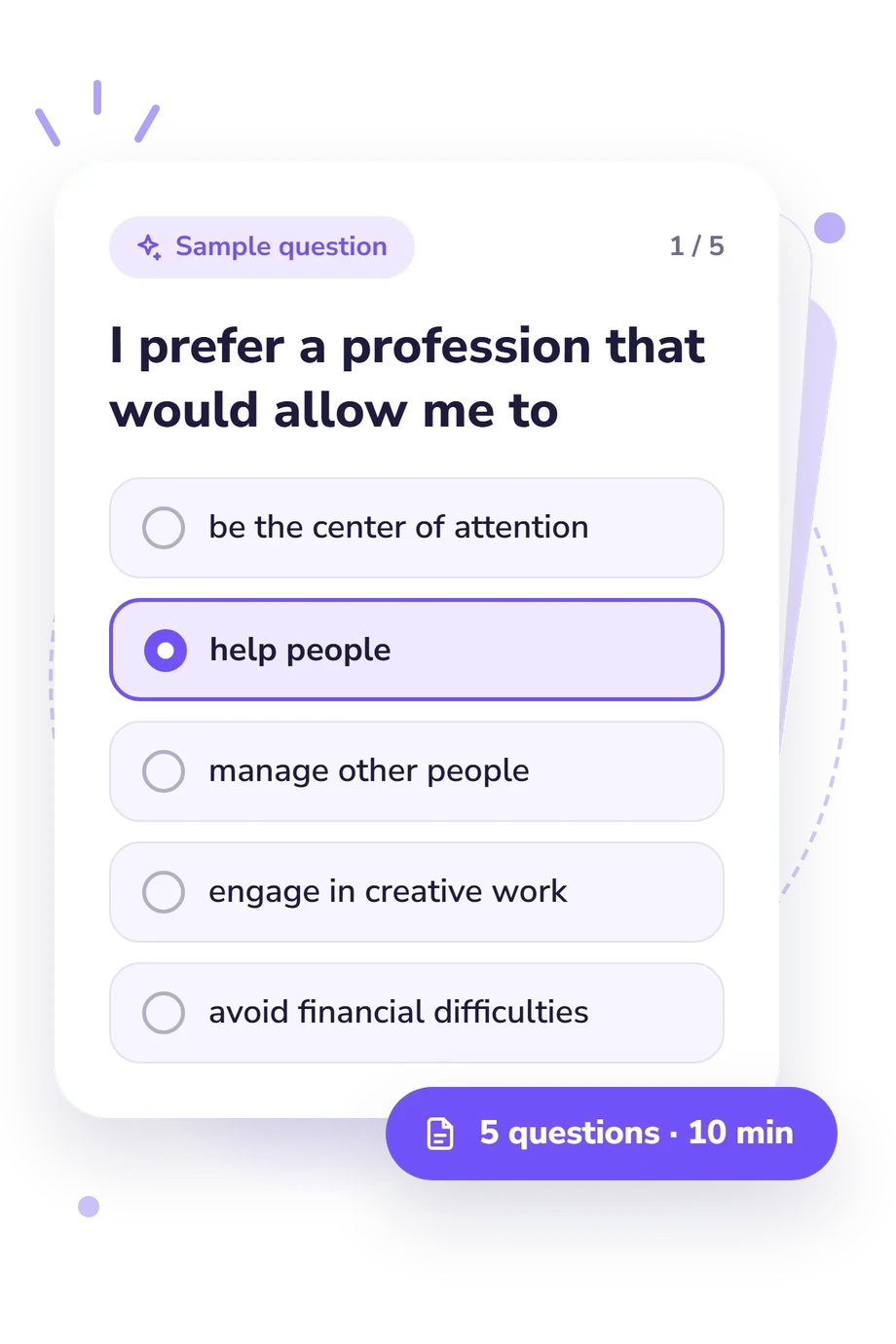
- be the center of attention
- help people
- manage other people
- engage in creative work
- avoid financial difficulties
- in advertising for my work
- in charitable activities
- in my election campaign
- in research and creative projects
- in secure stocks or in a bank at a high interest rate
- acting, journalism, or television presenting
- the clergy, medicine, or teaching
- politics or a leadership role
- science or the arts (e.g., scientist, artist, writer, poet)
- banking or finance
Work Motivation Hierarchy Test - Description and methodology of the test
People considering a career change, choosing between professional paths, or reflecting on what makes work satisfying may use the Work Motivation Hierarchy Test to clarify their priorities. This work motivation test presents a compact profile of motives that can influence occupational choices, helping readers compare outward recognition, material security, influence, creative self-realization, and contribution to others without reducing a career decision to one score.
What This Assessment Explores
The questionnaire examines five work motives: service, money, creativity, power, and fame. Results show emphasis, not a morally better motive or guaranteed career prediction.
The profile covers:
- Service shows a tendency to place the interests of work and other people ahead of personal interests: 5–25; Lower service focus 5–14, Balanced service focus 15–19, Strong service focus 20–25.
- Money shows material reward and career advancement: 5–25; Low money focus 5–9, Moderate money focus 10–19, High money focus 20–25.
- Creativity shows the pull toward self-realization through work: 5–25; Low 5–9, Moderate 10–19, High 20–25.
- Power shows desire to lead, direct, or control: 5–25; Low 5–14, Moderate 15–19, High 20–25.
- Fame shows the need for attention and social recognition: 5–25; Low 5–9, Moderate 10–19, High 20–25.
Taken together, the work motivation profile shows whether one motive dominates or several competing aims share attention.
Methodology and Evidence Base
Each item offers five alternatives, asking the respondent to choose the occupational preference, use of money, quotation, or life priority that fits best. Answers are grouped by motive rather than collected through a long agreement scale.
The scoring output compares five dimension scores and places each in its corresponding result band. This makes the profile useful for comparing motives, not for declaring a fixed identity. This work motivation assessment is most informative alongside career experience, abilities, values, and present circumstances.
The questionnaire is conceptually consistent with Rezapkina's Hierarchy of Work Motives (2008), but it is not presented as a validated adaptation. Kanfer, Frese, and Johnson (2017) provide broader contextual frameworks for understanding work motivation, including intrinsic and extrinsic motivation, while Ryan and Deci (2000) clarify those two forms.
Because responses are brief and self-reported, mood, financial pressure, recent work experiences, and self-awareness can influence the profile. The displayed bands are descriptive levels of motive focus for reflection, not clinical thresholds; interpretation should consider current circumstances and the limits of self-report.
- Rezapkina, G. V. (2008). Psychology and Career Choice: A Pre-Profile Training Program: Educational and Methodological Manual (2nd ed.). Moscow: Genesis. 207 pp. ISBN 978-5-98563-144-9.
- Kanfer, R., Frese, M., & Johnson, R. E. (2017). Motivation related to work: A century of progress. Journal of Applied Psychology, 102(3), 338–355. 10.1037/apl0000133
- Ryan, R. M., & Deci, E. L. (2000). Intrinsic and extrinsic motivations: Classic definitions and new directions. Contemporary Educational Psychology, 25(1), 54–67. 10.1006/ceps.1999.1020
Updated: