
Dutch Work Addiction Scale (DUWAS) Test
How the Scales are Structured
Who Usually Takes This Test?
See How You Compare
Below is a preview of how scores are typically distributed across each scale.
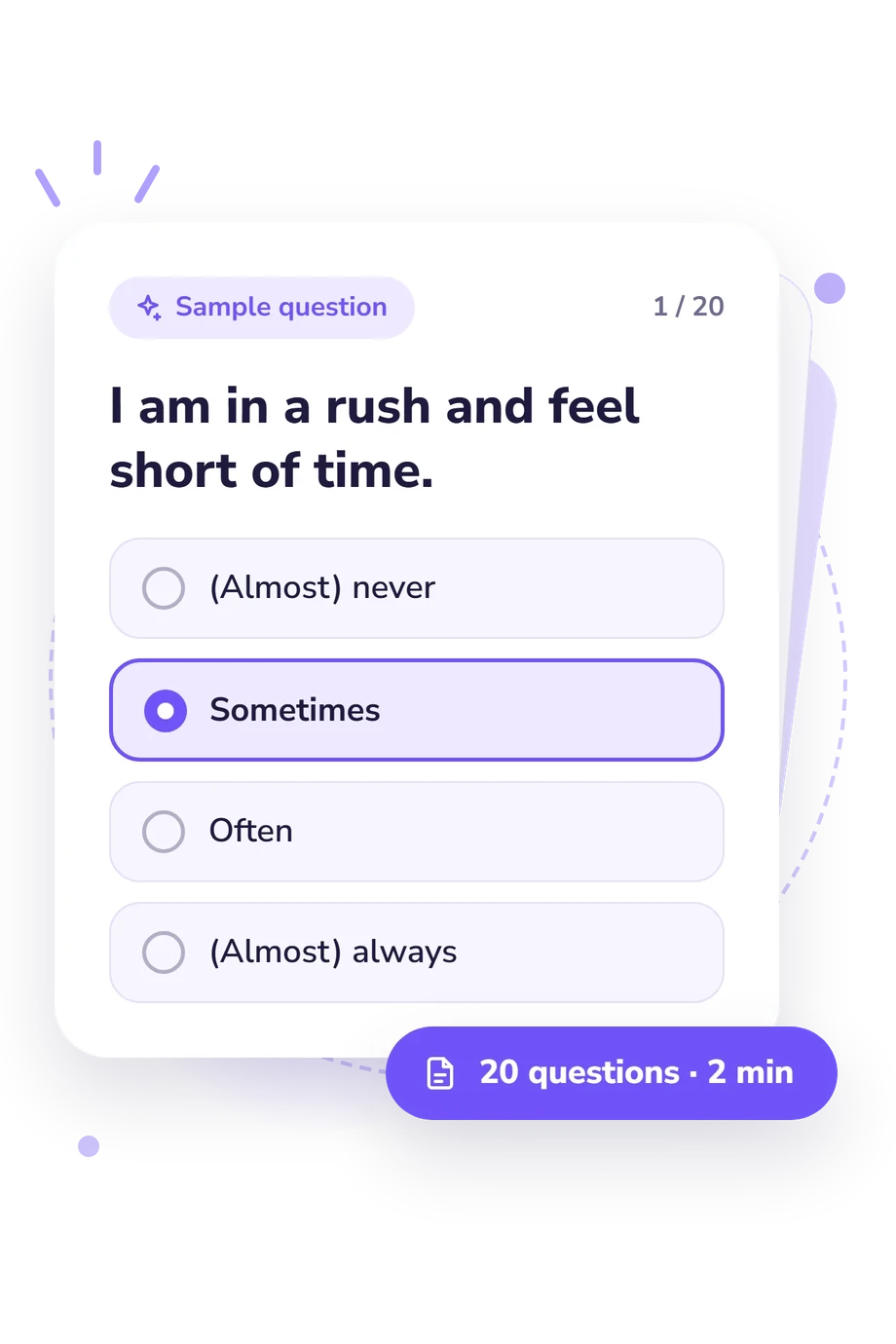
Example Questions From the Test
- (Almost) never
- Sometimes
- Often
- (Almost) always
- (Almost) never
- Sometimes
- Often
- (Almost) always
- (Almost) never
- Sometimes
- Often
- (Almost) always
Dutch Work Addiction Scale (DUWAS) Test - Description and methodology of the test
People who are reviewing demanding work patterns may use the Dutch Work Addiction Scale (DUWAS) Test to consider whether their experience reflects persistent internal pressure, a pattern of working beyond requirements, or a combination of the two. This work addiction test can help organize observations around compulsion, workload, and recovery rather than reducing the experience to a single label. It is for people deciding how to understand their work habits.
What This Assessment Explores
This questionnaire distinguishes internal pressure to keep working from simply having a heavy workload. Its items touch on time pressure, constant busyness, multitasking, guilt about taking leave, difficulty relaxing, and work replacing social or leisure time. This workaholism questionnaire is most useful when answers reflect recurring habits rather than one exceptional week.
The displayed dimensions are:
- Work Compulsiveness (1–4) measures difficulty detaching and persistent work thoughts; bands: Low 1–2, Moderate 2.1–3, High 3.1–4.
- Working Excessively (1–4) measures working beyond requirements and excessive workload; bands: Low 1–2, High 2.1–4.
- Work Addiction Scale (1–4) reflects overall work involvement and workaholism tendency; bands: Low 1–2, Moderate 2.1–3, High 3.1–4.
Higher scores indicate more of the relevant tendency. The profile presents these tendencies separately; it does not identify causes of strain.
Methodology and Scientific Basis
Each statement uses the same four-point frequency response: 1, (Almost) never; 2, Sometimes; 3, Often; and 4, (Almost) always. The items address thoughts, urges, behavior, and sacrifices outside work, so the result reflects subjective self-report rather than observed performance.
Methodologically, the questionnaire is conceptually consistent with the Dutch Work Addiction Scale (DUWAS), the two-factor workaholism measure evaluated by Schaufeli, Shimazu, and Taris. Its brief format also corresponds to later research on short workaholism measures, including Rantanen and colleagues’ cross-national study. It is not a direct adaptation of DUWAS, and the cited DUWAS studies do not validate this specific online administration.
The platform converts responses into displayed 1–4 scores and assigns the listed bands; because no item-weighting or aggregation formula is stated, no exact point contribution can be inferred. As a work-life balance assessment, it is best read alongside workload, recovery, workplace expectations, and recent stress. Mood, deadlines, memory, social desirability, and limited self-awareness can also influence self-report.
- Schaufeli, W. B., Shimazu, A., & Taris, T. W. (2009). Being driven to work excessively hard: The evaluation of a two-factor measure of workaholism in The Netherlands and Japan. Cross-Cultural Research, 43(4), 320–348. 10.1177/1069397109337239
- Rantanen, J., Feldt, T., Hakanen, J. J., Kokko, K., Huhtala, M., Pulkkinen, L., & Schaufeli, W. (2015). Cross-national and longitudinal investigation of a short measure of workaholism. Industrial Health, 53(2), 113–123. 10.2486/indhealth.2014-0129
Updated: