
Self-Development Readiness Scale Test
How the Scales are Structured
Who Usually Takes This Test?
See How You Compare
Below is a preview of how scores are typically distributed across each scale.
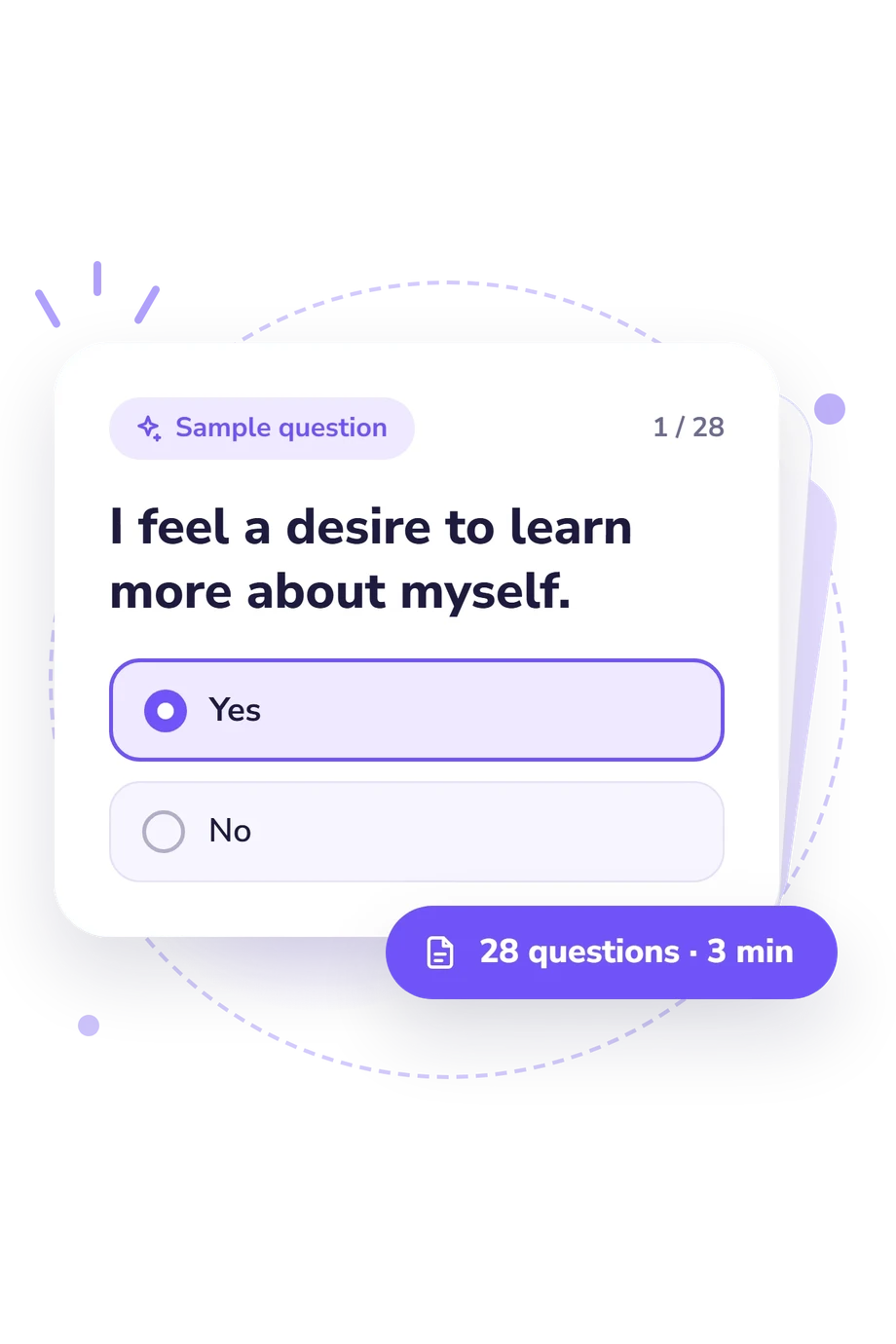
Example Questions From the Test
- Yes
- No
- Yes
- No
- Yes
- No
Self-Development Readiness Scale Test - Description and methodology of the test
People who want to understand their capacity for purposeful change can use the Self-Development Readiness Scale Test as a structured reflection tool. It suits anyone considering new habits, skills, or goals, especially when personal growth readiness is in question. The result shows how willing and able you feel to examine yourself and act on insight.
What This Assessment Explores
Readiness is examined as both an inward and action-oriented capacity. Its statements ask about knowing yourself, recognizing strengths and weaknesses, trusting your abilities, setting goals, building discipline, responding to mistakes, and resisting the belief that circumstances always control outcomes. The two results offer complementary views of self-knowledge and self-improvement that can be considered alongside one another, rather than a score of how the dimensions interact.
The two displayed dimensions describe the result as follows:
- Ability to Self-Improve (0-7) measures readiness and ability to change, develop qualities and skills, and mobilize personal resources; Low 0-3.5 is the lower band, while High 3.5-7 is the higher band.
- Readiness for Self-Knowledge (0-7) measures willingness and ability to understand personal characteristics and inner experience; Low 0-3 is the lower band, while High 4-7 is the higher band.
Methodology and Scientific Basis
Every item is a first-person statement answered with Yes or No. The statements cover confidence, persistence, self-discipline, openness to feedback, willingness to change, and beliefs about control over circumstances. In practice, the self-development readiness scale is interpreted through two separate dimensions rather than a single overall attitude score. Interpretation should use the displayed totals and bands; the Yes/No point assignment is not standardised in this version, so the bands provide the appropriate frame for reading the result.
The conceptual reference is the Readiness for Self-Development Test by Ratanova and colleagues. The online questionnaire adapts that instrument by presenting its content in English as 14 Yes/No statements. Related work by Kholodkova, Parfenova, and Bokova examines readiness and ability to self-develop, while Zhilgildinova, Abibulayeva, and Aituarova connect personal and professional growth with competence development. These sources support the relevance of the constructs, not validation of this online version.
This version has no stated population norms, reliability estimates, or clinical cutoffs. Self-reported answers can shift with current motivation, mood, self-awareness, or impression management, so the result is a reflective snapshot rather than a clinical diagnosis.
- Ratanova, T. A., Zolotareva, L. I., and Shlyakhta, N. F. Methods of Personality Study and Psychodiagnostics. Moscow: Moscow State Open Pedagogical University, 1997, pp. 190-192.
- Kholodkova, O. G., Parfenova, G. L., and Bokova, O. A. “Readiness and Ability to Self-Development of Gifted Rural Schoolchildren.” Integration of Education, 26(2), 2022, 297-311. 10.15507/1991-9468.107.026.202202.297-311
- Zhilgildinova, M., Abibulayeva, A., and Aituarova, A. “Integrating Professional and Personal Growth through the Competence-Based Approach.” Asian Journal of Individual and Organizational Behavior, 2, 2022, 35-43. 10.51847/z2Gso4r0MX
Updated: