
Emotion Regulation Questionnaire (ERQ) Test
How the Scales are Structured
Who Usually Takes This Test?
See How You Compare
Below is a preview of how scores are typically distributed across each scale.
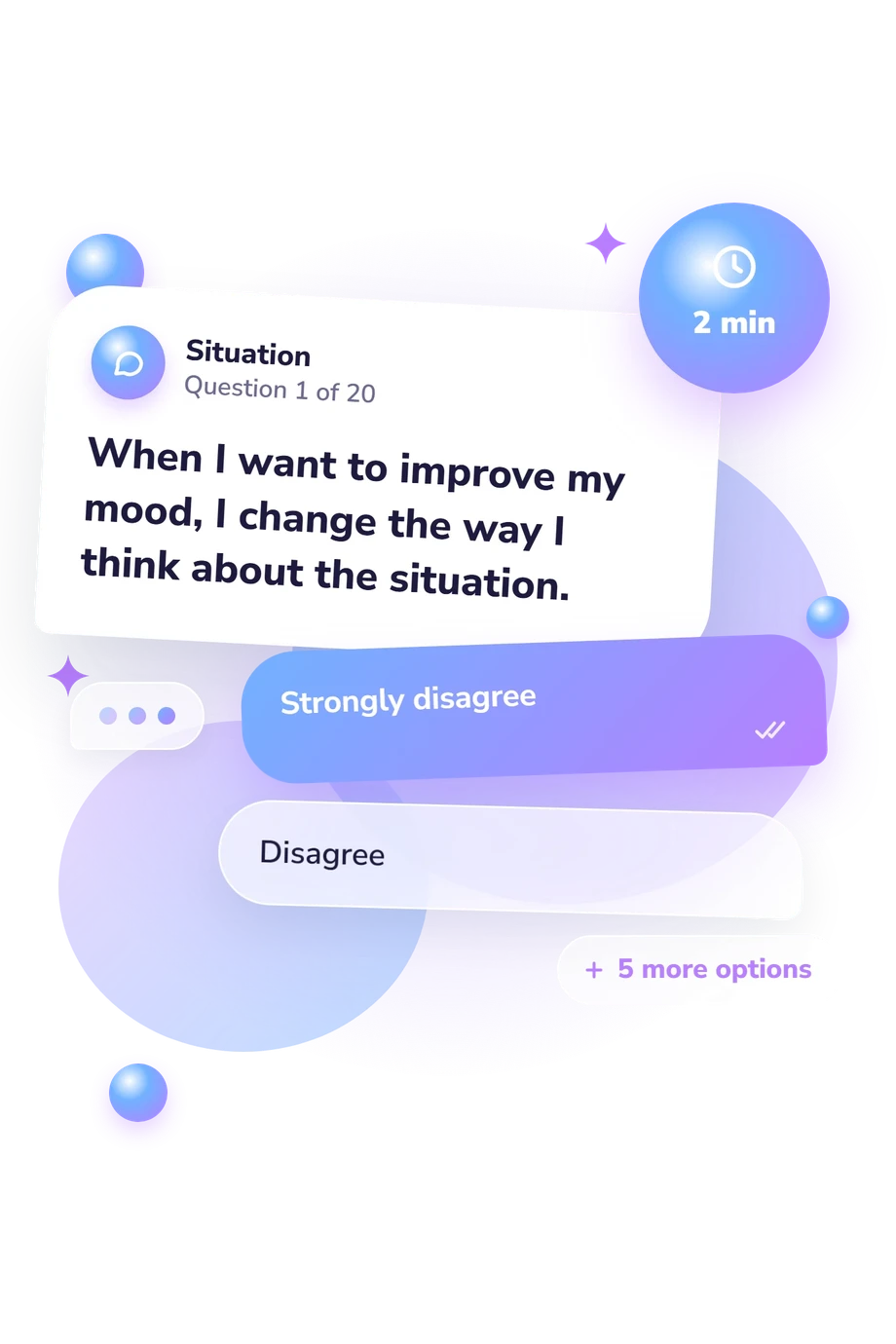
Example Questions From the Test
- Strongly disagree
- Disagree
- Somewhat disagree
- Neither agree nor disagree
- Somewhat agree
- Agree
- Strongly agree
- Strongly disagree
- Disagree
- Somewhat disagree
- Unsure
- Somewhat agree
- Agree
- Strongly agree
- Strongly disagree
- Disagree
- Somewhat disagree
- Neither agree nor disagree
- Somewhat agree
- Agree
- Strongly agree
Emotion Regulation Questionnaire (ERQ) Test - Description and methodology of the test
People who want a clearer picture of their emotional habits can use the Emotion Regulation Questionnaire (ERQ) Test to examine how they respond during positive, negative, or stressful emotional experiences. As an emotion regulation test, it offers a structured profile of two recurring strategies, helping respondents recognize patterns in emotion-regulation strategy use and support self-reflection.
What This Assessment Explores
The assessment examines what a person tends to do with emotion rather than judging feelings as good or bad. Its statements cover changing an interpretation, viewing stress differently, redirecting attention, keeping feelings private, and limiting visible expression after an emotion has arisen.
One part captures how a person changes thoughts, while the other addresses expressive restraint; together, they describe two emotion regulation strategies. Results help respondents recognize how strongly they tend to use each strategy and consider how each operates across situations.
The two displayed scales are:
- Expressive Suppression (4-28) indicates how strongly the respondent tends to inhibit the outward expression of an already-elicited emotional response; the bands are Low suppression (4-11), Moderate suppression (12-19), and High suppression (20-28).
- Cognitive Reappraisal (6-42) indicates how strongly the respondent tends to reinterpret situations to modify an emotional response; the bands are Low (6-17), Moderate (18-30), and High (31-42).
Methodology and Scientific Basis
Each statement uses a seven-point agreement response, from Strongly disagree to Strongly agree, although some middle choices use neutral or unsure wording. In practice, ERQ scoring groups responses into two conceptual processes and sums each group separately. Higher totals indicate stronger endorsement of a strategy, not a better or worse emotional outcome.
The closest source is the Emotion Regulation Questionnaire (ERQ), described by James Gross and Oliver John in 2003. Their model distinguishes changing a situation’s meaning from modifying outward expression, while Gross’s 1998 review places both within the broader study of emotion regulation. This online questionnaire is conceptually consistent with that instrument and framework, not a direct reproduction of a research administration.
A 2020 psychometric study by Preece and colleagues examined the ERQ in general community samples. It supports the relevance of the two-process structure, but does not establish local standardization, norms, or validity for every online presentation. The displayed bands are descriptive labels, not clinical thresholds.
Self-report results can shift with current context, self-awareness, and response bias. Read the profile as a prompt to examine concrete situations and recurring choices, alongside broader assessment when important decisions depend on it.
- Gross, J. J., & John, O. P. (2003). Individual differences in two emotion regulation processes: Implications for affect, relationships, and well-being. Journal of Personality and Social Psychology, 85(2), 348-362. 10.1037/0022-3514.85.2.348
- Preece, D. A., Becerra, R., Robinson, K., & Gross, J. J. (2020). The Emotion Regulation Questionnaire: Psychometric Properties in General Community Samples. Journal of Personality Assessment, 102(3), 348-356. 10.1080/00223891.2018.1564319
- Gross, J. J. (1998). The Emerging Field of Emotion Regulation: An Integrative Review. Review of General Psychology, 2(3), 271-299. 10.1037/1089-2680.2.3.271
Updated: