
Microsocial Relationship Adaptability Scale Test
How the Scales are Structured
Who Usually Takes This Test?
See How You Compare
Below is a preview of how scores are typically distributed across each scale.
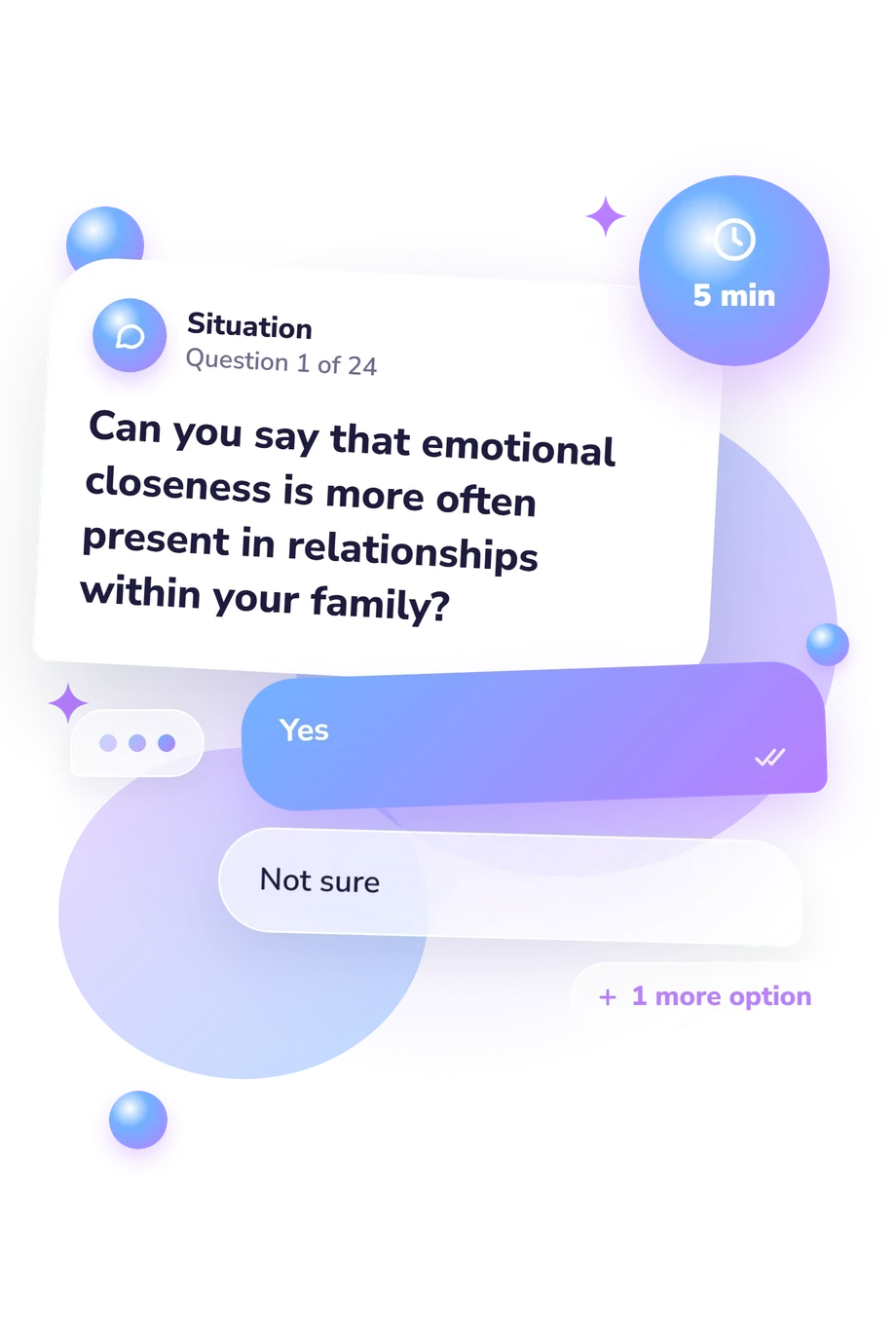
Example Questions From the Test
- Yes
- Not sure
- No
- Yes
- Sometimes
- No
- Yes
- Sometimes
- No
Microsocial Relationship Adaptability Scale Test - Description and methodology of the test
People who want to understand recurring patterns in family life can use this family adaptability profile to examine how flexibly they respond to closeness, disagreement, mood, and changing expectations. The Microsocial Relationship Adaptability Scale Test is especially relevant for self-reflection when communication feels uneven or cooperation becomes difficult. It produces a profile of overall, behavioral, intellectual, and emotional adaptability.
What This Assessment Explores
Rather than measuring one isolated trait, the questionnaire examines how a person adjusts to the emotional, communicative, and practical demands of family life. It examines family relationship adaptability through closeness, mutual understanding, self-control, cooperation, and responses to tension within family life.
The result separates these areas:
- Adaptability Level (0-1) reflects alignment between family goals and outcomes; Low-Moderate is 0-0.75, while High is 0.75-1.
- Behavioral (0-16) shows how well interaction and conduct are adjusted; Low is 0-7, Moderate is 8-12, and High is 13-16.
- Intellectual (0-16) measures mutual understanding and insight into motives; Low is 0-6, Moderate is 7-11, and High is 12-16.
- Emotional (0-16) reflects closeness, attunement, empathy, and support; Low is 0-5, Moderate is 6-11, and High is 12-16.
Read together, these scores indicate whether the main strain concerns behavior, understanding, emotional connection, or overall alignment.
Methodology and Scientific Basis
Each item offers three response choices, with wording that varies by frequency, certainty, intensity, or typical behavior. The format covers interaction and reactions under strain, including listening, handling another person’s mood, and stopping escalation.
The questionnaire interprets emotional, behavioral, and intellectual responses together, connecting emotional adaptability in family relationships with conduct and understanding instead of treating any answer as an isolated symptom. Displayed bands identify each range; they do not establish extra cutoffs or a different point system.
The questionnaire is conceptually consistent with Torokhtiy and Prokhorova's framework, which links family health with interaction, mutual understanding, and adjustment. Kramchenkova adds context on family psychological health, while Olson, Sprenkle, and Russell offer a broader theoretical parallel through the Circumplex model’s cohesion and adaptability dimensions. These sources clarify the constructs; they do not make this online version their published instrument or a validated adaptation.
No population norms are stated for this self-report format, and current context, self-awareness, and willingness to report uncomfortable reactions can influence the profile; it is therefore a self-reflection result rather than a clinical diagnosis.
- Torokhtiy, V. S., & Prokhorova, O. G. (2009). Psychological Health of the Family: A Teaching and Methodological Guide. St. Petersburg: KARO. 160 pp. ISBN 978-5-9925-0271-8.
- Kramchenkova, V. O. (2016). Value Orientations of the Spouses as a Psychological Family Health Factor. Problems of Modern Psychology, 33, 327-338.
- Olson, D. H., Sprenkle, D. H., & Russell, C. S. (1979). Circumplex Model of Marital and Family Systems: I. Cohesion and Adaptability Dimensions, Family Types, and Clinical Applications. Family Process, 18(1), 3-28. 10.1111/j.1545-5300.1979.00003.x
Updated: