
Self-Development Tendency Assessment Test
How the Scales are Structured
Who Usually Takes This Test?
See How You Compare
Below is a preview of how scores are typically distributed across each scale.
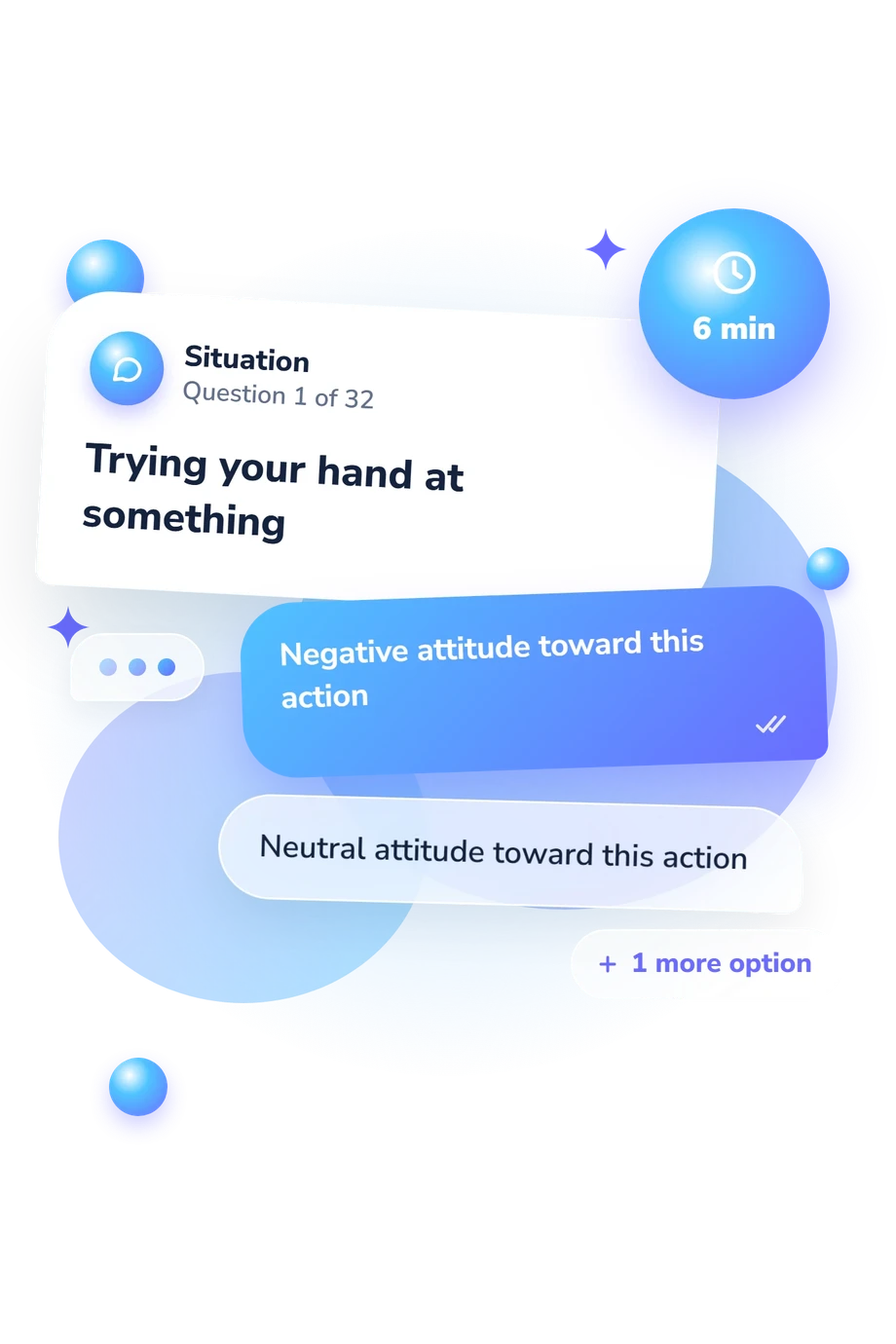
Example Questions From the Test
- Negative attitude toward this action
- Neutral attitude toward this action
- You like this action
- You rarely behave this way
- You behave this way from time to time
- You often behave this way
- You rarely do this
- You do this from time to time
- You often do this
Self-Development Tendency Assessment Test - Description and methodology of the test
People who want to understand why intentions do not become action can use the Self-Development Tendency Assessment Test as a structured starting point. Confidence, persistence, and related topics appear in the items, while the result focuses on readiness for change and consistency between attitudes and behavior. It suits anyone reflecting on habits, goals, learning, or a desire to make deliberate changes. This self-development assessment helps organize that reflection.
What This Assessment Explores
Questions include unfamiliar activities, learning about abilities, changing habits, self-reliance, mistakes, persistence through obstacles, and giving up plans. As a personal growth questionnaire, it compares attitudes toward growth-related actions with how often they appear in behavior. It suits people reflecting on goals and follow-through.
The result presents two scales:
- Discrepancy (0-32) compares attitudes with behavior: Aligned (0-10) indicates consistency, Some discrepancy (11-21) signals a gap, and Marked discrepancy (22-32) signals a larger deviation that may reflect internal conflict or external barriers.
- Readiness for Self-Development (16-144) measures motivation and inclination toward self-improvement and personal development. Low readiness (16-59), Moderate readiness (60-95), and High readiness (96-144) are the displayed bands; average scores may reflect a discrepancy between positive attitudes and behavior when resources or means are insufficient, so individual characteristics matter.
Methodology and Evidence Base
The questions shown use paired self-report items: one prompt asks whether an action feels negative, neutral, or positive, while its partner asks whether the behavior occurs rarely, from time to time, or often. This format compares orientation with expression rather than treating interest alone as action.
Scoring summarizes both sides. The attitude-behavior comparison informs the first result, while the second reflects motivation and inclination toward self-improvement.
As an online self-development questionnaire, it is conceptually consistent with Prihozhan’s 2007 work on self-development, not a documented standardized adaptation of a named published measure. That relationship supports the themes, but it does not establish that the online scoring reproduces a published instrument’s method or norms.
Read the two results together: strong motivation may coexist with discrepancy when resources or circumstances hinder implementation. The online questionnaire does not document point-by-point weighting or population norms, and self-report can be influenced by current context, self-awareness, and the wish to present oneself favorably; its bands are interpretive categories rather than clinical cutoffs, so the profile works best as a focused aid to reflection and goal planning.
- Prihozhan, A. M. (2007). Diagnostics of Personality Development in Adolescents. Moscow: ANO PEB, 56 pp. ISBN 978-5-89774-998-0.
- Berezhkovskaya, E. L., & Kravtsov, L. G. (2021). The Interaction of Secondary School and University as a Condition for Self-Determination among High School Students. Psychological-Educational Studies, 13(4), 39-57. 10.17759/psyedu.2021130403
Updated: