
Freudly+971 508685814hello@freudly.ai
Freudly
moral

Moral and Ethical Responsibility Level Assessment Test
Take the online Moral and Ethical Responsibility Level Assessment Test - AI psychologist FreudlyYou can take Moral and Ethical Responsibility Level Assessment Test here. Online version of a simple and accurate psychological test with interpretation.en
Understand a student’s moral and ethical responsibility in about 6 minutes. Get fast, actionable insight to support coaching, group work, and targeted skill-building.
Start Online Test
Questions: 306 minutes
08:30
October 2, 2025
October 2, 2025
Material has been updated
October 2, 2025
Material has been published
30,441 view
2,821 completion
2,328 likes
Verified by Daniel Hall
Psychologist with 25 years of experience
Share
Scale Explorer

How the Scales are Structured

example score
3/5
Lie Scale (LS)
Assesses the likelihood that responses are overly socially desirable or intentionally distorted, indicating the reliability of the test results.
Low (sincere)
Moderate
High (possible distortion)
02: Low (sincere) | 3: Moderate | 45: High (possible distortion)
A score of 3 falls in the moderate range, suggesting some tendency toward socially desirable responding, so the results should be interpreted with a bit of caution.
example score
3/5
Moral and Ethical Values (MaEV)
Measures the degree to which a person accepts and follows moral and ethical values in decision-making and responsibility-taking.
Low adherence
Moderate adherence
High adherence
01: Low adherence | 23: Moderate adherence | 45: High adherence
A score of 3 indicates a moderate orientation toward moral and ethical standards, with generally accepted values that may vary across situations.
example score
2/5
Altruistic Emotions (AE)
Measures the intensity of altruistic emotions such as empathy and the desire to help others.
Low
Moderate
High
01: Low | 23: Moderate | 45: High
A score of 2 suggests a moderate level of altruistic emotions, with empathy and helping motivation present but not consistently strong across situations.
example score
3/5
Existential Responsibility (ER)
Measures awareness of personal responsibility for one’s own life choices and actions.
Low
Moderate
High
01: Low | 23: Moderate | 45: High
A score of 3 indicates a moderate level of existential responsibility, with responsibility for life choices recognized in many situations but not consistently across contexts.
example score
2/5
Moral and Ethical Intuition (MaEI)
Measures how strongly a person relies on intuitive understanding when recognizing and navigating moral and ethical norms and situations.
Low
Moderate
High
01: Low | 23: Moderate | 45: High
A score of 2 indicates a moderate level of moral-ethical intuition, with some intuitive grasp of norms but inconsistent confidence across situations.
example score
2/5
Reflection on Moral and Ethical Situations (RoMaES)
Measures how well a person analyzes and reflects on moral and ethical situations and dilemmas.
Low reflection
Moderate reflection
High reflection
01: Low reflection | 23: Moderate reflection | 45: High reflection
A score of 2 suggests a moderate level of reflection, with some ability to analyze moral and ethical situations but with room for more consistent depth and consideration.
example score
15/25
Level of Moral and Ethical Responsibility (LoMaER)
Measures the overall development of a person’s moral and ethical responsibility, including adherence to moral principles and accountability for actions.
Low
Moderate
High
05: Low | 615: Moderate | 1625: High
A score of 15 falls in the Moderate range, suggesting moral and ethical responsibility is present but may be inconsistently applied across situations.
Start Online Test
just completed the test
DATA-BASED USER COHORTS

Who Usually Takes This Test?

Teachers and mentors
41%OF USERS
Educators use it to quickly assess students’ ethical decision-making and identify areas to strengthen responsibility and values.
Students in training groups
34%OF USERS
Students take it during classes or workshops to understand how they handle moral dilemmas and accountability toward others.
School psychologists and counselors
25%OF USERS
Support specialists use it as a brief screening tool to plan targeted development work around empathy, self-control, and social behavior.
BASED ON AGGREGATED, ANONYMIZED DATA FROM TENS OF THOUSANDS OF FREUDLY USERS.
Benchmarking

See How You Compare

Once you complete the test, your results are compared with real-world data from people in your country.
Below is a preview of how scores are typically distributed across each scale.
Lie Scale (LS)
Lie Scale (LS)
Average
2.5
Normal range
1.73.3
min.
0
max.
5
This curve shows how scores are typically distributed.
Once you complete the test, your result will appear on the scale so you can see how you compare.
Moral and ethical values (Maev)
Average
1.8
Normal range
0.92.7
min.
0
max.
5
This curve shows how scores are typically distributed.
Once you complete the test, your result will appear on the scale so you can see how you compare.
Altruistic Emotions (AE)
Average
1.6
Normal range
0.72.5
min.
0
max.
5
This curve shows how scores are typically distributed.
Once you complete the test, your result will appear on the scale so you can see how you compare.
Existential Responsibility (ER)
Average
1.6
Normal range
0.82.4
min.
0
max.
5
This curve shows how scores are typically distributed.
Once you complete the test, your result will appear on the scale so you can see how you compare.
Intuition in the Moral and Ethical Sphere (IitMaES)
Average
3.5
Normal range
2.54.4
min.
0
max.
5
This curve shows how scores are typically distributed.
Once you complete the test, your result will appear on the scale so you can see how you compare.
Reflection on Moral and Ethical Situations (RoMaES)
Average
3.4
Normal range
2.64.3
min.
0
max.
5
This curve shows how scores are typically distributed.
Once you complete the test, your result will appear on the scale so you can see how you compare.
Level of Development of Moral and Ethical Responsibility (LoDoMaER)
Average
8.2
Normal range
4.811.6
min.
0
max.
25
This curve shows how scores are typically distributed.
Once you complete the test, your result will appear on the scale so you can see how you compare.
Featured On
SAMPLE QUESTIONS

Example Questions From the Test

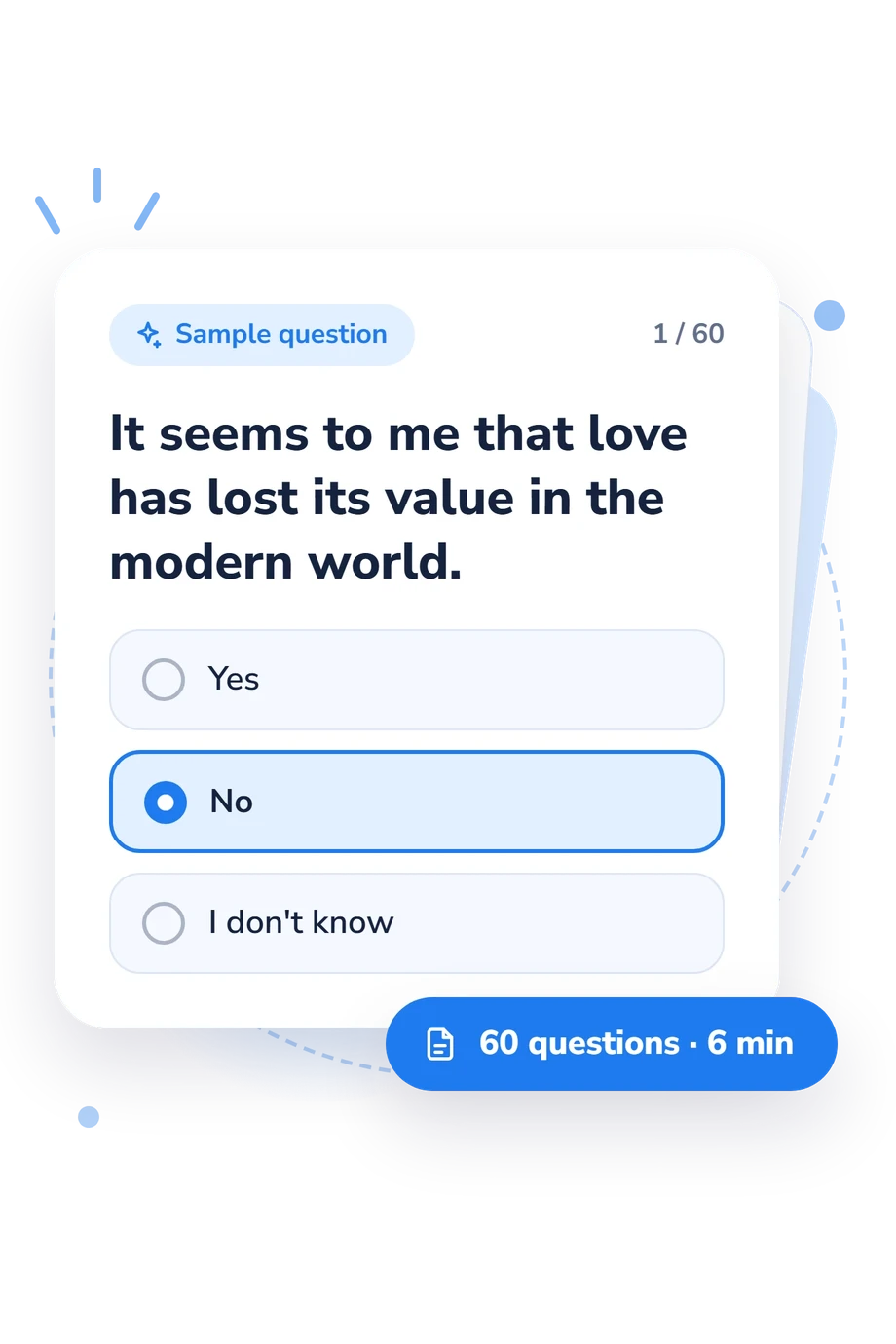
Please respond to the statements below. If you agree with a statement, answer “Yes”; if you do not agree, answer “No.” If you are unsure, answer “I don’t know.” Please note that the accuracy of the conclusions drawn will depend entirely on the honesty and precision of your responses.
    • Yes
    • No
    • I don't know
    • Yes
    • No
    • I don't know
    • Yes
    • No
    • I don't know
WHAT THE TEST MEASURES
About This Assessment
Diagnostic of the Level of Moral and Ethical Responsibility, DUMELP Test

Moral and Ethical Responsibility Level Assessment Test - Symptoms and Signs

moral
responsibility

This measure is designed to screen perceived moral and ethical responsibility in decision-making and accountability. The Moral and Ethical Responsibility Level Assessment is intended for brief use in educational or group settings to support understanding of values-based reasoning.

It consists of 30 items and typically takes about 6 minutes to complete. In the Kohlberg tradition, results are best interpreted as an initial indicator of self-reported responsibility and ethical orientation rather than a standalone clinical determination.

The Moral and Ethical Responsibility Level Assessment may be used to inform discussion, coaching, or broader psychological evaluation when questions arise about ethical judgment, responsibility to self and others, or related developmental goals.

Author: Lawrence Kohlberg
Literature: Rest, J. R. Moral development: Advances in research and theory. Praeger. 1986.
Popular tests
Comments
Leave a Comment