
Adolescent Emancipation Reaction Severity Scale Test
How the Scales are Structured
Who Usually Takes This Test?
See How You Compare
Below is a preview of how scores are typically distributed across each scale.
Example Questions From the Test
- Yes
- No
- Yes
- No
- Yes
- No
Adolescent Emancipation Reaction Severity Scale Test - Description and methodology of the test
Readers deciding whether to take the Adolescent Emancipation Reaction Severity Scale Test can use it to examine patterns that may otherwise be difficult to organize. The resulting independence profile can clarify which experiences deserve closer attention without reducing them to a single label. It also offers practical questions for self-reflection and everyday decisions.
What This Assessment Explores
This adolescent autonomy questionnaire examines autonomy, opposition, emancipation, and harmful conduct.
The dimensions are:
- Deviant Behavior (0-100) measures antisocial independence-seeking; low reflects identity diffusion or social desirability, high reflects deviance: Low 0-39; Moderate 40-60; High 61-100.
- Ideological Confrontation (0-100) measures value protest; low conformity, high tension: Conforming 0-39; Questioning 40-60; Ideological tension 61-100.
- Protest Reaction (0-100) measures boundary protest; low individuation, high destructive autonomy: Low protest 0-39; Moderate protest 40-60; High protest 61-100.
- Confrontation With Parents (0-100) measures parental opposition; low delayed autonomy, high confrontation: Low resistance 0-39; Moderate resistance 40-60; High confrontation 61-100.
- Emancipation Reaction Severity (0-100) measures autonomy striving; low conformism, middle typical, high reactive: Low emancipation 0-39; Typical for adolescence 40-60; High/Reactive emancipation 61-100.
Methodology and Scientific Basis
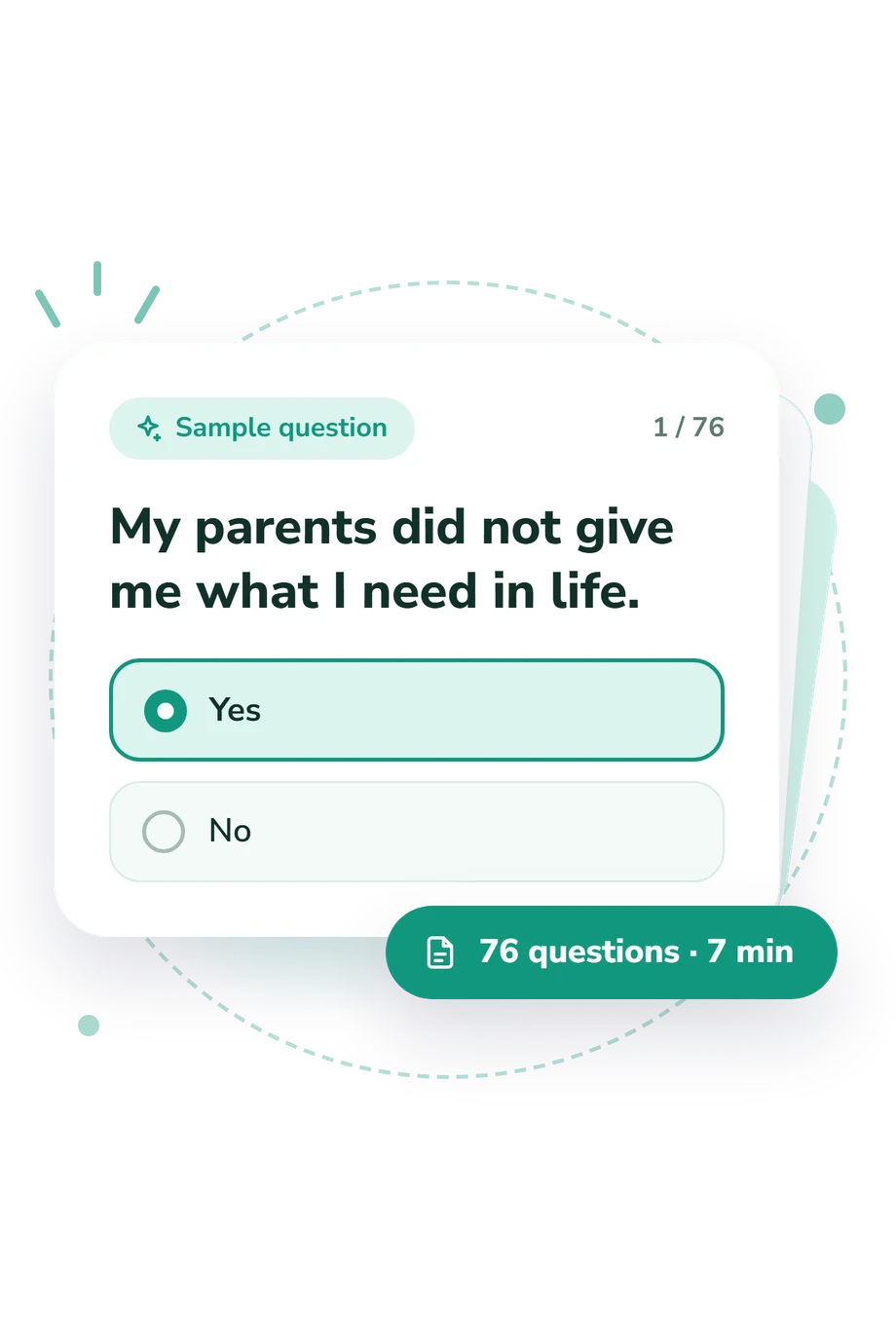
Each item presents a situation or belief and receives a Yes or No response, making it an adolescent emancipation assessment covering parental control, criticism, rules, school conduct, family conflict, risky behavior, and severe distress rather than an abstract trait.
The questionnaire presents results across the displayed dimensions, but it does not state how many points each answer contributes. The point-assignment method is not documented, so no answer-level formula or interpretation from one isolated behavior can be inferred.
Methodologically, its structure is conceptually consistent with the Emancipation Reaction Severity Questionnaire (Vindorf, 2013), the closest named source for this construct. It is not presented as an adaptation of that published questionnaire. Kulikova’s 2010 dissertation offers related work on emancipation reactions in adolescents with drug dependence, but that study population should not be transferred automatically to this online version.
No norms, reliability estimates, or independent validation are stated for this version. Because self-report is affected by current context, self-awareness, and response bias, the profile is best interpreted alongside the adolescent’s circumstances and broader assessment rather than as a diagnosis.
- Vindorf S.A. Features of Psychological Work with Adolescents at Risk of Drug Addiction. Pediatrician (St. Petersburg). 2013;4(4):116-119. 10.17816/PED44116-119
- Kulikova S.A. Emancipation Reaction in Adolescents with Drug Dependence: Abstract of Dissertation for the Degree of Candidate of Psychological Sciences. Saint Petersburg; 2010.
Updated: