
Legal Consciousness Assessment Test
How the Scales are Structured
Who Usually Takes This Test?
See How You Compare
Below is a preview of how scores are typically distributed across each scale.
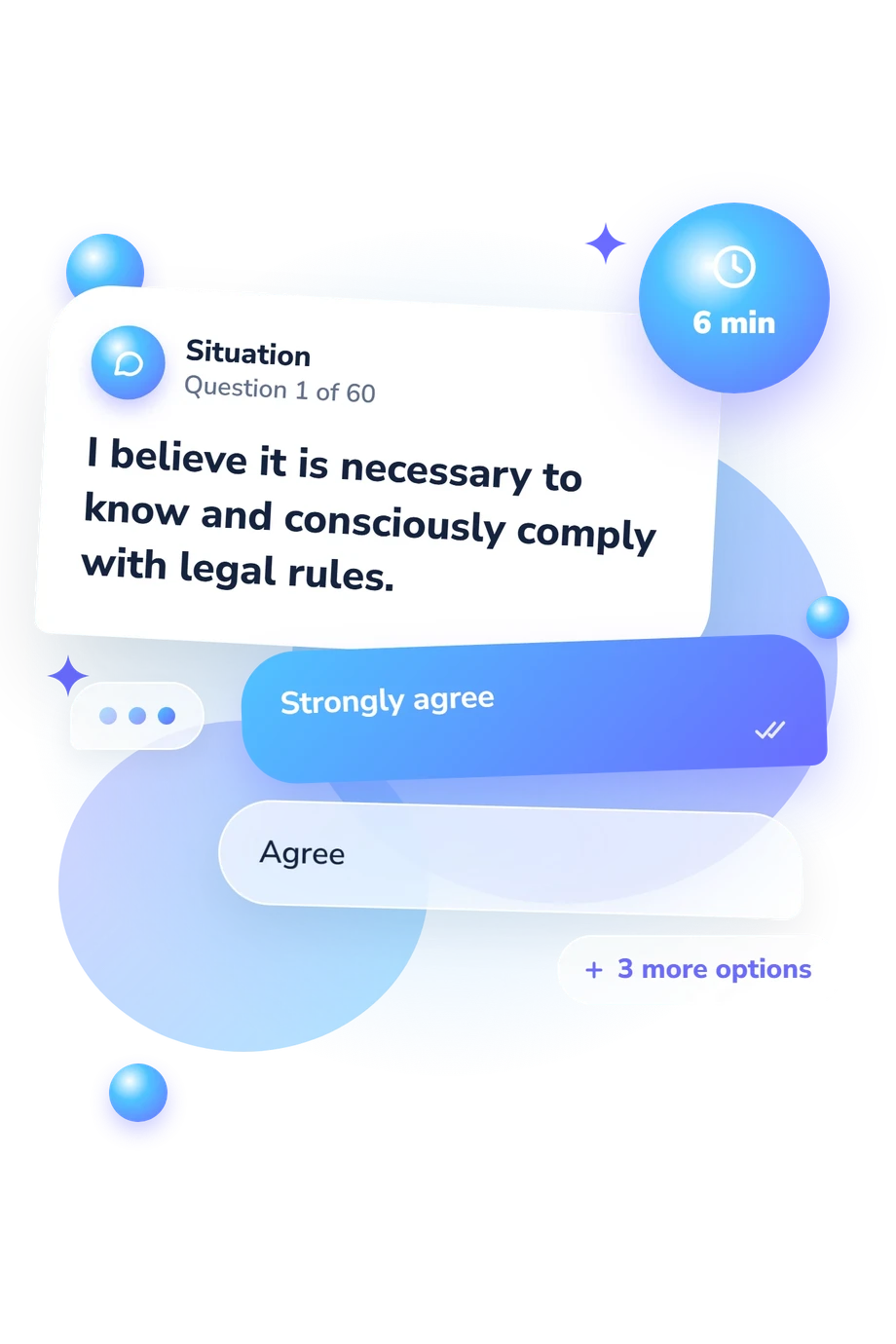
Example Questions From the Test
- Strongly agree
- Agree
- Not sure whether I agree or disagree
- Disagree
- Strongly disagree
- Strongly agree
- Agree
- Hard to say whether I agree or disagree
- Disagree
- Strongly disagree
- Completely agree
- Agree
- Hard to say whether I agree or not
- Disagree
- Completely disagree
Legal Consciousness Assessment Test - Description and methodology of the test
People organizing views about legal authority, compliance, civic responsibility, and rules in daily decisions can use this assessment as a structured guide. The Legal Consciousness Assessment Test is intended for readers considering personal responsibility and law's role in public life. It distinguishes patterns rather than simple approval or rejection. A legal consciousness questionnaire shows how responses align with knowledge, valuation, compliance, and engagement.
What This Assessment Explores
This legal attitude test measures:
- Legal Nihilism (-10-10) reflects poor knowledge, negative attitudes, undervalued regulation, possible lawbreaking: Low nihilism (-10-0); Elevated nihilism (1-10).
- Idealism (-10-10) shows overvalued law, limited knowledge: Low idealism (-10--1); Moderate / balanced (0-0); High idealism (1-10).
- Cynicism (-10-10) shows negative attitudes, undervalued law, antisocial behaviour regardless of legal knowledge: Low cynicism (-10-0); Elevated cynicism (0-10).
- Legal Fetishism (-10-10) shows faith in law alone, limited knowledge, defence readiness: Low (-10--1); Moderate (0-0); High (1-10).
- Skepticism (-10-10) shows knowledge, compliance, regulatory indifference, reluctance to engage: Low skepticism (-10--1); Moderate skepticism (0-6); High skepticism (7-10).
- Legal Realism (-10-10) shows knowledge, support for law and enforcement, lawful behaviour, defence readiness: Low realism (-10--1); Moderate realism (0-6); High realism (7-10).
Methodology and Scientific Basis
Each item is a self-report statement answered on a five-point agreement scale, from strong agreement to strong disagreement, with an uncertain or neutral option between them. The statements group around legal authority, social usefulness, compliance, personal responsibility, and engagement with legal relations. Results combine responses into the displayed profile; the ranges alone do not show how many points any answer contributes.
As an assessment of attitudes toward law, the online form is conceptually consistent with the published Diagnostics of Legal Consciousness instrument described by Beznosov and Bordunos in 2024; Beznosov's 2023 methodology and 2013 analysis provide related theoretical context. The online form is not documented as an identical adaptation, so that instrument's sample, norms, and scoring protocol should not be assumed to apply.
Interpret scores as self-reported tendencies shaped by current circumstances, knowledge, and candour. The form's scoring is not standardised; it has no established population norms or reliability estimates, so its bands are descriptive ranges rather than population cut-offs. Self-reported attitudes may not match observed conduct or actual legal knowledge.
- Dmitry Sergeevich Beznosov and Aleksandra Konstantinovna Bordunos. (2024). Legal Relationship Structure: Basis and Validation of the Questionnaire Diagnostics of Legal Consciousness. Social and Economic Psychology, 9(4), 84-117. 10.38098/ipran.sep_2024_36_4_04
- Dmitry Sergeevich Beznosov. (2023). Methodology "Attitude to Law." In L. G. Pochebut, S. D. Gurieva, and V. A. Chiker (Eds.), Methods and Methodology of Socio-Psychological Research (pp. 517-524). Saint Petersburg: Piter.
- Dmitry Sergeevich Beznosov. (2013). Socio-Psychological Analysis of an Individual's Attitude to Law. Psychological Journal, 34(4), 36-46.
Updated: