
Professional Self-Determination Adequacy Scale Test
How the Scales are Structured
Who Usually Takes This Test?
See How You Compare
Below is a preview of how scores are typically distributed across each scale.
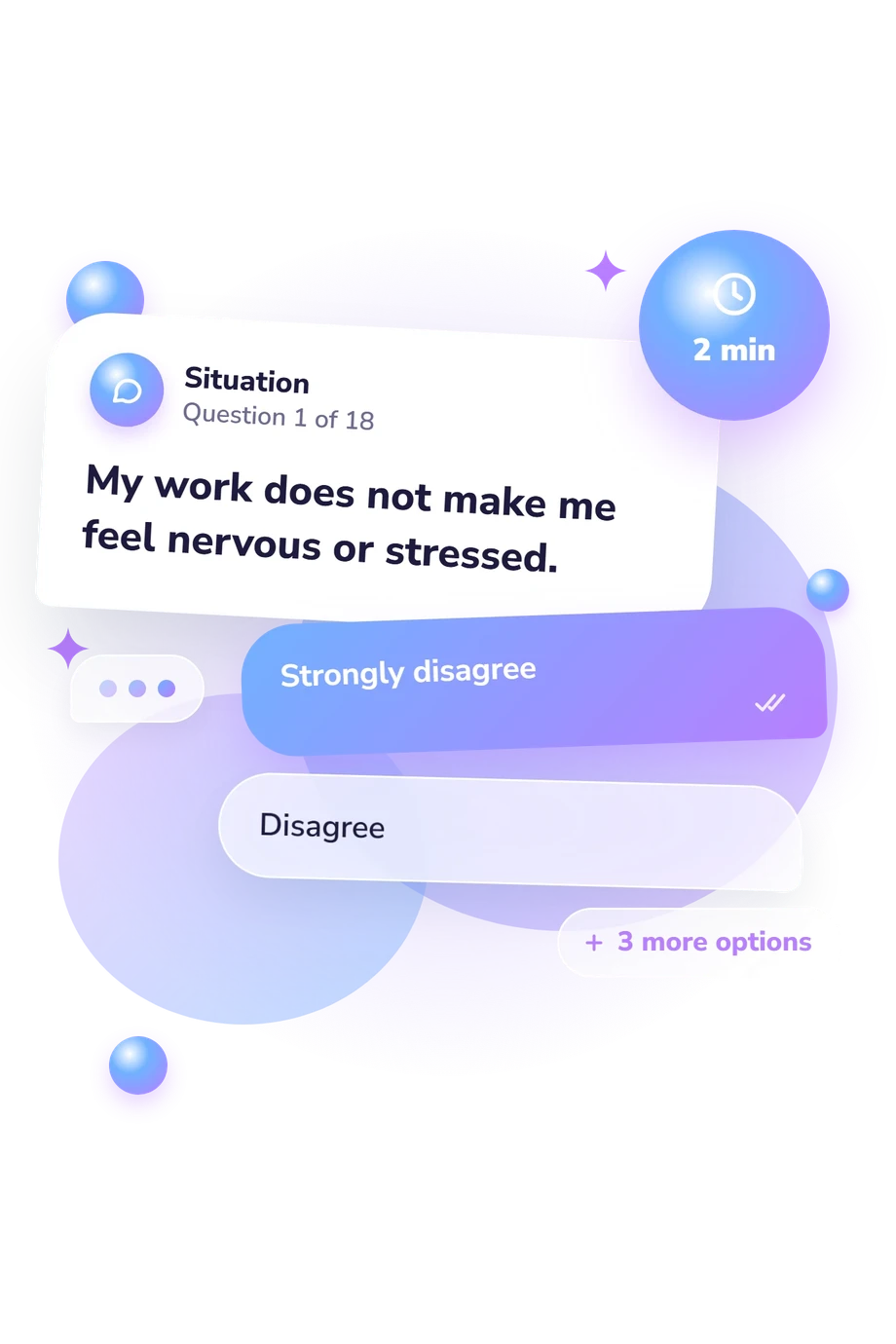
Example Questions From the Test
- Strongly disagree
- Disagree
- Neither agree nor disagree (not sure)
- Agree
- Completely agree
- Strongly disagree
- Disagree
- Neither agree nor disagree (not sure)
- Agree
- Strongly agree
- Strongly disagree
- Disagree
- Neither agree nor disagree (not sure)
- Agree
- Completely agree
Professional Self-Determination Adequacy Scale Test - Description and methodology of the test
For employees and people evaluating their current role, this assessment offers a structured way to examine confidence, perceived demands, and professional adjustment. The Professional Self-Determination Adequacy Scale Test turns those reflections into a profile of alignment between personal characteristics and work requirements. As a professional self-determination assessment, it highlights perceived alignment and development areas without determining why strain occurs.
What This Assessment Explores
The questionnaire examines how personal resources meet work demands. It covers confidence in handling tasks, perceived control, nervousness, expectations for the future, and awareness of the knowledge, skills, and qualities a role requires. It suits people reflecting on an existing job, career direction, or development needs.
The two result dimensions are:
- Job Fit With Employee Characteristics (5-25) shows whether work matches individual characteristics: Low match (5-16) means weaker alignment, while High match (17-25) indicates a more harmonious fit associated with greater job satisfaction and a reduced risk of occupational burnout.
- Fit of Personal Qualities to Job Requirements (4-20) shows whether personal qualities meet job demands: Needs development (4-15) signals possible competency-building needs, while Strong fit (16-20) indicates stronger adaptation and potential for effective performance.
A job fit assessment turns these dimensions into focused reflection on alignment and development.
Methodology and Scientific Basis
Responses use a five-point agreement scale from strong disagreement to strong or complete agreement, with a neutral or uncertain midpoint. The statements cover calm functioning, control, confidence, perceived difficulty, future prospects, and knowledge of role requirements. Since they include both comfortable experiences and work difficulties, interpretation should follow the reported dimensions rather than an assumed item-by-item scoring rule.
The result organizes responses into two scores, although the exact contribution of each answer is not specified. Its methodology is conceptually consistent with Smirnova (2023), but this does not establish that the online questionnaire is a direct reproduction or validated adaptation. As a professional self-determination questionnaire, it can be read alongside Kalashnikova (2004), which connects professional self-determination adequacy with burnout under demanding conditions, and Kalashnikova (2010), which discusses developmental potential in special professional settings.
For this online version, standardized norms, reliability coefficients, and clinical cutoffs are not specified. Scores may reflect current stress, workplace circumstances, self-awareness, and response style, so they are best treated as a structured snapshot rather than a fixed judgment of competence.
- Smirnova, Anna Yurievna. “Psychometric Characteristics of the ‘Appropriateness of Professional Self-Determination’ Scale.” Izvestiya of Saratov University. Philosophy. Psychology. Pedagogy, vol. 23, no. 3, 2023, pp. 336-342. 10.18500/1819-7671-2023-23-3-336-342
- Kalashnikova, Svetlana Anatolyevna. “Adequacy of Professional Self-Determination and Its Manifestation in the Development of the Professional Burnout Syndrome under Special Conditions of Activity.” Dissertation for the Candidate of Psychological Sciences, Chita, 2004, 206 pp.
- Kalashnikova, Svetlana Anatolyevna. “Personal-Development Potential of Special Conditions of Professional Activity.” Humanitarian Vector. Series: Pedagogy, Psychology, 2010, no. 1, pp. 80-86.
Updated: