
Freudly+971 508685814hello@freudly.ai
Freudly
loneliness

Loneliness Type Diagnostic Questionnaire Test
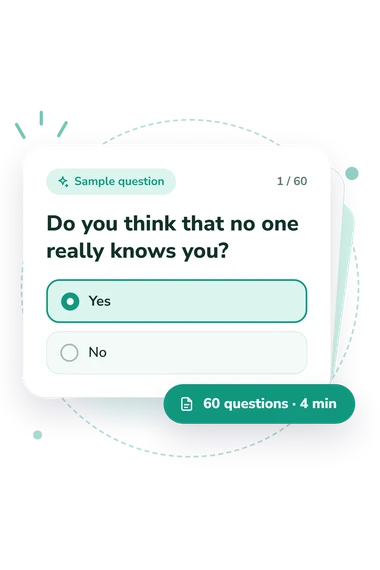
Take the online Loneliness Type Diagnostic Questionnaire Test - AI psychologist FreudlyYou can take Loneliness Type Diagnostic Questionnaire Test here. Online version of a simple and accurate psychological test with interpretation.en
Designed for self-reflection, the Loneliness Type Diagnostic Questionnaire Test presents 30 yes-or-no questions and takes about 4 minutes to complete. Your result highlights overall loneliness alongside distinct ways it may be experienced, helping you notice interpersonal needs, emotional tensions, and possible areas for more thoughtful self-understanding.
Questions: 304 minutes
Loneliness Type Diagnostic Questionnaire Test: sample question card
October 2, 2025October 2, 2025Material has been updatedOctober 2, 2025Material has been published
25,031 view
1,825 completions
1,586 likes
Daniel HallPsychologist · Test reviewer
1,586 likes
Scale Explorer

How the Scales are Structured

DissociatedD
Measures the intensity of dissociated loneliness marked by internal discord, anxiety, and detachment from others.
example score9/15
9/15Moderateexample score
0 – 5Low
6 – 10Moderate
11 – 15High
A score of 9 falls in the Moderate range, suggesting noticeable episodes of inner conflict and detachment from others that can make solitude feel acutely uncomfortable.
AlienatingA
Measures the degree to which loneliness is experienced as social alienation, disconnection, and reduced capacity for empathy or collaboration.
example score9/15
9/15Moderateexample score
0 – 5Low
6 – 10Moderate
11 – 15High
A score of 9 falls in the Moderate range, suggesting a noticeable tendency toward feeling disconnected from others and less engaged in supportive relationships right now.
DiffuseD
Measures the intensity of diffuse loneliness marked by interpersonal suspicion, inner contradictions, and seeking self-worth validation through others without feeling truly connected.
example score9/14
9/14Moderateexample score
0 – 4Low
5 – 9Moderate
10 – 14High
A score of 9 indicates a moderate level of diffuse loneliness, suggesting noticeable reliance on others for validation alongside difficulty achieving a stable sense of connection.
LonelinessL
Measures the current overall intensity of subjective loneliness and perceived social disconnection.
example score4/18
4/18Lowexample score
0 – 5Low
6 – 12Moderate
13 – 18High
A score of 4 falls in the Low range, suggesting relatively little current loneliness or perceived disconnection at this time.
just completed the test
DATA-BASED USER COHORTS

Who Usually Takes This Test?

Feeling disconnected lately
41%OF USERS
People who sense growing isolation and want a quick snapshot of how intense their loneliness is right now and what type it resembles.
In counseling or therapy
34%OF USERS
Clients who take the test to help name their experience (diffuse, alienation, or dissociation) and track changes between sessions.
After major life changes
25%OF USERS
Those adjusting to a move, breakup, job change, or starting college who want to understand why loneliness has shown up and how it manifests.
BASED ON AGGREGATED, ANONYMIZED DATA FROM TENS OF THOUSANDS OF FREUDLY USERS.
Benchmarking

See How You Compare

Once you complete the test, your results are compared with real-world data from people in your country.
Below is a preview of how scores are typically distributed across each scale.
Shaded area — where most people score
Dot — the average
You — your score lands on each curve after the test— your score, after the test
DissociatedD
You?
Average8.5
Typical rangeTypical6.1 – 10.9
Possible0 – 15
AlienatingA
You?
Average3.9
Typical rangeTypical1.3 – 6.5
Possible0 – 15
DiffuseD
You?
Average10.5
Typical rangeTypical8.3 – 12.6
Possible0 – 14
Loneliness ScaleLS
You?
Average11.4
Typical rangeTypical8.3 – 14.6
Possible0 – 18
Featured On
SAMPLE QUESTIONS

Example Questions From the Test

    • Yes
    • No
    • Yes
    • No
    • Yes
    • No
WHAT THE TEST MEASURES

Loneliness Type Diagnostic Questionnaire Test - Description and methodology of the test

loneliness
social alienation

People who want to understand whether loneliness is mainly experienced as isolation, unstable connection, or inner conflict may use the Loneliness Type Diagnostic Questionnaire Test as a structured self-reflection exercise. This loneliness diagnostic questionnaire is intended for people who want a clearer picture of their interpersonal experience, not a label imposed from outside. Its result combines an overall indicator with several patterns that may guide further reflection.

What This Assessment Explores

The questionnaire treats loneliness as more than time spent alone. Its items cover belonging, perceived care, empathy, self-criticism, dependence on others’ moods, difficulty forming satisfying relationships, and feeling different from other people. Looking at different types of loneliness can show whether isolation is intertwined with alienation, inner conflict, or strained connection.

The result is organized into four dimensions:

  • Dissociated (0-15) reflects shifts between identifying with others and feeling alienated; Low 0-5, Moderate 6-10, High 11-15.
  • Alienating (0-15) reflects disconnection, reduced empathy or cooperation, and feeling unnecessary; Low 0-5, Moderate 6-10, High 11-15.
  • Diffuse (0-14) reflects suspiciousness, inner conflict, and seeking validation without genuine communication; Low 0-4, Moderate 5-9, High 10-14.
  • Loneliness (0-18) reflects the overall intensity of subjective isolation and limited emotional support; Low 0-5, Moderate 6-12, High 13-18.

Methodology and Scientific Basis

Each item uses a yes-or-no response, recording a direct self-report about experiences, beliefs, and relationship patterns. Responses are combined into four displayed totals, but the questionnaire does not state a point value for each answer. Results should therefore be read through the published ranges and bands rather than inferred from individual wording.

The framework is conceptually consistent with the Korchagina Loneliness Test (2008), which treats loneliness as multidimensional. Korchagina’s 2010 work and Plamadeala (2017) examine the value of distinguishing a general loneliness indicator from distinct forms. Perjan, Sanduleac, and Plamadeala (2017) used Korchagina’s scale alongside other measures when studying loneliness and self-actualization.

As a loneliness self-assessment, this online questionnaire is a structured reflection tool, not a newly validated clinical instrument. Its categories do not establish population norms, reliability coefficients, or diagnostic cutoffs for this version. Current mood, recent social events, self-awareness, and socially desirable responding may influence answers, so the profile is best read as a snapshot of perceived loneliness and relational experience.

Author: Daniel Perlman, Letitia Anne Peplau
Literature:
  • Korchagina, S. G. (2008). Psychology of Loneliness: A Study Guide. Moscow: Moscow Psychological and Social Institute, 228 pp. ISBN 978-5-9770-0076-5.
  • Korchagina, S. G. (2010). Diagnostic Methods for Studying Loneliness. Bulletin of the Russian New University. Series: Man in the Modern World, no. 1, pp. 52-62.
  • Plamadeala, Victoria (2017). Psychometric Characteristics of Schmidt N., Sermat V., Differential Loneliness Scale and S. Korchagina Loneliness Test. Psihologie, no. 1-2 (30), pp. 45-55. ISSN 1857-2502.
  • Perjan, Carolina, Sergiu Sanduleac, and Victoria Plamadeala (2017). Relationship between Self-Actualization and Loneliness in Young Adults. Rethinking Social Action. Core Values in Practice, pp. 597-610. 10.18662/lumproc.rsacvp2017.55.
Popular tests
Comments
Leave a Comment