
Personality Dynamic Stability Scale Test
How the Scales are Structured
Who Usually Takes This Test?
See How You Compare
Below is a preview of how scores are typically distributed across each scale.
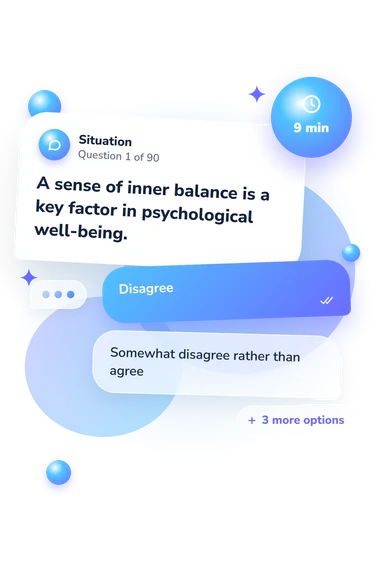
Example Questions From the Test
- Disagree
- Somewhat disagree
- Hard to say
- Somewhat agree
- Agree
- Disagree
- Rather disagree than agree
- Hard to say
- Rather agree than disagree
- Agree
- Disagree
- Rather disagree than agree
- Hard to say
- Rather agree than disagree
- Agree
Personality Dynamic Stability Scale Test - Description and methodology of the test
People who want to understand how they remain themselves while responding to a changing world may find the Personality Dynamic Stability Scale Test useful for structured self-reflection. It examines balance, openness to novelty, and preference for familiar patterns, helping you consider whether current choices feel coherent and aligned with your values. As a personality stability assessment, it works best when answers reflect your usual experience rather than one stressful day.
What This Assessment Explores
Readers considering values, routines, responses to change, and familiar patterns can examine their fit. In practical terms, this dynamic stability questionnaire describes how you combine continuity with willingness to change, without treating either style as universally better.
The profile contains three linked dimensions:
- Stability as a Sense of Balance (15-75) reflects alignment among values, goals, activities, and lifestyle: Low balance (15-34), Moderate balance (35-54), or High balance (55-75).
- Positive Attitude Toward Change (15-75) reflects openness to novelty, complexity, and learning: Low openness to change (15-34), Moderate openness to change (35-54), or High openness to change (55-75).
- Positive Attitude Toward Stability (15-75) reflects a preference for seeing the world as stable and orderly, relying on stereotyped thinking and familiar responses, and limiting life plans to everyday tasks: Low consistency preference (15-34), Moderate consistency preference (35-54), or High consistency preference (55-75).
Methodology and Evidence Base
Each statement uses a five-point agreement scale from Disagree to Agree, with intermediate choices and a midpoint for uncertainty. The items address novelty, familiar settings, self-control, life direction, and learning. Responses are grouped by dimension, so the result describes a pattern across related answers rather than one isolated response.
The online questionnaire is registered to Jack Block and Jeanne H. Block; it is conceptually consistent with, rather than a verified adaptation of, Grishina et al.'s 2024 questionnaire. That study included 674 participants across two series and examined construct validity through the Big Five, life position, and self-determination. Kostromina and Grishina (2023) and Grishina’s 2019 volume provide a processual framework: personality can preserve coherence while changing.
Interpret the profile in light of current circumstances, particularly when dimensions pull in different directions. The displayed bands are descriptive catalogue categories rather than published norms, and self-report can be influenced by context, self-awareness, and response style. This personality stability profile can prompt reflection on goals, routines, responses to novelty, familiar patterns, and adaptation in everyday life, especially when scores differ.
- Grishina, N. V., Kostromina, S. N., & Odintsova, M. M. (2024). Questionnaire "Dynamic Stability of Personality." New Psychological Research, 3, 75-94. 10.51217/npsyresearch_2024_04_03_04
- Kostromina, S. N., & Grishina, N. V. (2023). Psychology of Changeability: Basic Principles of Description of Processual Nature of Personality. Integrative Psychological and Behavioral Science, 57(2), 569-589. 10.1007/s12124-022-09730-3
- Grishina, N. V. (Ed.). (2019). Psychology of Personality: Being in Change. St. Petersburg: St. Petersburg University Press.