
Purpose in Life Tes
How the Scales are Structured
Who Usually Takes This Test?
See How You Compare
Below is a preview of how scores are typically distributed across each scale.
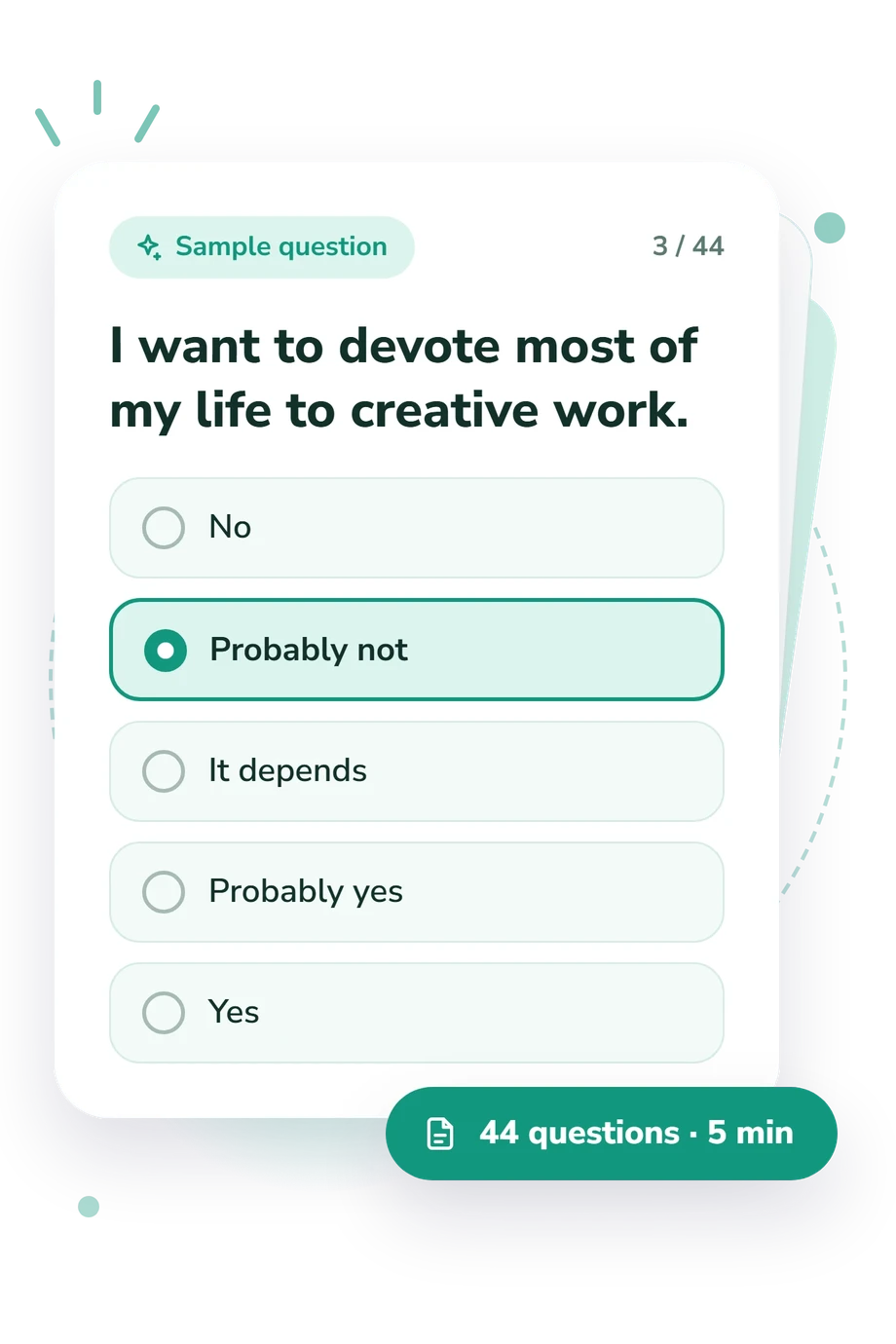
Example Questions From the Test
- No
- Probably not
- Sometimes
- Probably yes
- Yes
- No
- Rather no
- It depends
- Rather yes
- Yes
- No
- Probably no
- It depends
- Probably yes
- Yes
Purpose in Life Tes - Description and methodology of the test
People reassessing their direction, priorities, or motivation may use the purpose in life test to examine how personal beliefs translate into goals and action. A purpose quiz can help people reflect on meaning, responsibility, work preferences, and the balance between personal aims and concern for others. The profile describes current tendencies rather than assigning one fixed identity or life path.
What This Assessment Explores
This life purpose quiz examines purpose clarity, goal pursuit, responsibility, meaning, adaptation, self-care, concern for others, and work roles. Five groups summarize them:
- Coherence and action show harmony, implementation, and confidence through Harmony of Life Purpose Realization Factors (1-5), Life Purpose Agency (0-5), and Belief in the Attainability of Life Purpose (0-5).
- Direction shows competing goals, focus, and clarity through Multidirectionality of Life Purpose (0-5), Purpose Unidirectionality (0-5), Low Awareness of Life Purpose (0-5), and High Life Purpose Awareness (0-5).
- Responsibility reflects agency, ideals, and adaptation through External Locus of Control (0-5), Internal Locus of Control (0-5), Spiritual Orientation (0-5), and Situational Orientation (0-5).
- Balance describes self-care, altruism, and guidance through Self-Support (0-5), Support for Others (0-5), and Subordinate Orientation (0-5).
- Work expression covers influence, innovation, and structure through Leadership and Management (0-5), Creator, Creativity (0-5), and Executor, Routine (0-5).
Methodology and Scientific Basis
Responses use five ordered choices from No to Yes, with middle options such as Rather no, It depends, and Probably yes. This records degree of agreement while allowing uncertainty and context.
Scoring maps answers onto separate indices. Higher values generally indicate more of the named tendency; displayed ranges and bands organize interpretation, not population norms or clinical thresholds. Labels include Low harmony, High effectiveness, Focused, Balanced Multidirectional, Highly Multidirectional, and related low, moderate, high, clear, unclear, mixed, and balanced categories.
Life Purpose methodology (Motkov, 1998) is the closest named source for the questionnaire’s conceptual structure. This online form is conceptually consistent with it, not automatically a standardized adaptation.
Arendachuk (2018) offers related value-and-meaning context, while Halian et al. (2022) report associated psychological findings; neither validates this exact form.
A what is my purpose in life quiz turns a broad concern into dimensions for reflection. Interpret the pattern alongside current circumstances and self-awareness: mood, pressure, response bias, and changing priorities can affect answers. It is a reflection aid, not a clinical judgment.
- Motkov, O. I. (1998). The Methodology "Life Purpose." School Psychologist, no. 36, pp. 8-9.
- Arendachuk, I. V. (2018). Dynamics of Value and Meaning Characteristics of Social Activity of Modern Youth. RUDN Journal of Psychology and Pedagogics, 15(3), 287-307. 10.22363/2313-1683-2018-15-3-287-307.
- Halian, I., Kurova, A., Stepanenko, L., Semenov, O., & Semenova, N. (2022). Comparison Analysis of the Correlation Between Emotional Stability and Mental Health Parameters in Athletes of Various Skill Levels. Amazonia Investiga, 11(54), 65-75. 10.34069/AI/2022.54.06.7.
Updated: