
Military Vocational Orientation Questionnaire Test
How the Scales are Structured
Who Usually Takes This Test?
See How You Compare
Below is a preview of how scores are typically distributed across each scale.
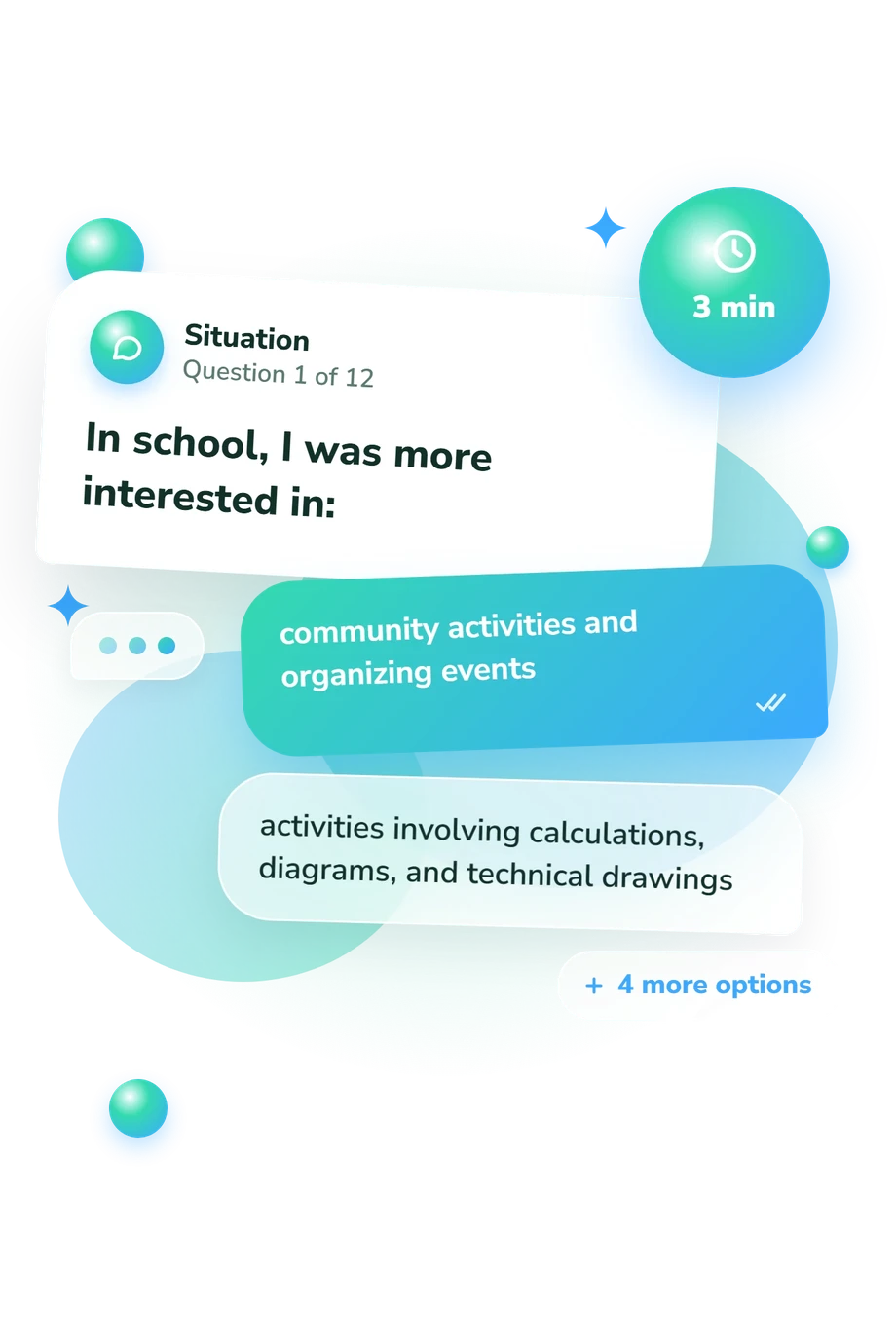
Example Questions From the Test
- the ability to inspire and energize others
- seriousness and focus at work
- the ability to remain effective despite fatigue
- punctuality and accuracy
- courage and decisiveness
- technical competence
- instructional and organizational work
- operating and maintaining computer equipment
- work involving the use of communications equipment
- driving a car or other vehicles
- regular participation in sports training
- servicing and repairing technical equipment
- sports team coach
- sport shooter
- amateur athlete
- race car driver
- karate, sambo, or boxing athlete
- mechanic on a motorcycle racing team
Military Vocational Orientation Questionnaire Test - Description and methodology of the test
For people weighing different forms of military service, the Military Vocational Orientation Questionnaire Test offers a focused way to examine preferred kinds of work rather than general ability. This military career questionnaire helps respondents clarify preferences before exploring training or assignment options. The result highlights motivating environments: organizing, handling information, operating equipment, maintaining vehicles, managing risk, or leading others.
What This Assessment Explores
Questions draw on interests, qualities, choices, strengths, and duties. Military career interests describe preferred work, not ability.
The six displayed dimensions are:
- Technological (0-12) shows interest in technical support and maintenance: Low 0-6; Pronounced 7-12.
- Special Operations (0-12) shows interest in special operations: Low interest 0-6; Elevated interest 7-12.
- Driver Specialties (0-12) shows interest in military specialties involving the operation of motor vehicles: Low interest 0-6; Expressed interest 7-12.
- Communications and Surveillance (0-12) shows interest in communications and surveillance: Low interest 0-6; High interest 7-12.
- Operator Specialties (0-12) shows interest in operator specialties involving work with technical devices and equipment: Low interest 0-6; Pronounced interest 7-12.
- Command (0-12) shows inclination toward command specialties involving leadership and unit management: Low 0-6; Pronounced 7-12.
Methodology and Scientific Basis
Each prompt uses six self-report choices, asking which activity, quality, or future duty feels most characteristic or appealing. Repeated alternatives contrast organizational, technical, physical, risk-related, driving, communication, and leadership themes, making the exercise a preference profile rather than a timed performance test.
Each dimension is reported separately. The displayed ranges do not reveal how individual answers contribute to each score, while the result bands describe lower or higher expressed interest. The output maps military specialty preferences.
The questionnaire is conceptually consistent with the Military-Professional Orientation of Youth (Petrov and Rostunov, 1988), but is not presented as its direct adaptation. Noss's 1992 work and Kolomiichenko and Osipov's 2023 study examine military-professional orientation and readiness for military-specialty choice, respectively; those subjects do not by themselves validate or standardize this online questionnaire. The online version has no documented norms or validation, and self-report remains sensitive to response bias, current circumstances, and self-awareness; use the profile alongside broader reflection on interests and real-world requirements.
- Petrov, V. P., and Rostunov, A. T. Military-Professional Orientation of Youth. Moscow: Military Publishing House, 1988, 219 pp.
- Noss, I. N. Efficiency of Psychodiagnostics of Military-Professional Orientation in Suvorov Cadets: Abstract of a Candidate Dissertation in Psychology. Moscow, 1992, 23 pp.
- Kolomiichenko, L. V., and Osipov, V. L. Studying High School Students' Readiness to Choose a Military Specialty: Parametric Characteristics and Diagnostic Tools. World of Education - Education in the World, no. 3, 2023, pp. 230-236. 10.51944/20738536_2023_3_230
Updated: