
Freudly+971 508685814hello@freudly.ai
Freudly

Ambivalence Toward Men Inventory (AMI) Test
Take the online Ambivalence Toward Men Inventory (AMI) Test - AI psychologist FreudlyYou can take Ambivalence Toward Men Inventory (AMI) Test here. Online version of a simple and accurate psychological test with interpretation.en
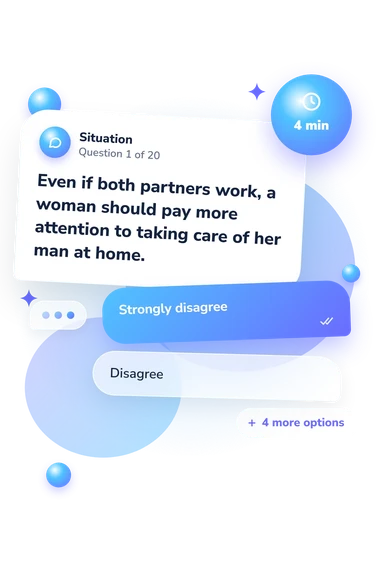
With 20 questions taking about 4 minutes, the Ambivalence Toward Men Inventory (AMI) Test explores contrasting beliefs and feelings about men, gender roles, relationships, care, protection, and power. Your profile can highlight patterns of hostile or benevolent attitudes, supporting thoughtful self-reflection about expectations in personal and social relationships.
Questions: 204 minutes
Ambivalence Toward Men Inventory: situation and reply bubbles
October 2, 2025October 2, 2025Material has been updatedOctober 2, 2025Material has been published
35,293 views
3,336 completions
2,724 likes
Daniel HallPsychologist · Test reviewer
2,724 likes
Scale Explorer

How the Scales are Structured

Heterosexual HostilityHH
Heterosexual hostility measures the extent to which someone perceives men as likely to dominate women in romantic, sexual, and intimate relationships.
example score3/5
3/5Moderateexample score
0 – 1.6Low
1.7 – 3.3Moderate
3.4 – 5High
A score of 3 falls in the Moderate range, suggesting a noticeable but not extreme tendency to view men as dominant over women in intimate contexts.
Compensatory Gender DifferentiationCGD
Measures the extent to which someone believes men need women’s help to manage domestic tasks and household responsibilities.
example score2/5
2/5Moderate endorsementexample score
0 – 1Low endorsement
2 – 3Moderate endorsement
4 – 5High endorsement
A score of 2 indicates a moderate tendency to view men as less able to handle domestic matters without women’s assistance.
Resentment of PaternalismRoP
Measures the extent to which a person perceives men as seeking greater societal power than women through paternalistic dynamics.
example score2/5
2/5Moderate resentmentexample score
0 – 1.6Low resentment
1.7 – 3.3Moderate resentment
3.4 – 5High resentment
A score of 2 falls in the Moderate resentment range, suggesting a noticeable but not strongly pronounced perception that men pursue greater power over women in society.
Hostility Toward MenHTM
Measures the extent of negative attitudes toward men, including viewing men as weak or overly dominant in relationships and society.
example score2/5
2/5Moderate hostilityexample score
0 – 1Low hostility
2 – 3Moderate hostility
4 – 5High hostility
A score of 2 indicates a moderate level of hostile attitudes toward men, suggesting some negative perceptions are present but not strongly endorsed.
Heterosexual IntimacyHI
Heterosexual intimacy measures the extent to which someone believes a woman's life is incomplete without a man.
example score2/5
2/5Moderateexample score
0 – 1Low
2 – 3Moderate
4 – 5High
A score of 2 falls in the Moderate range, suggesting a some endorsement of the idea that a woman’s life is more complete with a man, without viewing it as essential.
Complementary Gender DifferentiationCGD
Measures the extent to which men are viewed as naturally complementary protectors and providers who are willing to take risks for women.
example score2/5
2/5Moderate endorsementexample score
0 – 1.6Low endorsement
1.7 – 3.3Moderate endorsement
3.4 – 5High endorsement
A score of 2 falls in the Moderate endorsement range, suggesting a somewhat supportive but not strongly idealized view of men as protectors/providers.
MaternalismM
Maternalism measures the extent to which someone believes men need women’s care and guidance in the home.
example score2/5
2/5Moderateexample score
0 – 1Low
2 – 3Moderate
4 – 5High
A score of 2 falls in the Moderate range, suggesting occasional endorsement of the idea that men benefit from women’s care at home without it being a strong or consistent belief.
Benevolence Toward MenBTM
Measures the extent to which someone holds positive, protective-provider views of men and believes men are needed and deserving of care.
example score3/5
3/5Moderateexample score
0 – 1.6Low
1.7 – 3.3Moderate
3.4 – 5High
A score of 3 falls in the Moderate range, suggesting a noticeable but not strongly idealized tendency to view men as protectors/providers who are needed and should be cared for.
just completed the test
DATA-BASED USER COHORTS

Who Usually Takes This Test?

Relationship reflection seekers
41%OF USERS
People trying to understand mixed feelings about men that show up in dating, marriage, family dynamics, or after difficult experiences.
Therapists and counselors
34%OF USERS
Mental health professionals who use a quick measure to explore clients’ supportive and distrustful attitudes toward men in clinical work.
Gender studies learners
25%OF USERS
Students, educators, and researchers examining gender stereotypes and how positive and hostile views toward men can coexist.
BASED ON AGGREGATED, ANONYMIZED DATA FROM TENS OF THOUSANDS OF FREUDLY USERS.
Benchmarking

See How You Compare

Once you complete the test, your results are compared with real-world data from people in your country.
Below is a preview of how scores are typically distributed across each scale.
Shaded area — where most people score
Dot — the average
You — your score lands on each curve after the test— your score, after the test
Heterosexual hostilityHh
You?
Average3.5
Typical rangeTypical2.8 – 4.3
Possible0 – 5
Compensatory gender differences.Cgd
You?
Average1.7
Typical rangeTypical0.9 – 2.5
Possible0 – 5
Resentment of paternalismRop
You?
Average3.3
Typical rangeTypical2.3 – 4.2
Possible0 – 5
Hostility toward menHtm
You?
Average3.7
Typical rangeTypical2.8 – 4.7
Possible0 – 5
Heterosexual intimacyHi
You?
Average2.6
Typical rangeTypical1.9 – 3.2
Possible0 – 5
Complementary gender differences.Cgd
You?
Average2.1
Typical rangeTypical1.2 – 3.1
Possible0 – 5
MaternalismM
You?
Average3.6
Typical rangeTypical2.7 – 4.5
Possible0 – 5
Benevolence toward menBtm
You?
Average3.1
Typical rangeTypical2.4 – 3.9
Possible0 – 5
Featured On
SAMPLE QUESTIONS

Example Questions From the Test

Below are a number of statements about men and women and their relationships in contemporary society. Please indicate the extent to which you agree or disagree with each statement using the response scale provided.
    • Strongly disagree
    • Disagree
    • Somewhat disagree
    • Somewhat agree
    • Agree
    • Strongly agree
    • Strongly disagree
    • Disagree
    • Somewhat disagree
    • Somewhat agree
    • Agree
    • Strongly agree
    • Strongly disagree
    • Disagree
    • Somewhat disagree
    • Somewhat agree
    • Agree
    • Strongly agree
WHAT THE TEST MEASURES

Ambivalence Toward Men Inventory (AMI) Test - Description and methodology of the test

People who want to examine how they interpret men, masculinity, dependence, protection, and power may use this questionnaire for structured self-reflection. The Ambivalence Toward Men Inventory (AMI) Test presents a profile of related beliefs rather than one overall attitude score. An attitudes toward men questionnaire can help readers notice tensions in expectations about intimacy, care, and social control.

What This Assessment Explores

Results show patterns across dependence, intimacy, and power. A gender role beliefs assessment covers dimensions:

  • Compensatory Gender Differentiation (0-5) measures men's domestic dependence (Low endorsement 0-1; Moderate endorsement 2-3; High endorsement 4-5). Maternalism (0-5) measures men's need for nurturing (Low 0-1; Moderate 2-3; High 4-5).
  • Complementary Gender Differentiation (0-5) measures protective-provider beliefs (Low endorsement 0-1.6; Moderate endorsement 1.7-3.3; High endorsement 3.4-5). Benevolence Toward Men (0-5) measures positive protector-provider beliefs (Low 0-1.6; Moderate 1.7-3.3; High 3.4-5).
  • Heterosexual Intimacy (0-5) measures women's need for men (Low 0-1; Moderate 2-3; High 4-5). Heterosexual Hostility (0-5) measures male dominance in relationships (Low 0-1.6; Moderate 1.7-3.3; High 3.4-5).
  • Hostility Toward Men (0-5) measures negative views of dominant, weak men (Low hostility 0-1; Moderate hostility 2-3; High hostility 4-5). Resentment of Paternalism (0-5) measures male power-seeking (Low resentment 0-1.6; Moderate resentment 1.7-3.3; High resentment 3.4-5).

Methodology and Evidence Base

Every statement uses six ordered choices from strong disagreement to strong agreement, addressing domestic care, intimacy, protection, risk, or social control. This response format captures degree of endorsement rather than a yes-or-no position.

Responses are combined into separate scale scores, producing a multidimensional profile rather than a total score. Higher values indicate stronger endorsement of the tendency represented by a scale. The online version does not establish population norms or a published per-answer weighting, so its bands describe this questionnaire's output rather than universal cutoffs.

Its conceptual anchor is Ambivalence Toward Men Inventory (Glick & Fiske, 1999), which distinguishes negative and benevolent beliefs within ambivalent sexism theory across power, gender differentiation, and heterosexuality. This questionnaire is conceptually consistent with that instrument, not presented as an adaptation of its published scoring system.

Krivoshchekov, Gulevich, and Lyubkina (2018) evaluated a Russian version, including its factor structure, consistency, and validity. Those findings support the construct's study but cannot be transferred directly to this English online profile. An ambivalence toward men scale is also sensitive to current relationships, social desirability, and self-awareness, so interpret patterns in personal context.

Literature:
  • Glick, P., & Fiske, S. T. (1999). The Ambivalence Toward Men Inventory: Differentiating Hostile and Benevolent Beliefs About Men. Psychology of Women Quarterly, 23(3), 519-536. 10.1111/j.1471-6402.1999.tb00379.x
  • Krivoshchekov, V. S., Gulevich, O. A., & Lyubkina, A. S. (2018). Hostile and Benevolent Attitudes toward Men: Psychometric Properties of the Russian Version of the Ambivalence toward Men Inventory. Psychology. Journal of the Higher School of Economics, 15(3), 427-446. 10.17323/1813-8918-2018-3-427-446
Popular tests
Comments
Leave a Comment