
Types of Personal Self-Determination Test
How the Scales are Structured
Who Usually Takes This Test?
See How You Compare
Below is a preview of how scores are typically distributed across each scale.
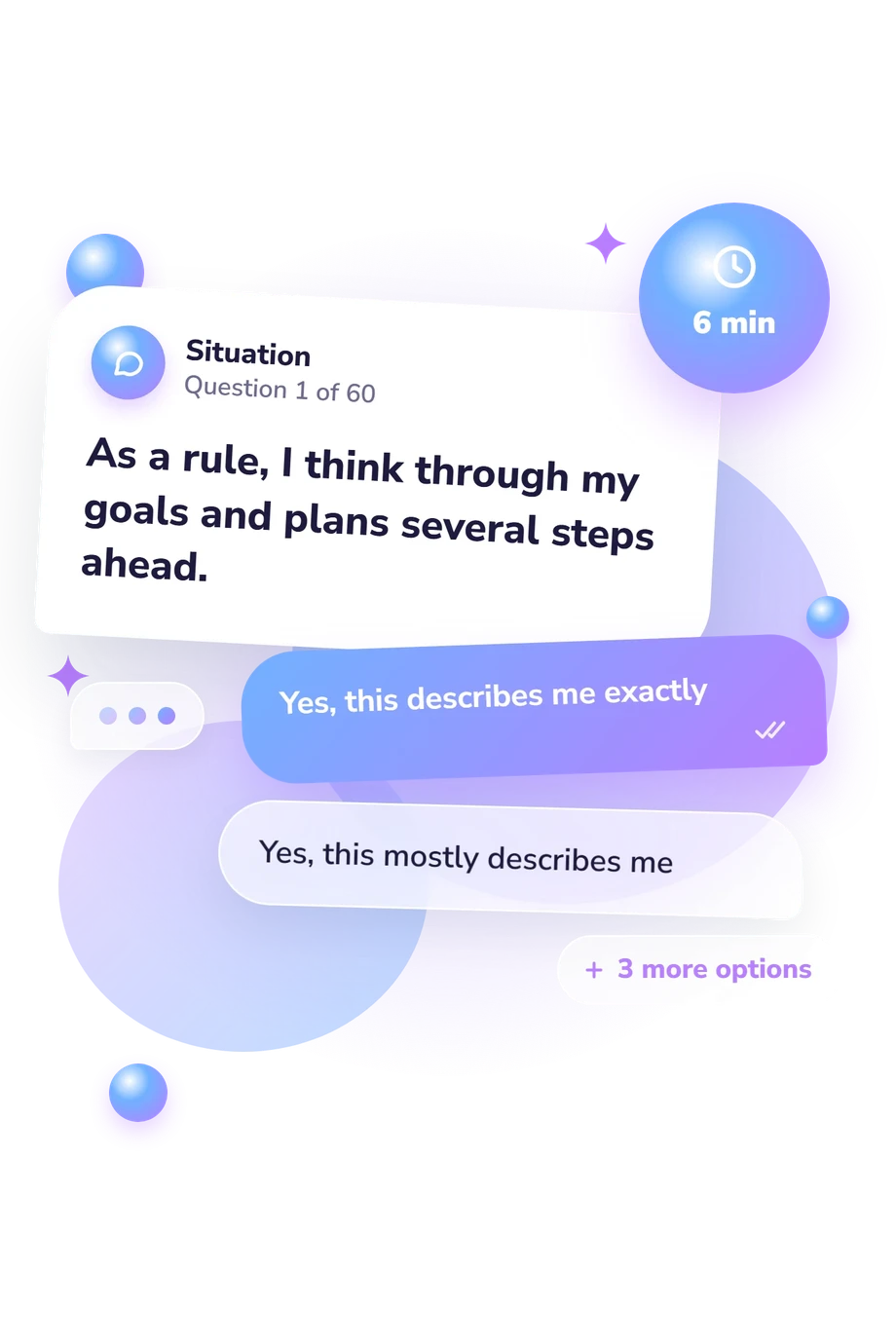
Example Questions From the Test
- Yes, this describes me exactly
- Yes, this mostly describes me
- Hard to say; both yes and no
- No, this mostly does not describe me
- No, this definitely does not describe me
- Yes, this is absolutely true of me
- Yes, this is probably true of me
- Hard to say; both yes and no
- No, this is probably not true of me
- No, this is definitely not true of me
- Yes, this applies to me completely
- Yes, this mostly applies to me
- Not sure; both yes and no
- No, this mostly does not apply to me
- No, this definitely does not apply to me
Types of Personal Self-Determination Test - Description and methodology of the test
People considering whether to examine how meaning, purposeful action, and flexibility work together may find the Types of Personal Self-Determination Test useful as a structured self-reflection exercise. This personal self-determination assessment suits readers curious about the balance between life direction, deliberate effort, and adaptive energy, rather than anyone seeking a single label for their personality.
What This Assessment Explores
This framework treats self-determination as more than persistence or independence. As a personality self-determination test, it links values and life direction with deliberate effort, initiative, inner energy, and flexibility. The result describes a current pattern, not a fixed identity.
These four displayed dimensions explain what each part of the result represents:
- Meaning-Oriented (0-10) measures value-based reflection, self-analysis, authenticity, and meaning seeking: Low meaning focus (0-3), Developing meaning (4-5), Strong meaning orientation (6-10).
- Goal-Oriented (0-10) measures planning, initiative, and effort toward aims: Low goal focus (0-4), Moderate goal focus (5-6), High goal focus (7-10).
- Functional (0-10) measures inner energy, spontaneous intentions, novelty seeking, and flexibility in responding to the environment: Low (0-4), Moderate (5-6), High (7-10).
- Personal Self-Determination Index (1-5) reflects integration across energetic, goal-directed, and meaning-related activity in pursuing life aims: Low integration (1-2.4), Moderate integration (2.5-3.7), High integration (3.8-5).
Methodology and Scientific Basis
In practice, the self-determination questionnaire uses statements about planning, inner exploration, persistence, initiative, learning, novelty, problem solving, and adaptation. The five ordered options range from an exact or definite match to a definite non-match, with an intermediate uncertainty option. The response-to-score calculation is not specified, and the listed ranges function only as the displayed result bands; no particular weighting or point rule is stated.
This questionnaire is conceptually consistent with the Types of Personality Self-Determination Questionnaire described by Kostromina et al. (2024), but it is not presented as an adaptation of that research instrument or as validated by its study. Kostromina et al. (2023) describe a complementary model in which meaning-oriented, goal-directed, and energetic functioning interact. Deci and Ryan (2000) provide broader context through autonomous motivation and basic psychological needs. The online format is not presented as reproducing the research instrument’s administration or standardization.
Interpret the output as a profile: stronger scores indicate stronger endorsement of related tendencies, while the index concerns their integration. The displayed bands are descriptive profile levels, and self-report answers can shift with current context, self-awareness, and impression management.
- Kostromina, S. N., Filatova, A. F., Moskvicheva, N. L., Zinovyeva, E. V., & Odintsova, M. M. (2024). The Development and Validation of the Questionnaire "Types of Personality Self-Determination". Siberian Journal of Psychology, 92, 84-105. 10.17223/17267080/92/5
- Kostromina, S. N., Filatova, A. F., Moskvicheva, N. L., Zinovyeva, E. V., & Odintsova, M. M. (2023). Complementary Model of Personality Self-Determination. Russian Psychological Journal, 20(1), 82-99. 10.21702/rpj.2023.1.6
- Deci, E. L., & Ryan, R. M. (2000). The "What" and "Why" of Goal Pursuits: Human Needs and the Self-Determination of Behavior. Psychological Inquiry, 11(4), 227-268. 10.1207/S15327965PLI1104_01
Updated: