
Mental Health Drivers Test
How the Scales are Structured
Who Usually Takes This Test?
See How You Compare
Below is a preview of how scores are typically distributed across each scale.
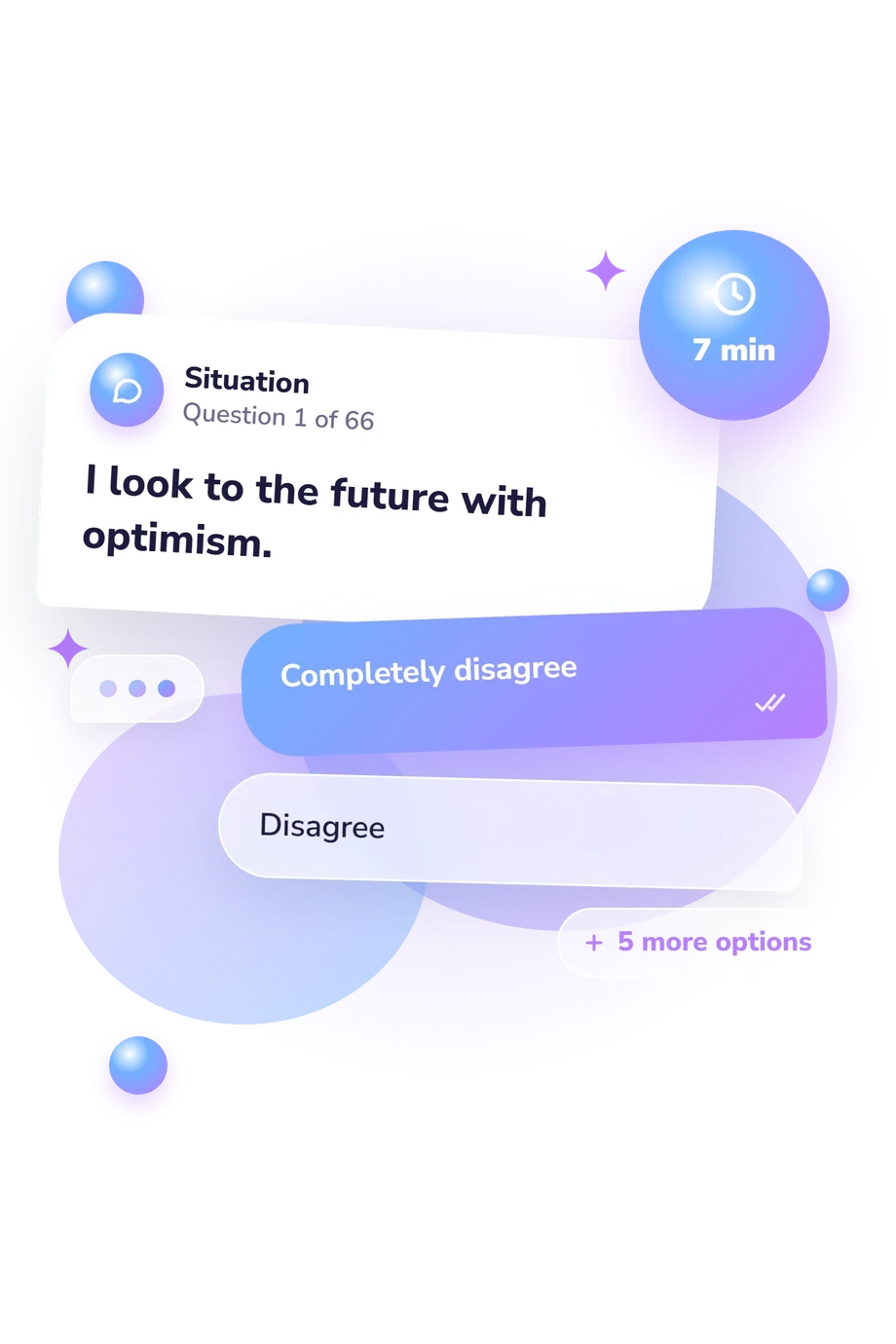
Example Questions From the Test
- Completely disagree
- Disagree
- Disagree somewhat
- Neither agree nor disagree
- Agree somewhat
- Agree
- Completely agree
- Strongly disagree
- Disagree
- Disagree somewhat
- Neither agree nor disagree
- Agree somewhat
- Agree
- Strongly agree
- Strongly disagree
- Disagree
- Somewhat disagree
- Neither agree nor disagree
- Somewhat agree
- Agree
- Strongly agree
Mental Health Drivers Test - Description and methodology of the test
People who want a clearer picture of the everyday resources supporting psychological well-being can use the Mental Health Drivers Test as a structured self-reflection exercise. It suits anyone considering how habits, relationships, and personal direction affect mental health. This mental health drivers assessment creates a practical profile of reported strengths and areas that may benefit from deliberate attention, without reducing well-being to one emotional state.
What This Assessment Explores
The questionnaire examines practical capacities linked with psychological well-being, not a single mood or symptom score. Its themes include personal direction, social connection, planning, punctuality, support, optimism, and engagement with life. As a mental health skills test, it helps respondents identify reported resources that seem stronger or need attention.
The displayed scales describe the profile in four complementary ways:
- Goal Management (10-70) reflects planning and pursuing aims: Needs Structure 10-32; Developing 33-49; Strong 50-70.
- Social Environment Management (14-98) reflects healthy connections and effective interaction: Needs strengthening 14-41; Developing 42-69; Strong 70-98.
- Time Management (9-63) reflects planning time to support lower stress: Developing 9-27; Adequate 28-45; Strong 46-63.
- Mental Health Drivers (33-231) reflects overall resources for maintaining well-being: Developing resources 33-99; Adequate resources 100-165; Strong resources 166-231.
Methodology and Scientific Basis
Responses use a seven-point agreement scale, moving from disagreement through a neutral midpoint to agreement. Statements cover routines, attitudes, and experiences such as setting goals, meeting obligations, planning time, enjoying social contact, receiving support, and discussing mental health. As a mental health questionnaire, it turns item responses into bands for each displayed scale and the overall index, but item weights and the rule for combining responses are not specified. Higher scores indicate more developed skills on the skill scales and stronger resources on the overall index.
The structure is conceptually consistent with the DSLAQ, connecting goals, social environment, and time use. This questionnaire is not DSLAQ or a stated validated adaptation. Corey Keyes describes mental health as more than the absence of illness, while George Vaillant emphasizes positive social functioning.
Interpret the result as a self-report profile. Stress, workload, mood, self-awareness, and response style can affect answers. Because no population norms or clinical cutoffs are stated, the bands indicate reported resources within this questionnaire rather than a diagnosis; they are useful for choosing reflection priorities and monitoring change.
- Bashkin, Evgeny B., Yuliya A. Chudina, and Dmitriy A. Shlyakhta. (2025). Drivers of Student Learning Activity Questionnaire (DSLAQ): Results of Psychometric Analysis. RUDN Journal of Psychology and Pedagogics, 22(1), 25-53. 10.22363/2313-1683-2025-22-1-25-53
- Keyes, Corey L. M. (2005). Mental illness and/or mental health? Investigating axioms of the complete state model of health. Journal of Consulting and Clinical Psychology, 73(3), 539-548. 10.1037/0022-006X.73.3.539
- Vaillant, George E. (2012). Positive mental health: Is there a cross-cultural definition? World Psychiatry, 11(2), 93-99. 10.1016/j.wpsyc.2012.05.006
Updated: