
Family Anxiety Analysis Test
How the Scales are Structured
Who Usually Takes This Test?
See How You Compare
Below is a preview of how scores are typically distributed across each scale.
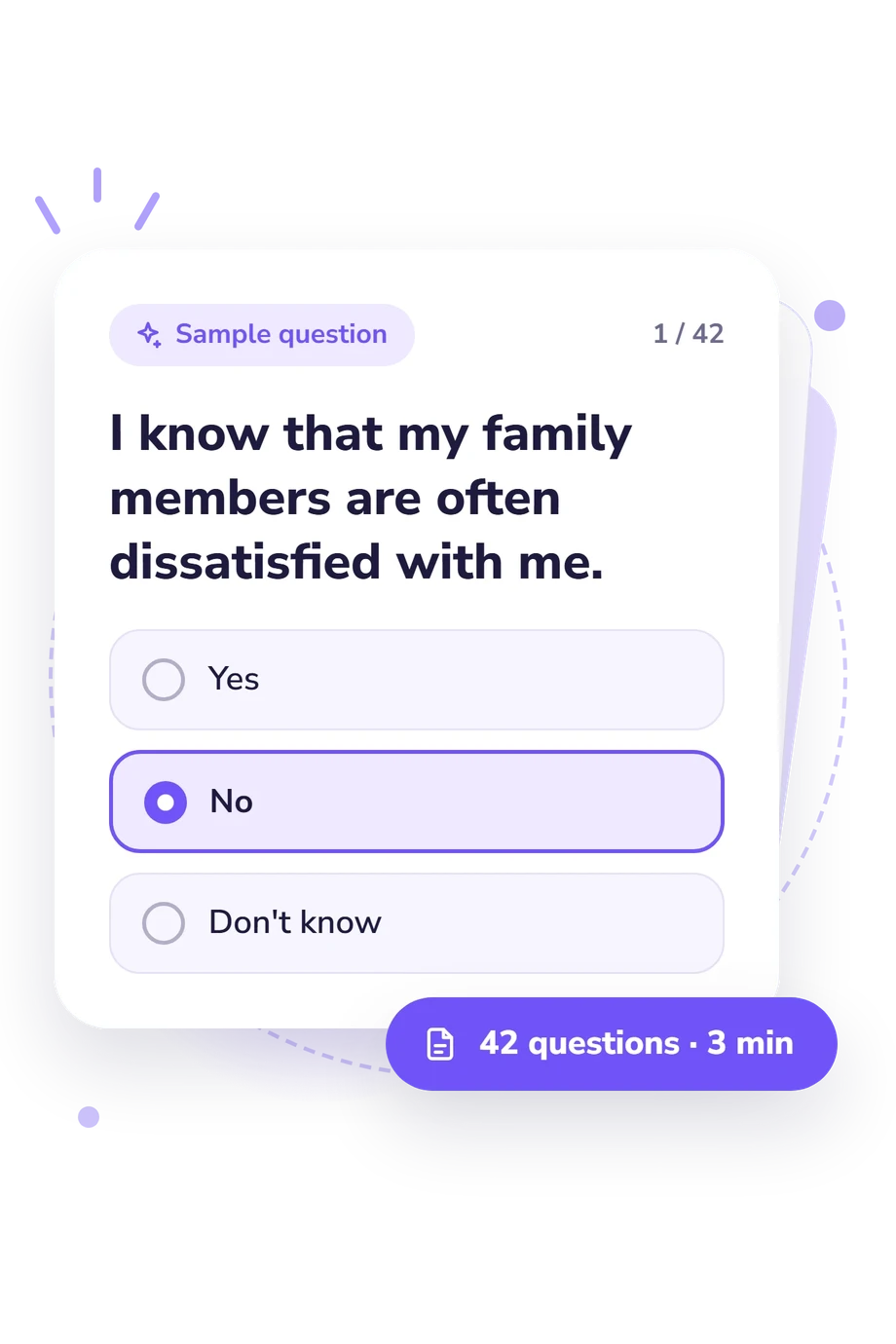
Example Questions From the Test
- Yes
- No
- Don't know
- Yes
- No
- Don't know
- Yes
- No
- Don't know
Family Anxiety Analysis Test - Description and methodology of the test
People who feel uneasy, over-responsible, or persistently worried in family situations may use the Family Anxiety Analysis Test to organize those experiences into a clearer profile. This family anxiety questionnaire asks respondents to reflect on their own relationships, responsibilities, and reactions at home. The result highlights patterns that may deserve attention in everyday family life.
What This Assessment Explores
The questionnaire examines criticism, inadequacy, duties, restraint, helplessness, and fear of disappointing relatives in family situations. It suits people reflecting on recurring reactions around family responsibilities. Four dimensions allow the family anxiety assessment to distinguish different emphases:
- Tension (0-7) reflects internal tension and hypervigilance, including persistent anxiety and excessive effort even in routine family matters; Low tension 0-4; Elevated tension 5-5; High tension 6-7.
- Anxiety (0-7) reflects apprehension and worry about family responsibilities and events, including persistent fears of not coping or doing things incorrectly; Low 0-3; Elevated 4-4; High 5-7.
- Guilt (0-7) reflects guilt, inadequacy, awkwardness, and disruptive behavior in the family; Low 0-3; Moderate 4-4; High 5-7.
- General Family Anxiety (0-21) reflects family-specific doubts, fears, and worries; higher results may indicate insecurity about oneself or a partner’s feelings and helplessness in family matters; Low 0-13; High 14-21.
Methodology and Evidence Base
Each statement presents a family situation or reaction, and the respondent selects Yes, No, or Don't know. The items cover perceived criticism, fear of doing things wrong, nervousness at home, helplessness, self-restraint, and worry about family events. The response pattern is summarized across the displayed dimensions. The questionnaire does not specify how responses are converted into points, so the displayed ranges should not be reverse-engineered into an invented scoring rule.
Conceptually, it is consistent with Analysis of Family Anxiety (Eidemiller & Yustitskis, 1999), which places anxiety in family roles, expectations, and emotional relationships. It is not presented as a standardized adaptation of that work. The online version therefore shares this construct’s focus but should not be treated as the published instrument or its standardized adaptation.
Family anxiety results are best read as a profile of reported experience: a higher dimension suggests stronger endorsement of that theme here, not a diagnosis or fixed trait. Because the format depends on self-report and has no stated normative standardization for this online version, scores may shift with current stress, self-awareness, and willingness to disclose.
- Eidemiller, E. G., & Yustitskis, V. (1999). Psychology and psychotherapy of the family. Saint Petersburg: Piter.
- Murtazina, E. I., & Minullina, A. F. (2016). Research on role sets and emotional relationships in military personnel marriage. International Journal of Environmental and Science Education, 11(6), 1175-1183.
- Karas, I., Borovikova, A., & Babadzhanova-Pavlova, A. (2017). The Representations of Women, Survivors of Violence, about Socio-psychological Support of Relatives. Clinical Psychology and Special Education, 6(3), 47-61. 10.17759/cpse.2017060303
Updated: