
Leadership Style Assessment Test
How the Scales are Structured
Who Usually Takes This Test?
See How You Compare
Below is a preview of how scores are typically distributed across each scale.
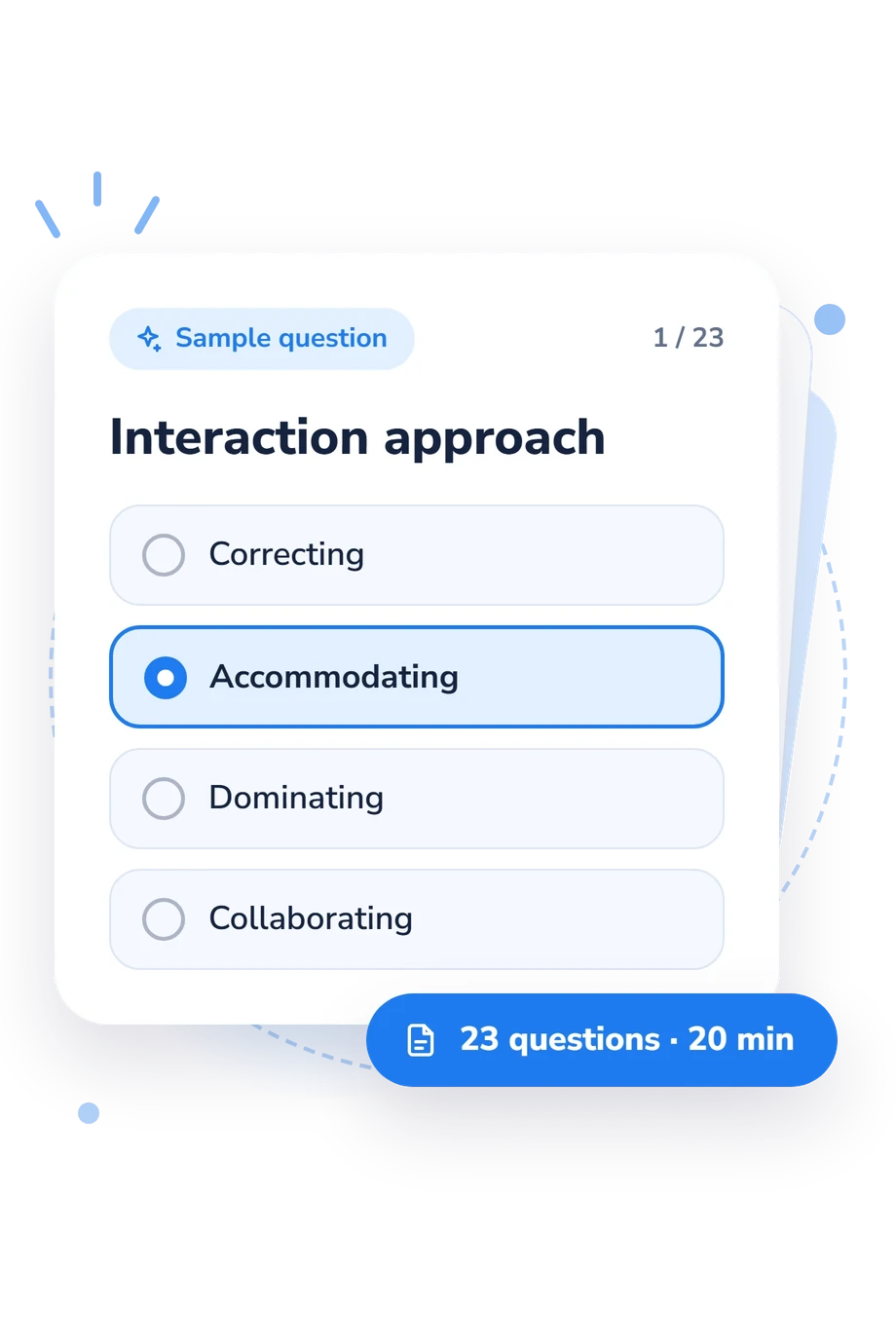
Example Questions From the Test
- Correcting
- Accommodating
- Dominating
- Collaborating
- Written orders
- Dialogue
- Verbal instructions
- Meeting
- Weak in both directions
- Patronizing, favors subordinates
- Arrogant, favors the manager
- Two-way in both directions
Leadership Style Assessment Test - Description and methodology of the test
Managers, team leads, and professionals preparing to guide others can use this Leadership Style Assessment Test to examine the choices behind their everyday leadership. As a leadership assessment, it is useful when you want to understand whether your habits lean toward task control, relationship building, shared motivation, or cautious administration. The result gives you a practical starting point for reflecting on how you influence people and organize work.
What This Assessment Measures
At its core, the questionnaire examines different leadership styles through workplace decisions and interactions, especially how a person balances task achievement with relationships. Its scenarios cover communication, delegation, evaluation, mistakes, conflict, stress, motivation, and staff expectations. It suits managers, supervisors, coordinators, and reflective team members. The four result dimensions are:
- Integrative (0-230) reflects joint task and relationship focus: Limited integrated focus (0-80), Developing integration (81-160), and Strong integrated style (161-230).
- Dedicated (0-230) reflects decisive task focus with low relationship focus: People-balanced (0-80), Task-leaning (81-160), and Highly devoted (161-230).
- Sociable (0-230) reflects relationship focus, personal development, and team support: Low sociability focus (0-80), Moderate sociability focus (81-160), and High sociability focus (161-230).
- Detached (0-230) reflects low task and relationship focus with an emphasis on stability and precision: Low detached (0-80), Moderate detached (81-160), and High detached (161-230).
Methodology and Evidence Base
Each item presents four response choices, asking the respondent to select the alternative that best matches a usual approach rather than rate agreement. The choices contrast communication, direction, support, control, conflict handling, and responses to pressure. This forced-choice format produces a pattern across situations rather than one global score.
The questionnaire reports four separate scores and places each in the displayed band. Those bands are descriptive, not validated population norms or clinical thresholds; the online questionnaire does not document how responses produce four scores.
Its style structure is conceptually consistent with Management Style Diagnosis Test (Reddin, 1977) and Reddin's managerial-effectiveness framework, but it is not presented as a verbatim adaptation. Lewin, Lippitt, and White's studies, alongside White and Lippitt's work on autocratic and democratic climates, add context for how leadership behavior shapes group interaction.
Together, these sources give the leadership profile a clear conceptual context; they do not establish population norms for this online questionnaire. As a self-report tool, results can shift with current pressures, self-perception, and socially desirable responding, so important decisions should also draw on concrete workplace examples and broader assessment.
- Reddin, William J. Management Style Diagnosis Test. 2nd ed. Fredericton, New Brunswick: Organizational Tests Ltd., 1977.
- Reddin, William J. Managerial Effectiveness. New York: McGraw-Hill, 1970.
- Lewin, Kurt, Ronald Lippitt, and Ralph K. White. “Patterns of Aggressive Behavior in Experimentally Created ‘Social Climates’.” The Journal of Social Psychology 10, no. 2 (1939): 269-299. 10.1080/00224545.1939.9713366
- White, Ralph K., and Ronald Lippitt. Autocracy and Democracy: An Experimental Inquiry. New York: Harper, 1960.
Updated: