
Therapy Test
How the Scales are Structured
Who Usually Takes This Test?
See How You Compare
Below is a preview of how scores are typically distributed across each scale.
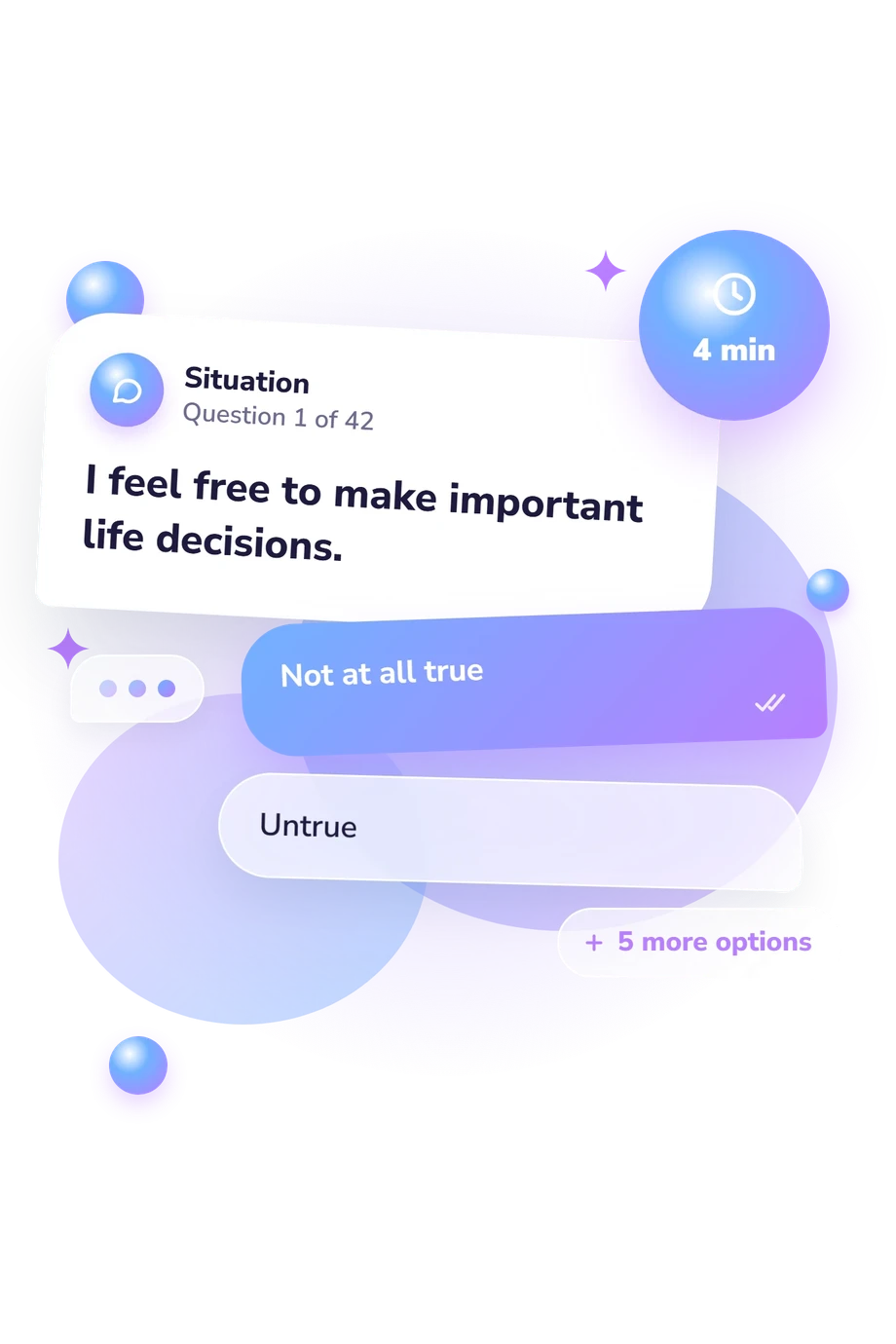
Example Questions From the Test
- Absolutely not true
- Not true
- Mostly not true
- Not sure
- Mostly true
- True
- Completely true
- Completely untrue
- Not true
- Mostly untrue
- Not sure
- Mostly true
- True
- Completely true
- Completely untrue
- Untrue
- Mostly untrue
- Not sure
- Mostly true
- True
- Completely true
Therapy Test - Description and methodology of the test
People seeking a structured way to reflect on relationships, capability, and personal choice can use the Basic Psychological Need Satisfaction Scale (BPNSS) to examine how these needs are experienced in everyday situations. This assessment is labelled Therapy Test. It suits readers who want focused self-reflection about motivation, confidence, independence, and social support. A basic psychological needs questionnaire can highlight patterns worth considering in current relationships, responsibilities, and stress.
What This Assessment Explores
Self-determination theory connects well-being with connection, effectiveness, and self-directed choice. The items ask about care from others, social closeness, capability, learning, expressing opinions, decision-making, and pressure.
As a basic psychological needs assessment, it suits readers reflecting on everyday relationships and functioning. The result can show which needs feel more supported or strained in the situations being considered.
The displayed dimensions are:
- Relatedness (1–7) reflects the need for warm, supportive relationships, mutual care, and harmony; Low connectedness (1–4.9) and High connectedness (5–7) are the displayed bands.
- Competence (1–7) reflects perceived effectiveness, confidence, usefulness, and ability to achieve outcomes; Low competence (1–4.9) and High competence (5–7) are the displayed bands.
- Autonomy (1–7) reflects independent action guided by inner motives and a coherent sense of self; Low autonomy (1–4.9) and High autonomy (5–7) are the displayed bands.
Methodology and Evidence Base
Each statement uses seven ordered response options, from complete untruth through uncertainty to complete truth. The wording covers supportive experiences and difficulties, such as feeling free to decide versus pressured, or capable versus incapable. Answer each statement according to how true it is for you, following any timeframe expressed in that item.
Results are reported separately for the three displayed dimensions rather than as one verdict. This online version has not been standardized or validated; its displayed bands are interpretation labels, not population norms or clinical cutoffs. A basic needs self-assessment is most informative when considered alongside circumstances and changes over time.
The closest published evidence is Johnston and Finney's (2010) evaluation of the Basic Need Satisfaction in General Scale. This online questionnaire is conceptually related to that work but should not be treated as an equivalent reproduction or as inheriting its psychometric evidence. Its content is conceptually consistent with self-determination theory described by Deci and Ryan (2000). Mood, conflict, social desirability, and limited self-awareness can influence self-report, so read the result as a context-sensitive reflection.
- Gagné, M. (2003). The Role of Autonomy Support and Autonomy Orientation in Prosocial Behavior Engagement. Motivation and Emotion, 27(3), 199–223. 10.1023/A:1025007614869
- Johnston, M. M., & Finney, S. J. (2010). Measuring Basic Needs Satisfaction: Evaluating Previous Research and Conducting New Psychometric Evaluations of the Basic Needs Satisfaction in General Scale. Contemporary Educational Psychology, 35(4), 280–296. 10.1016/j.cedpsych.2010.04.003
- Deci, E. L., & Ryan, R. M. (2000). The What and Why of Goal Pursuits: Human Needs and the Self-Determination of Behavior. Psychological Inquiry, 11(4), 227–268. 10.1207/S15327965PLI1104_01
Updated: