
Emotional Intelligence Test (EmIn)
How the Scales are Structured
Who Usually Takes This Test?
See How You Compare
Below is a preview of how scores are typically distributed across each scale.
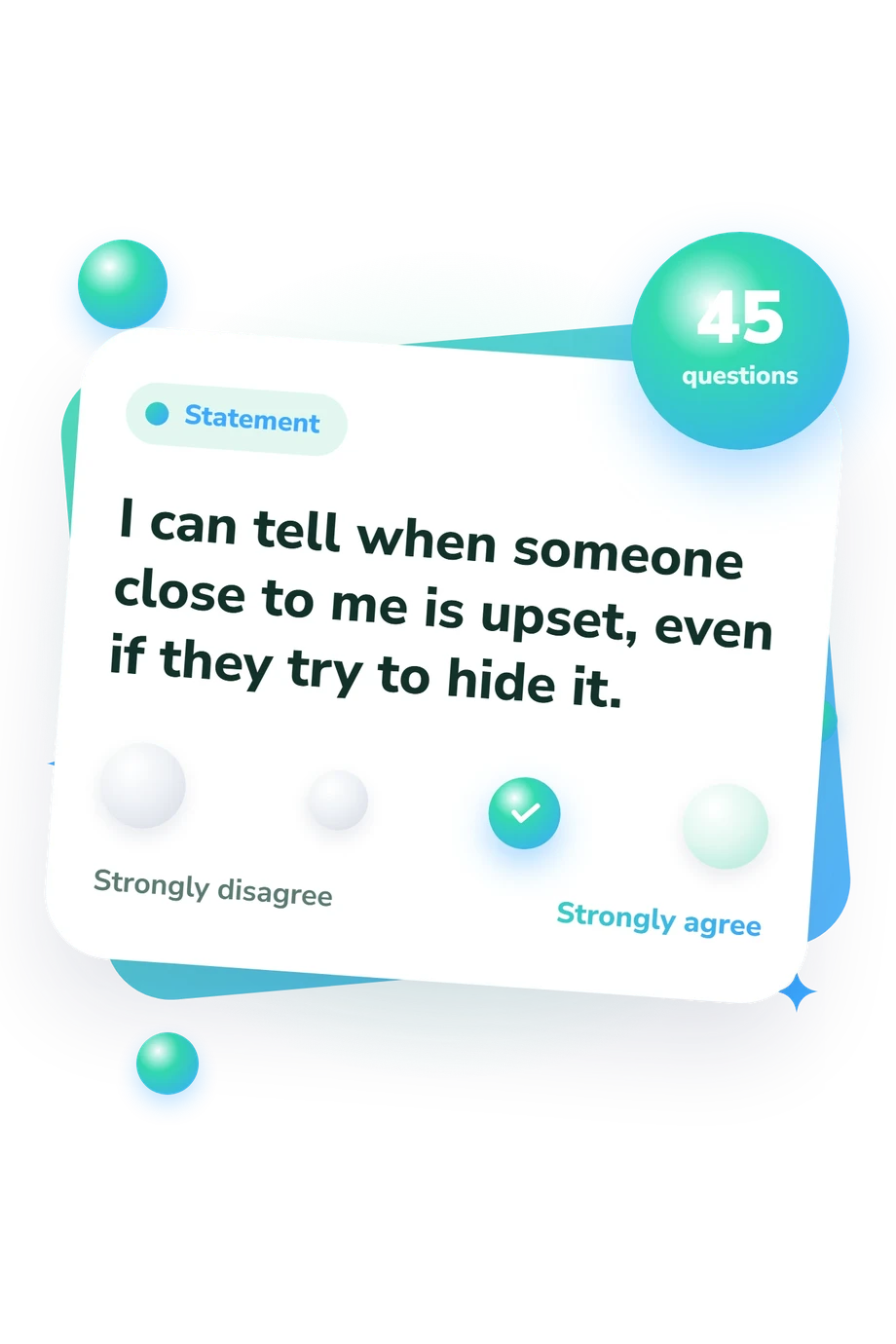
Example Questions From the Test
- Strongly disagree
- Somewhat disagree
- Somewhat agree
- Strongly agree
- Strongly disagree
- Rather disagree
- Rather agree
- Strongly agree
- Strongly disagree
- Somewhat disagree
- Somewhat agree
- Strongly agree
Emotional Intelligence Test (EmIn) - Description and methodology of the test
People who want to understand emotional habits can use this assessment to examine how they notice, interpret, regulate, and express feelings in interactions. The Emotional Intelligence Test (EmIn) offers a structured profile rather than a single label. Its dimensions show relative patterns in emotional abilities and tendencies across the five areas. The emotional intelligence profile helps organize attention around emotional reactions, relationships, and communication patterns.
What This Assessment Explores
Across the profile, this emotional intelligence questionnaire covers five abilities: reading cues, identifying feelings and causes, influencing others’ moods, managing reactions, and controlling expression. Results show relative patterns.
The profile includes:
- Understanding Others' Emotions (0-36) measures sensitivity to external cues or intuition: Lower sensitivity 0-12; Moderate sensitivity 13-24; Higher sensitivity 25-36.
- Managing Others' Emotions (0-27) measures influencing others’ feelings, including possible manipulation: Low 0-9; Moderate 10-18; High 19-27.
- Understanding One's Own Emotions (0-30) measures recognizing and explaining personal feelings: Limited awareness 0-10; Developing awareness 11-20; Strong awareness 21-30.
- Intrapersonal Emotion Regulation (0-21) measures managing desired and unwanted feelings: Low 0-7; Moderate 8-14; High 15-21.
- Expression Control (0-21) measures control of outward emotion: Low control 0-7; Moderate 8-14; High 15-21.
Methodology and Evidence Base
The questionnaire presents short self-report statements about noticing, naming, influencing, or regulating emotion. In the sampled items, most response sets use a four-point agreement scale from strongly disagree to strongly agree; one sampled item uses disagree and agree without somewhat. This format captures graded endorsement rather than open narrative answers.
The questionnaire displays separate scale totals and result bands, but does not document how individual responses contribute to each total; an item-level scoring rule should not be inferred. Comparing the pattern across dimensions is more informative than treating one number as a complete account of emotional functioning.
The online questionnaire is conceptually consistent with the EmIn Questionnaire (Lyusin, 2006), but its displayed scores should not be assumed to reproduce that instrument’s scoring or norms. Lyusin (2009) provides later psychometric data; Lyusin and Ovsyannikova (2015) offer related context on links between emotional intelligence, personality, and mood. The multidimensional structure comes from the 2006 EmIn source.
These emotional intelligence results have no stated population norms or clinical cutoffs; they depend on current context, self-awareness, and honest reporting. Use the profile for reflection, not to predict behavior in every situation.
- Lyusin, D. V. (2006). A New Method for Measuring Emotional Intelligence: The EmIn Questionnaire. Psychological Diagnostics, No. 4, pp. 3-22. In Russian.
- Lyusin, D. V. (2009). Emotional Intelligence Questionnaire EmIn: New Psychometric Data. In D. V. Lyusin and D. V. Ushakov (Eds.), Social and Emotional Intelligence: From Models to Measurements (pp. 264-278). Moscow: Institute of Psychology of the Russian Academy of Sciences. In Russian.
- Lyusin, D., and Ovsyannikova, V. (2015). Relationships between Emotional Intelligence, Personality Traits and Mood. Psychology: Journal of the Higher School of Economics, 12(4), 154-164. 10.17323/1813-8918-2015-4-154-164. In Russian.
Updated: