
Psychoanalytic Self-Assessment Questionnaire of Mature Personality Test
How the Scales are Structured
Who Usually Takes This Test?
See How You Compare
Below is a preview of how scores are typically distributed across each scale.
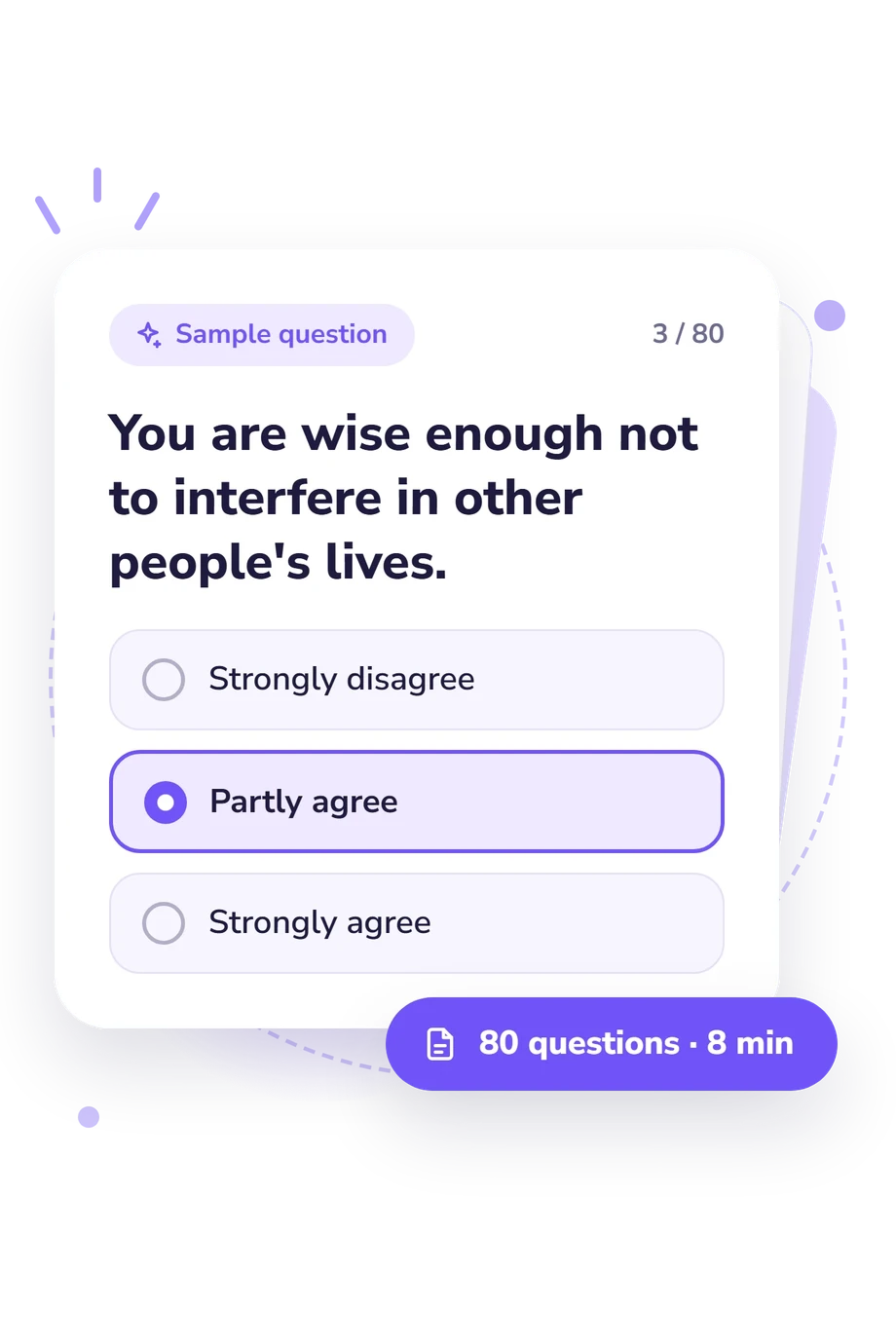
Example Questions From the Test
- Strongly disagree
- Agree somewhat
- Strongly agree
- Strongly disagree
- Partly agree
- Strongly agree
- Completely disagree
- Partly agree
- Completely agree
Psychoanalytic Self-Assessment Questionnaire of Mature Personality Test - Description and methodology of the test
For people examining how they respond to responsibility, change, frustration, relationships, and personal values, the Psychoanalytic Self-Assessment Questionnaire of Mature Personality Test offers a structured way to consider psychological maturity. It is useful when a person wants a mature personality assessment that connects everyday choices with broader patterns of self-acceptance, resilience, autonomy, and inner balance.
What This Assessment Explores
The questionnaire treats maturity as a pattern of choices and reactions, not as perfection. Its statements touch responsibility, autonomy, self-acceptance, emotional steadiness, flexibility, purpose, conscience, resilience, and openness to growth.
For self-reflection, this personality maturity questionnaire brings those themes together in four practical areas:
- Responsibility and autonomy show how readily you own choices, respect boundaries, and avoid shifting blame.
- Emotional steadiness reflects how you handle frustration, loss, uncertainty, and minor provocations.
- Flexibility and growth indicate whether you can revise familiar habits and continue toward meaningful goals.
- Integration and self-acceptance describe how you care for yourself, accept imperfections, and remain authentic.
The main result is the Personality Maturity Scale (40-120), defined as maturity across psychological criteria. Its bands are Initial maturity (40-70), Moderate maturity (71-100), and Confident maturity (101-120). These labels describe the indicated level, not a fixed identity.
Methodology and Scientific Basis
The sampled statements use three-level agreement responses. The result is presented on one Personality Maturity Scale, but the response-to-score formula and any item weighting are not disclosed.
Although its title uses psychoanalytic language, this psychoanalytic self-assessment overlaps with Maslow’s humanistic themes of growth, purpose, self-acceptance, and fuller functioning. The questionnaire is conceptually consistent with Ananyev’s health-psychology work and with Maslow’s humanistic themes, but it is not presented here as a direct adaptation. Ananyev’s health-psychology account and Maslow’s work on motivation and being supply the relevant theoretical context.
Use the result alongside the item-level reactions it brings up: easy, uncertain, or uncomfortable answers can reveal useful priorities for reflection. The bands are descriptive categories, while self-report is influenced by current mood, self-presentation, and self-awareness. The online version provides descriptive bands rather than published normative or psychometric benchmarks. Read alongside the statements, the result can focus reflection on responsibility, acceptance of change, handling disappointment, self-regulation, authenticity, and goal pursuit.
- Ananyev, V. A. (2007). Practicum on Health Psychology: A Methodological Manual on Primary Specific and Nonspecific Prevention. Saint Petersburg: Rech. ISBN 5-9268-0527-9.
- Ananyev, V. A. (2000). Psychology of Health: Ways of Establishing a New Branch of Human Knowledge. In G. S. Nikiforov (Ed.), Psychology of Health (pp. 10-88). Saint Petersburg: Saint Petersburg University Press.
- Maslow, A. H. (1968). Toward a Psychology of Being (2nd ed.). New York: Van Nostrand.
- Maslow, A. H. (1943). A Theory of Human Motivation. Psychological Review, 50(4), 370-396. 10.1037/h0054346
Updated: