
Freudly+971 508685814hello@freudly.ai
Freudly
aging

Readiness for Age-Related Changes Scale Test
Take the online Readiness for Age-Related Changes Scale Test - AI psychologist FreudlyYou can take Readiness for Age-Related Changes Scale Testhere. Online version of a simple and accurate psychological test with interpretation.en
Understand how you feel about age-related changes and your readiness to adapt in about 16 minutes. This 84-item check-in highlights acceptance, stress, and coping needs to guide next steps.
Start Online Test
Questions: 8416 minutes
08:30
October 2, 2025
October 2, 2025
Material has been updated
October 2, 2025
Material has been published
16,326 views
1,334 completions
1,163 likes
Verified by Daniel Hall
Psychologist with 25 years of experience
Share
Scale Explorer

How the Scales are Structured

example score
8/42
Physiological (P)
Measures readiness to understand, accept, and adapt to physical manifestations of aging such as appearance and sensory changes.
Low readiness
Moderate readiness
High readiness
015: Low readiness | 1629: Moderate readiness | 3042: High readiness
A score of 8 indicates low physiological readiness, suggesting limited acceptance of bodily changes and fewer perceived strategies for adapting to them at this time.
example score
30/42
Professional (P)
Measures readiness to adapt professionally to age-related changes, including tolerating a reduced career role and finding self-expression beyond work, especially around retirement.
Low readiness
Moderate readiness
High readiness
015: Low readiness | 1629: Moderate readiness | 3042: High readiness
A score of 30 indicates high professional readiness, suggesting relative comfort with shifting away from a central work role and openness to new forms of activity and self-expression.
example score
25/42
Personal-Psychological (PP)
Measures how well a person understands and accepts psychological changes with aging and uses self-regulation and compensation strategies to adapt.
Low readiness
Moderate readiness
High readiness
015: Low readiness | 1629: Moderate readiness | 3042: High readiness
A score of 25 indicates moderate personal-psychological readiness, suggesting a generally workable acceptance of age-related psychological changes with some areas that may still require adjustment or support.
example score
26/42
Social (S)
Measures readiness to recognize, accept, and adapt to age-related changes in social roles, status, and relationships.
Low readiness
Moderate readiness
High readiness
015: Low readiness | 1629: Moderate readiness | 3042: High readiness
A score of 26 indicates moderate social readiness, suggesting generally adaptive attitudes with some areas where social-role changes may still feel challenging.
example score
34/56
Motivational (M)
Measures the degree of motivation to actively use productive strategies to adapt to age-related changes.
Low
Moderate
High
019: Low | 2038: Moderate | 3956: High
A score of 34 indicates a moderate level of motivation to adjust and take constructive steps in response to age-related changes.
example score
32/56
Affective (A)
Measures emotional tolerance and acceptance of age-related changes as normal and inevitable.
Low acceptance
Moderate acceptance
High acceptance
019: Low acceptance | 2038: Moderate acceptance | 3956: High acceptance
A score of 32 indicates a moderate level of emotional acceptance of age-related changes, with some remaining discomfort or ambivalence possible.
example score
7/56
Cognitive (C)
Measures how aware and understanding a person is of current or expected age-related changes and their naturalness.
Low awareness
Moderate awareness
High awareness
018: Low awareness | 1937: Moderate awareness | 3856: High awareness
A score of 7 indicates low cognitive readiness, suggesting limited recognition or understanding of age-related changes as a natural part of life at this time.
example score
107/168
Overall Readiness (OR)
Measures overall readiness to accept and adapt to current or anticipated age-related changes through planning and active coping strategies.
Low readiness
Moderate readiness
High readiness
056: Low readiness | 57112: Moderate readiness | 113168: High readiness
A score of 107 indicates moderate readiness, suggesting a generally accepting stance toward age-related changes with some remaining areas where adaptation and future planning may feel less settled.
Start Online Test
just completed the test
DATA-BASED USER COHORTS

Who Usually Takes This Test?

Midlife transition seekers
41%OF USERS
Adults in their late 30s to 50s who are noticing shifts in energy, priorities, or identity and want to see how open they are to adapting.
Retirement and role changers
34%OF USERS
People preparing for or entering retirement, empty nest, or a major lifestyle change who want clarity on coping with new routines and limitations.
Support and counseling clients
25%OF USERS
Clients in therapy or support programs who feel anxious about aging, self-worth, or health-related changes and want a structured check-in on their emotional readiness.
BASED ON AGGREGATED, ANONYMIZED DATA FROM TENS OF THOUSANDS OF FREUDLY USERS.
Benchmarking

See How You Compare

Once you complete the test, your results are compared with real-world data from people in your country.
Below is a preview of how scores are typically distributed across each scale.
Physiological (P)
Physiological (P)
Average
30.5
Normal range
23.337.6
min.
0
max.
42
This curve shows how scores are typically distributed.
Once you complete the test, your result will appear on the scale so you can see how you compare.
Professional (P)
Professional (P)
Average
29.9
Normal range
22.337.5
min.
0
max.
42
This curve shows how scores are typically distributed.
Once you complete the test, your result will appear on the scale so you can see how you compare.
Personality-psychological (P)
Average
22.8
Normal range
17.228.4
min.
0
max.
42
This curve shows how scores are typically distributed.
Once you complete the test, your result will appear on the scale so you can see how you compare.
Social (S)
Social (S)
Average
28.6
Normal range
21.236
min.
0
max.
42
This curve shows how scores are typically distributed.
Once you complete the test, your result will appear on the scale so you can see how you compare.
Motivational (M)
Motivational (M)
Average
39.4
Normal range
3246.8
min.
0
max.
56
This curve shows how scores are typically distributed.
Once you complete the test, your result will appear on the scale so you can see how you compare.
Affective (A)
Affective (A)
Average
22.5
Normal range
12.432.7
min.
0
max.
56
This curve shows how scores are typically distributed.
Once you complete the test, your result will appear on the scale so you can see how you compare.
Cognitive (C)
Cognitive (C)
Average
39.9
Normal range
31.248.7
min.
0
max.
56
This curve shows how scores are typically distributed.
Once you complete the test, your result will appear on the scale so you can see how you compare.
Overall readiness score (Ors)
Average
118.2
Normal range
91.9144.5
min.
0
max.
168
This curve shows how scores are typically distributed.
Once you complete the test, your result will appear on the scale so you can see how you compare.
Featured On
SAMPLE QUESTIONS

Example Questions From the Test

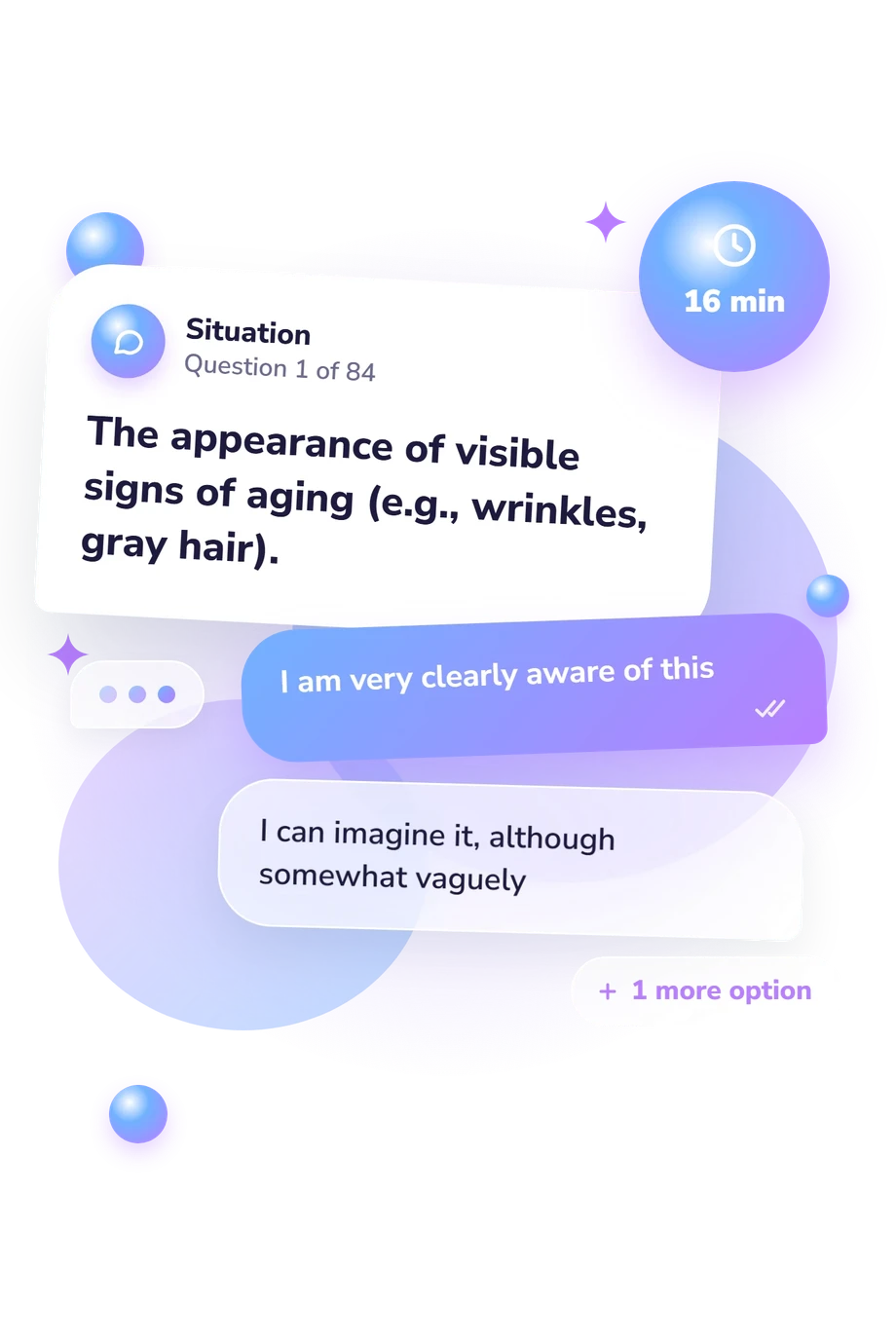
Below is a list of life changes that may accompany the aging process. For each item, please answer three questions: A. Are you aware of these changes occurring in your life (or of their possible occurrence in the future)? B. What is your attitude toward the change described in the item? C. How do you adapt to the described situation (or how would you adapt in the future)?
    • I am very clearly aware of this
    • I can imagine it, although somewhat vaguely
    • I do not think about this
    • I take it calmly as a normal, inevitable change
    • I take a middle position
    • I take it very hard and feel distressed
    • I am very clearly aware of this
    • I can imagine it, though somewhat vaguely
    • I do not think about this
WHAT THE TEST MEASURES
About This Assessment
Readiness for Age-Related Changes Test

Readiness for Age-Related Changes Scale Test - Symptoms and Signs

aging
age
temporal perspective

This measure assesses an individual’s attitudes and perceived preparedness for normative changes associated with aging. The Readiness for Age-Related Changes Scale provides a structured self-report format to help characterize acceptance, concern, and perceived capacity to adapt to age-related transitions (Baltes & Lachman).

The instrument includes 84 items and typically takes about 16 minutes to complete. Results are intended to support clinical formulation by identifying potential areas of adjustment difficulty and informing discussion about coping strategies and expectations.

In applied settings, the Readiness for Age-Related Changes Scale may be used with adults across the lifespan to guide assessment of emotional and cognitive appraisals of aging-related change and to monitor perceived readiness over time.

Author: Margie E. Lachman, Paul B. Baltes
Literature: Baltes, P. B., & Baltes, M. M. (Eds.). Successful aging: Perspectives from the behavioral sciences. Cambridge University Press. 1990.
Popular tests
Comments
Leave a Comment