
Assessment of Pedagogical Stereotyping Level Test
How the Scales are Structured
Who Usually Takes This Test?
See How You Compare
Below is a preview of how scores are typically distributed across each scale.
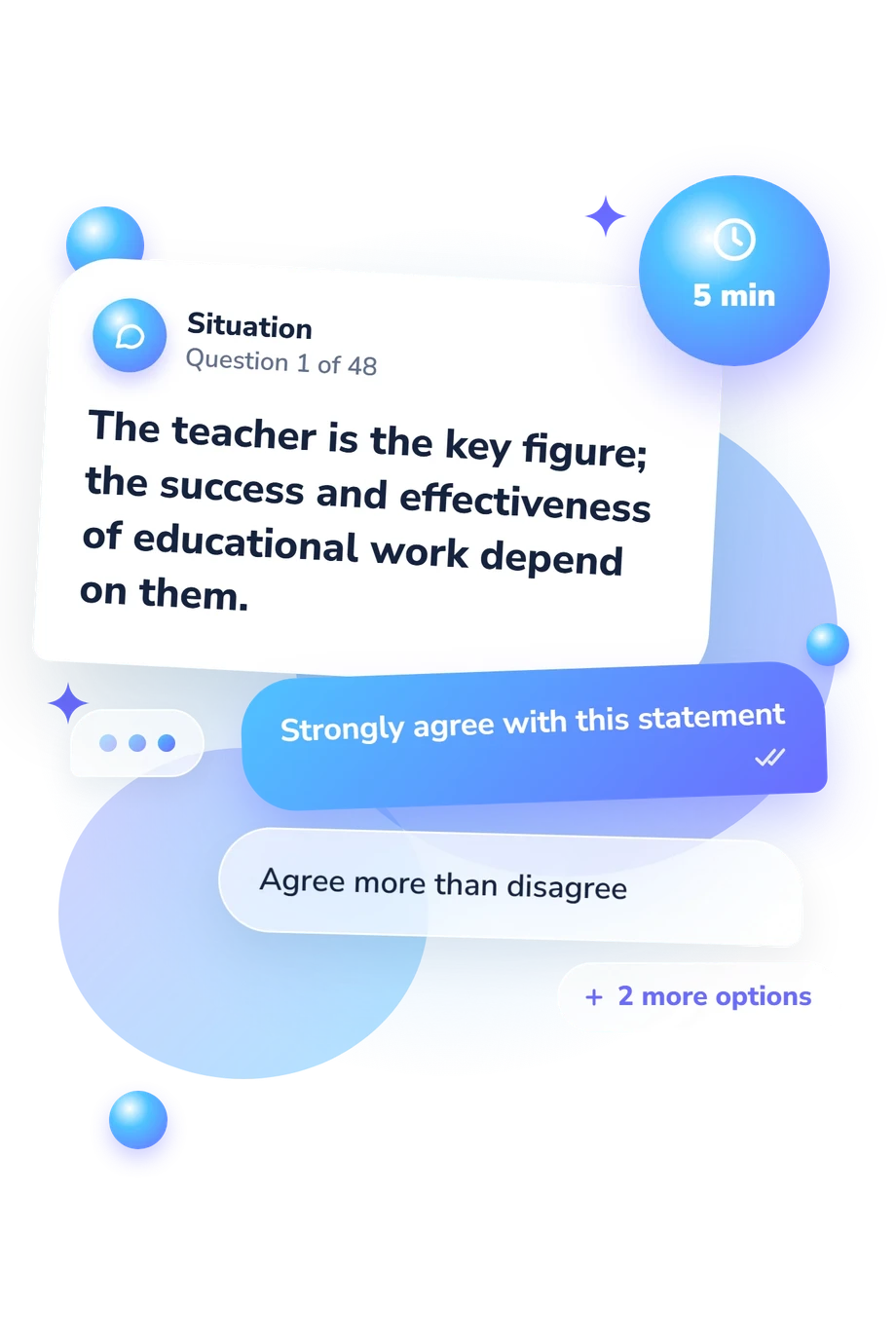
Example Questions From the Test
- Strongly agree with this statement
- Agree more than disagree
- Disagree more than agree
- Strongly disagree
- Strongly agree
- Agree more than disagree
- Disagree more than agree
- Strongly disagree
- Completely agree with this statement
- Agree more than disagree
- Disagree more than agree
- Completely disagree
Assessment of Pedagogical Stereotyping Level Test - Description and methodology of the test
For educators considering how habitual assumptions affect practice, the Assessment of Pedagogical Stereotyping Level Test offers a structured way to examine beliefs that can shape decisions, relationships, and expectations. This pedagogical stereotyping assessment is most useful when the respondent wants a clearer profile of professional attitudes rather than a flattering or negative label. The result can highlight areas for reflection across work with children, families, methods, and the teaching role.
What This Assessment Explores
The items examine beliefs about authority, discipline, individuality, family responsibility, gendered expectations, and the teacher’s role. The four domain scales and one overall indicator, with their displayed bands, are:
- Attitudes Toward Forms and Methods of Upbringing (6-24) shows reliance on formulaic methods: Flexible approach 6-12; Moderate stereotyping 13-15; Strong reliance on standard methods 16-24.
- Attitudes Toward Parents (6-24) reflects inflexibility toward parents: Flexible attitude 6-12; Moderate stereotyping 13-15; High stereotyping 16-24.
- Attitudes Toward Children (6-24) reflects stereotyped perceptions and interactions: Low 6-12; Moderate 13-15; High 16-24.
- Attitudes Toward the Teaching Profession (6-24) reflects stereotypical beliefs about the role: Low stereotyping 6-12; Moderate stereotyping 13-15; High stereotyping 16-24.
- Pedagogical Stereotyping Level (24-96) summarizes rigidity in professional activity: Low 24-48; Moderate 49-63; High 64-96.
This teacher stereotyping questionnaire helps educators notice where fixed assumptions may narrow interpretation, communication, or choice.
Methodology and Evidence Base
Each item uses a four-point agreement response, moving from strong agreement to strong disagreement. The statements address teaching methods, views of children and parents, discipline, family roles, and beliefs about the profession. The questionnaire reports results on the displayed scales; higher scores carry the scale-specific interpretations described above, while the bands organize interpretation without creating an additional scoring rule.
The structure is conceptually consistent with Buchilova’s 2002 dissertation on overcoming pedagogical stereotypes, while Buchilova’s 2010 monograph and Davydova’s 2016 study provide supporting context for pedagogical stereotypes and their relationship to professional activity. The online format presents these themes as a self-report profile of the respondent’s stated educational attitudes.
Its pedagogical stereotyping profile can support reflective discussion about habits in judgment and interaction. Because it is self-report, results may be influenced by current experience, social desirability, and limited self-awareness; use the profile as a prompt for reflection rather than as a standalone professional judgment.
- Buchilova, Irina Anatolyevna. (2002). Psychological Features of Overcoming Pedagogical Stereotypes among Students and Preschool Educators: Dissertation for the Candidate of Psychological Sciences, specialty 19.00.07, Educational Psychology. Cherepovets, 204 pp.
- Buchilova, Irina Anatolyevna. (2010). Psychological Features of Overcoming Pedagogical Stereotypes among Students and Preschool Educators: Monograph. Cherepovets: Cherepovets State University, 86 pp.
- Davydova, Oksana. (2016). Interrelation of Pedagogical Stereotypes and Parameters of Teachers’ Professional Activities. Science and Education, 11, 24-30. 10.24195/2414-4665-2016-11-6
Updated: