
Class Group Reflexivity Test
How the Scales are Structured
Who Usually Takes This Test?
See How You Compare
Below is a preview of how scores are typically distributed across each scale.
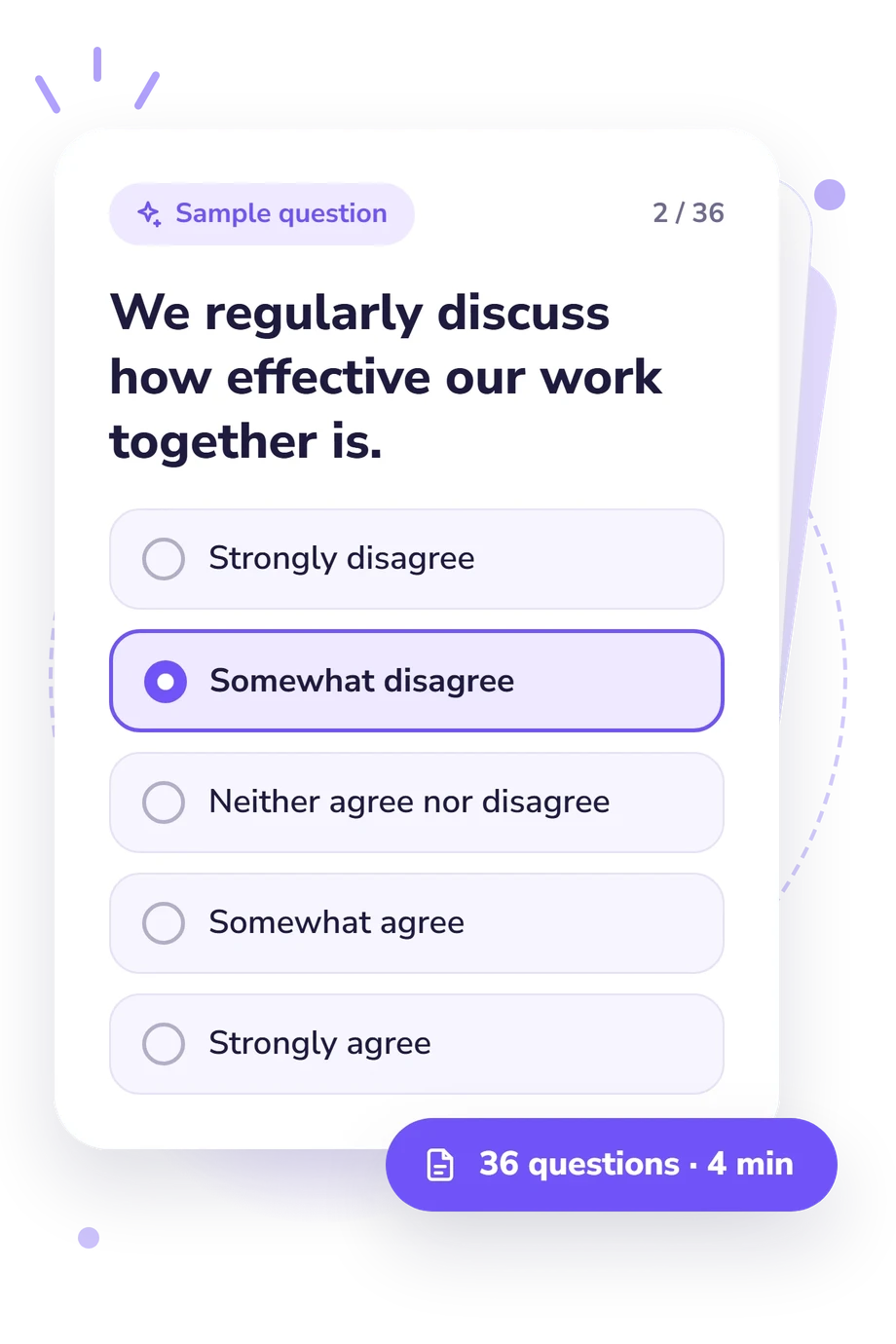
Example Questions From the Test
- Strongly disagree
- Somewhat disagree
- Neither agree nor disagree
- Somewhat agree
- Strongly agree
- Strongly disagree
- Somewhat disagree
- Neither agree nor disagree
- Somewhat agree
- Strongly agree
- Strongly disagree
- Somewhat disagree
- Neither agree nor disagree
- Somewhat agree
- Strongly agree
Class Group Reflexivity Test - Description and methodology of the test
People who want to understand how a class notices, discusses, and adjusts its collective work can use the Class Group Reflexivity Test as a structured starting point. It is especially relevant when classmates are reviewing cooperation, planning, or shared goals. As a reflection assessment for a class group, it turns everyday discussion patterns into a profile of reflective capacity rather than a judgment of individual personalities.
What This Assessment Explores
This questionnaire examines how a class interprets experience, recognizes resources and capabilities, and reflects on the goals, tasks, and meaning of joint activity.
It suits groups reviewing shared work.
The profile shows stronger or less developed reflective analysis of group work.
Four readings appear:
- Reflection on Past Experience (6-30) shows how the group analyzes and uses past experience: Limited reflection (6-12), Developing reflection (13-23), or Strong reflection (24-30).
- Appraisal of Group Resources and Capabilities (6-30) shows recognition of resources, collective potential, and capabilities: Low awareness (6-12), Moderate awareness (13-24), or High awareness (25-30).
- Meaning Analysis of Joint Activity (6-30) shows reflection on goals, tasks, and meaning: Low clarity (6-12), Moderate clarity (13-25), or High clarity (26-30).
- Group Reflexivity (18-90) shows self-analysis of actions, goals, and values and ability to adjust activity: Low (18-36), Moderate (37-71), or High (72-90).
Methodology and Scientific Basis
The method is conceptually consistent with the Group Reflexivity framework described by Nestik in 2015, which treats a group’s examination of its activity, goals, and values as a collective process. Zhuravlev and Nestik place this process within social-psychological research on group self-analysis.
Each statement uses a five-point agreement response, from strong disagreement to strong agreement, with minor wording variations. Items address consequences, goals, methods, information sharing, resources, trust, future scenarios, and wider environmental change. The questionnaire is an assessment of group reflexivity: it displays four score profiles with their result bands; it does not state a response-combination rule, and the online scores are descriptive rather than norm-referenced.
Tarasov’s 2025 study concerns its own published modification and psychometric verification. This questionnaire is only conceptually consistent with that work; it is not that published instrument and does not inherit its validation or psychometric findings. Carter and West’s team research provides a related example of examining reflexivity alongside group functioning.
Because answers are self-reported, current group events, personal perspective, and willingness to answer candidly can influence the result.
- Tarasov, S. V. (2025). Modification and Psychometric Verification of Questionnaire the 'Group Reflexivity' by T. A. Nestik. Social Psychology and Society, 16(1), 159-174. 10.17759/sps.2025160109
- Nestik, T. A. (2015). Social-Psychological Determination of Group Attitude to Time. Doctoral dissertation, Moscow, 479 pp.
- Zhuravlev, A. L., & Nestik, T. A. (2012). Group Reflexivity: Theoretical Approaches and Perspectives of Research. Psychological Journal, 33(4), 27-37.
- Carter, S. M., & West, M. (1998). Reflexivity, Effectiveness and Mental Health in BBC-TV Production Teams. Small Group Research, 29(5), 583-601. 10.1177/1046496498295003
Updated: