
Assessment of Dominant Response Type Test
How the Scales are Structured
Who Usually Takes This Test?
See How You Compare
Below is a preview of how scores are typically distributed across each scale.
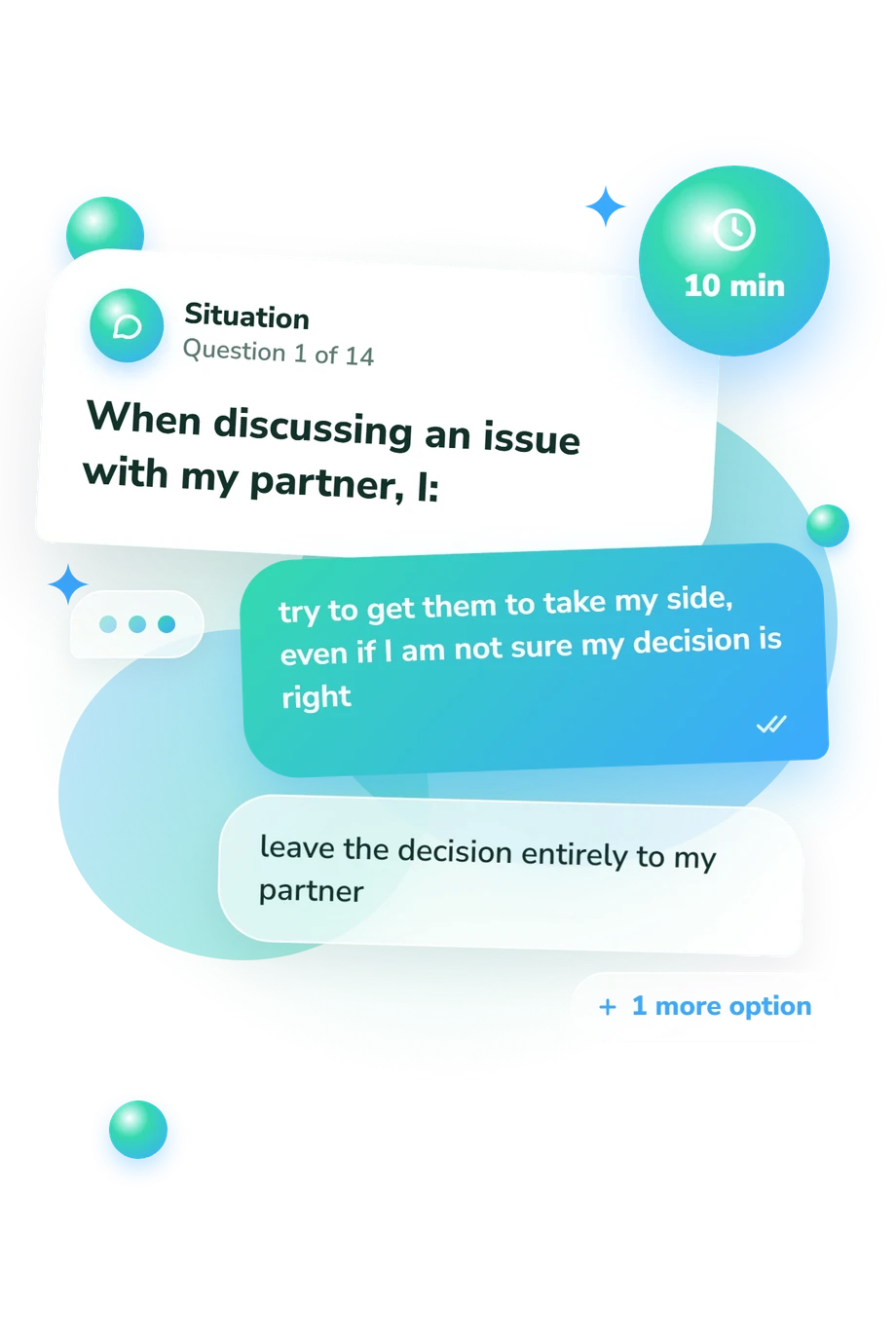
Example Questions From the Test
- respond in the same way
- become silent, while feeling hurt
- try not to notice it
- feel at a loss and may be unable to argue back
- call them stubborn, stupid, ignorant, etc.
- try to explain to them what they are mistaken about
- strength of character and the ability to stand up for my opinion
- reaching compromise decisions
- the ability to find someone who is more competent in this area
Assessment of Dominant Response Type Test - Description and methodology of the test
People who want to understand their habitual conduct during disagreement may use the Assessment of Dominant Response Type Test to examine how they approach shared decisions, resistance, accusations, and stalled conversations. It is intended for readers reflecting on relationships, friendships, or other interpersonal situations. This dominant response type assessment can clarify which reactions tend to guide communication when cooperation becomes difficult.
What This Assessment Measures
The questionnaire explores responses to joint decisions, resistance, tense discussion, unfair accusations, and stalled problem solving. It is suited to readers examining interpersonal habits and wanting separate levels across their conflict responses.
The three displayed scales are:
- Problem Solving (0-42) measures compromise and collaborative resolution: Low solution focus (0-19), Moderate solution focus (20-34), High solution focus (35-42).
- Avoidance (0-42) measures postponing confrontation and unresolved issues: Low withdrawal (0-12), Moderate withdrawal (13-28), High withdrawal (29-42).
- Aggression (0-42) measures direct expression of dissatisfaction, blame, active confrontation, escalation, and attempts to dominate or control: Low (0-8), Moderate (9-25), High (26-42).
Read as a profile, the result shows separate levels on all three scales for the situations assessed; it does not establish one overall dominant response type. This response style assessment is a prompt for noticing habits, not a fixed identity.
Methodology and Evidence Base
Each item presents a brief interpersonal situation followed by three response options. The choices contrast collaborative problem solving, postponement, and direct confrontation, so the respondent selects the reaction that best matches their usual approach. This is a structured self-report format, not an interview or observed-behavior task.
The questionnaire reports results across the three displayed dimensions and assigns each result to its shown band, with the profile reflecting reactions to compromise, postponed confrontation, blame, and direct challenge. The questionnaire is conceptually consistent with the Leading Response Type Method (Kashapov & Shalaeva, 2003), but it is not a direct adaptation of that published method. No population norms or clinical standardization are reported for this questionnaire.
Kurdek (1994) and Ridley, Wilhelm, and Surra (2001) offer comparative context through research on conflict-resolution styles and couples’ conflict responses in relation to relationship functioning. The dominant response type questionnaire can therefore be read as a behavioral profile, not evidence of a disorder.
Self-awareness, honesty, and current circumstances can affect answers, so the result describes reported tendencies at completion rather than every behavior in conflict.
- Kashapov, M. M., & Shalaeva, T. G. (2003). Methodology for Diagnosing the Leading Type of Response. In Theory and Practice of Resolving Conflict Situations (pp. 144-146). Moscow and Yaroslavl: Remder.
- Kurdek, L. A. (1994). Conflict Resolution Styles in Gay, Lesbian, Heterosexual Nonparent, and Heterosexual Parent Couples. Journal of Marriage and the Family, 56(3), 705-722. 10.2307/352880
- Ridley, C. A., Wilhelm, M. S., & Surra, C. A. (2001). Married Couples’ Conflict Responses and Marital Quality. Journal of Social and Personal Relationships, 18(4), 517-534. 10.1177/0265407501184005
Updated: