
Interactive Orientation of Personality Assessment Test
How the Scales are Structured
Who Usually Takes This Test?
See How You Compare
Below is a preview of how scores are typically distributed across each scale.
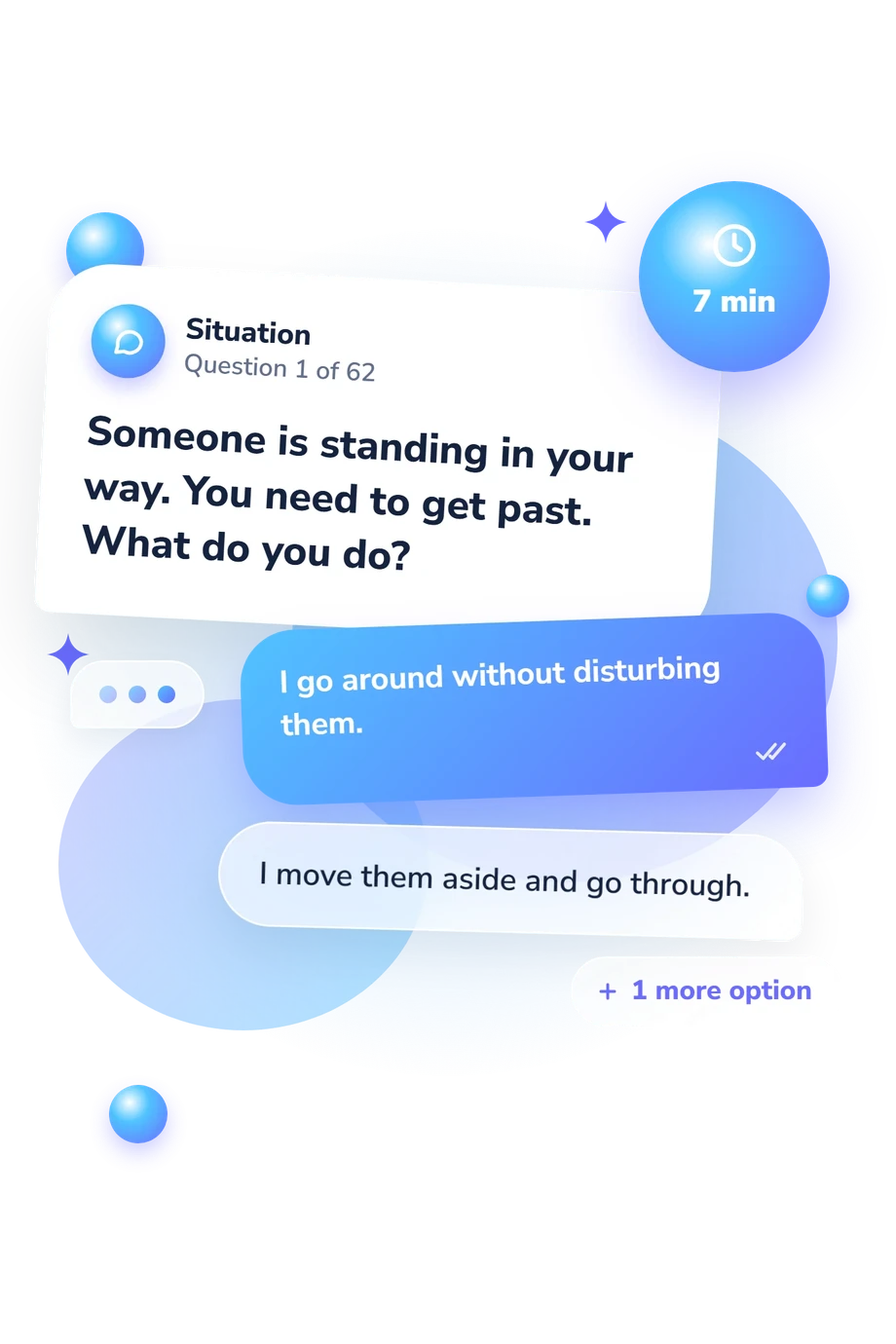
Example Questions From the Test
- Go around without disturbing them.
- Move them aside and go through.
- It depends on my mood.
- Nothing—it's not my concern.
- I do not know; it depends on how things turn out.
- I would go over and start talking to her.
- I hurry to school (work).
- If I am asked for help, I will not refuse.
- I call 112 and stop passersby.
Interactive Orientation of Personality Assessment Test - Description and methodology of the test
People considering how their everyday choices affect belonging, responsibility, or independence may find this assessment useful. The Interactive Orientation of Personality Assessment Test offers a structured self-report profile for noticing patterns that may otherwise remain automatic. This personality orientation assessment can help readers decide which habits deserve closer attention and which choices reflect deliberate priorities.
What This Assessment Measures
Situations involving responsibility, empathy, fairness, values, and pressure show how a person may respond in ordinary social life. This interactive orientation assessment compares immediate reactions with deliberate, socially engaged choices. Results describe an orientation pattern, not a fixed verdict on character.
The profile presents three result dimensions:
- Marginal Orientation (0-31) reflects being guided by circumstances, impulsive action, poor behavioral control, imitation, and infantilism; Low 0-13, Moderate 14-23, High 24-31.
- Cooperation Orientation (0-31) indicates constructive small-group relationships through empathy and shared activity; higher scores are typically associated with optimal socialization and adaptation; Low collaboration focus 0-13, Moderate collaboration focus 14-23, High collaboration focus 24-31.
- Self-Interest Orientation (0-31) shows whether personal well-being and claims dominate interaction, potentially sidelining others’ values and complicating adjustment; Low self-focus 0-13, Moderate self-focus 14-23, High self-focus 24-31.
Methodology and Evidence Base
Situational prompts use response alternatives to represent different ways of acting, reacting, or assigning importance. Selecting the closest alternative makes the questionnaire a situational self-report method focused on ordinary decisions and relationships.
The questionnaire is conceptually consistent with the Interactive Personality Orientation method associated with Shchurkova and the 2002 publication by Fetiskin, but the online version is not thereby established as that instrument, an adaptation, or a validated version. Ptashko, Chernikova, Perebeinos, Sokolova, and Sivrikova (2020) offer contextual evidence about orientation and social engagement, not validation of this questionnaire.
Selected alternatives produce the displayed profile, but no item-by-item key or point allocation is published. The score bands indicate relative tendency; they do not by themselves establish current norms, reliability, or clinical validity. Because the assessment focuses on personality orientation in interaction, this self-report personality assessment is most useful for self-observation: mood, self-presentation, and the imagined situation can influence answers. Treat the result as a snapshot, not a diagnosis or complete account of personality.
- Fetiskin, N. P., Kozlov, V. V., & Manuilov, G. M. (2002). Socio-Psychological Diagnostics of Personality Development and Small Groups: A Study Guide. Moscow: Institute of Psychotherapy. ISBN 5-89939-086-7.
- Ptashko, T. G., Chernikova, E. G., Perebeinos, A. E., Sokolova, N. A., & Sivrikova, N. V. (2020). The Relationship between the Type of Adolescents’ Individual Personality Orientation and Characteristics of Their Social Engagement. Science for Education Today, 10(1), 79-96. 10.15293/2658-6762.2001.05.
- Shchurkova, N. E. (2002). Educational Technology. Moscow: Russian Pedagogical Society. ISBN 5-93134-175-7.
Updated: