
Differential Meaning-in-Life Crisis Questionnaire Test
How the Scales are Structured
Who Usually Takes This Test?
See How You Compare
Below is a preview of how scores are typically distributed across each scale.
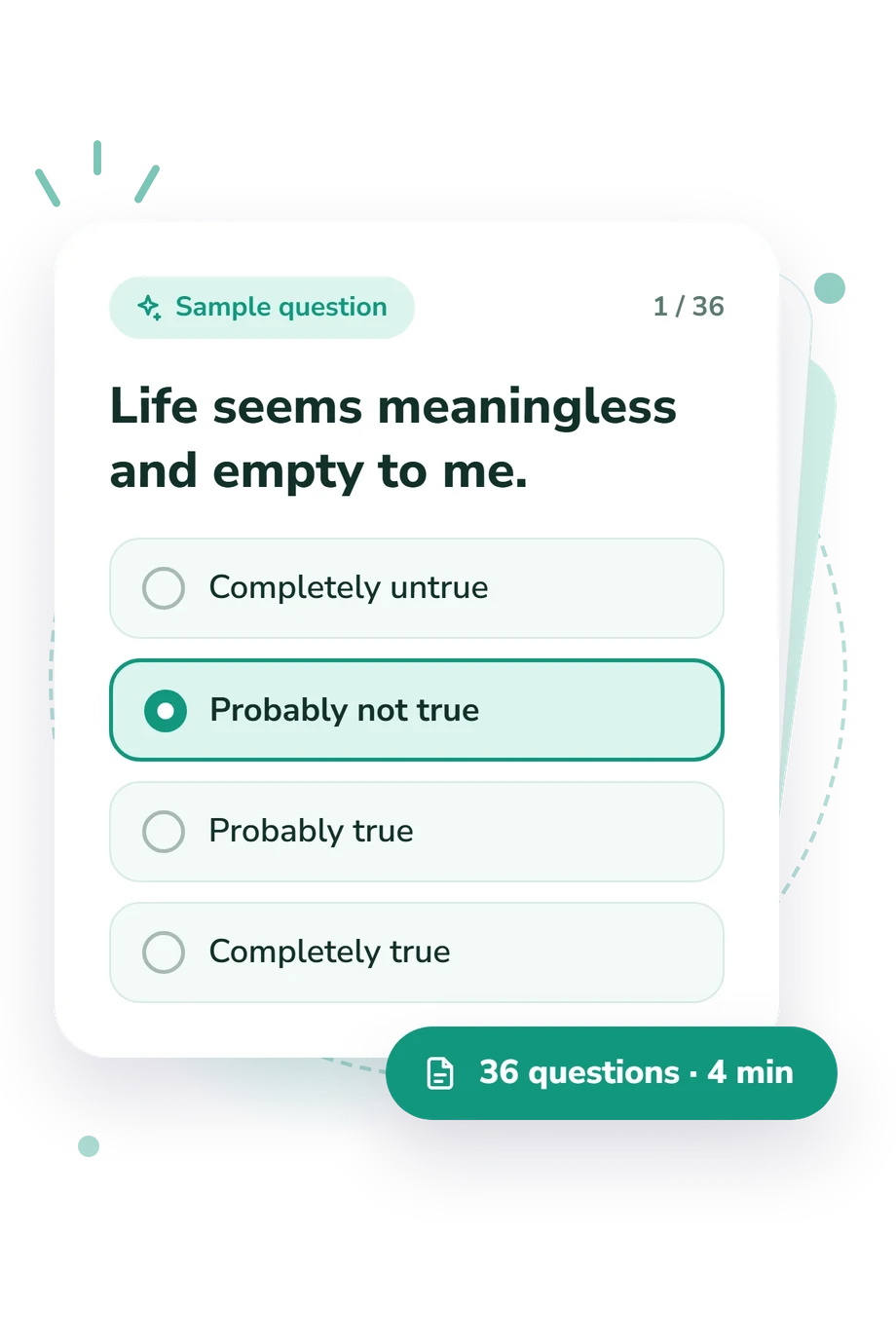
Example Questions From the Test
- Completely untrue
- Probably not true
- Probably true
- Completely true
- Completely untrue
- Probably not true
- Probably true
- Completely true
- Completely untrue
- Mostly untrue
- Mostly true
- Completely true
Differential Meaning-in-Life Crisis Questionnaire Test - Description and methodology of the test
People reconsidering their direction, values, or goals may use this meaning in life crisis assessment when they want a clearer structure for personal reflection. The Differential Meaning-in-Life Crisis Questionnaire Test separates several forms of meaning-related strain instead of reducing them to one general feeling. Its profile can help a respondent decide which aspect of their current experience deserves closer attention.
What This Assessment Explores
Meaning-related crisis can appear when a person cannot identify what matters, loses a former direction, or cannot turn a valued purpose into action. For someone seeking a differentiated profile of meaning in life difficulties, the questionnaire organizes current concerns involving goals, values, and fulfillment. It describes patterns without prescribing what anyone should value.
The displayed profile contains four result dimensions:
- Unrealized Potential Crisis (6-24) reflects dissatisfaction when meaningful goals remain unrealized; Low 6-17, High 18-24.
- Meaning Loss Crisis (6-24) reflects difficulty preserving meaning during adversity; Low 6-15, High 16-24.
- Meaninglessness Crisis (6-24) reflects difficulty defining personal meaning and inner emptiness; Low 6-13, High 14-24.
- Overall Meaning-in-Life Crisis Level (18-72) integrates absence, loss, and nonrealization of meaning; Low 18-30, Moderate 31-44, High 45-72.
Methodology and Evidence Base
Each statement asks about meaning, values, goals, effort, or emotion. Four ordered response options run from completely untrue or false to completely true, creating a graded self-report format.
The three dimensions yield subscale scores alongside an overall index. Higher scores indicate greater difficulty in the direction defined by each scale; the displayed bands organize results without implying a point-by-point rule.
Its conceptual anchor is the Differential Meaning-in-Life Crisis Questionnaire (Karpinskii, 2008). Karpinskii’s meaning in life crisis framework distinguishes meaning-seeking, meaning-saving, and meaning-realization tasks: finding, maintaining, and enacting meaning. This online version is conceptually consistent with that work, not a direct reproduction of the published instrument or transfer of its validation. Karpinskii’s later research connects crisis states with difficulty solving these tasks and realizing purpose.
The displayed thresholds help organize a personal profile, but this online form has no documented population norms or independent standardization. Scores are context-sensitive self-report indicators: current stress, self-awareness, and response style can influence them, so the profile should be considered with the person’s circumstances rather than treated as a stand-alone diagnosis.
- Karpinskii, K. V. (2008). Life Meaning Crisis Questionnaire: Monograph. Grodno: Publishing House of GrGU. 108 pp. (In Russian.)
- Karpinskii, K. V. (2012). Life Meaning and Resources for Its Realization: Towards Understanding of Personality Crisis Mechanisms. Psychology. Journal of the Higher School of Economics, 9(4), 3-33.
- Karpinskii, K. V. (2019). Meaning-in-Life State as an Indicator of the Personality Agentive Development. Vestnik of Saint Petersburg University. Psychology, 9(1), 7-20. 10.21638/11701/spbu16.2019.101
Updated: