
Freudly+971 508685814hello@freudly.ai
Freudly
values

Rokeach Value Survey (RVS) Test
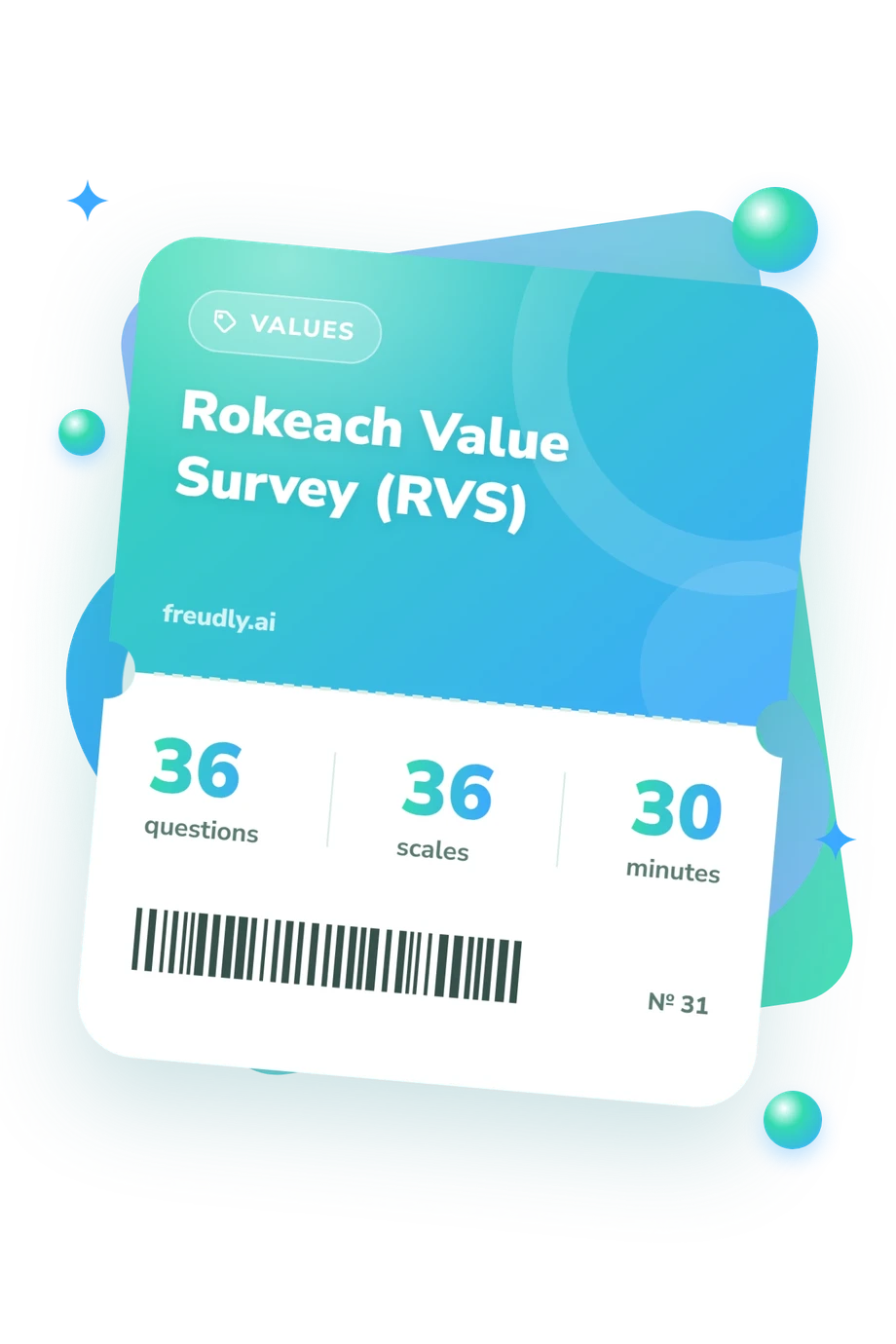
Take the online Rokeach Value Survey (RVS) Test - AI psychologist FreudlyYou can take Rokeach Value Survey (RVS) Testhere. Online version of a simple and accurate psychological test with interpretation.en
Understand what matters most to you and how it shapes your choices in about 30 minutes. This 36 item ranking gives clear insights to align goals, relationships, and motivation.
Start Online Test
Questions: 3630 minutes
08:30
July 14, 2025
July 14, 2025
Material has been updated
July 14, 2025
Material has been published
16,953 views
2,254 completions
999 likes
Verified by Daniel Hall
Psychologist with 25 years of experience
Share
Scale Explorer

How the Scales are Structured

example score
14/18
An Active, Eventful Life (A Full and Emotionally Rich Life) (AAELFaERL)
Measures how highly you prioritize a full, emotionally rich, and active life as a core life goal.
Lower priority
Moderate priority
High priority
16: Lower priority | 712: Moderate priority | 1318: High priority
A score of 14 falls in the High priority range, suggesting you place strong importance on pursuing an active, purposeful, and emotionally rich life.
example score
6/18
Wisdom (W)
Measures how highly you prioritize life wisdom as a guiding end value, reflecting mature judgment and common sense gained through experience.
High priority
Moderate priority
Lower priority
16: High priority | 712: Moderate priority | 1318: Lower priority
A score of 6 indicates life wisdom is a high-priority terminal value for you relative to the other values you ranked.
example score
9/18
Health (Physical and Mental) (HaM)
Measures the relative priority you assign to maintaining physical and mental health as a terminal life value.
High priority
Moderate priority
Lower priority
16: High priority | 712: Moderate priority | 1318: Lower priority
A score of 9 falls in the Moderate priority range, suggesting health is an important value for you but not among your very top-ranked priorities.
example score
4/18
Interesting Work (IW)
Measures how highly you prioritize having interesting work as a life goal relative to other terminal values.
High priority
Moderate priority
Lower priority
16: High priority | 712: Moderate priority | 1318: Lower priority
A score of 4 indicates that interesting work is a high-priority terminal value for you compared with many of the other values in the list.
example score
13/18
Beauty of Nature and Art (BoNaA)
Measures how strongly a person prioritizes experiencing and appreciating beauty and the sublime in nature and art as a life goal.
Lower priority
Moderate priority
Higher priority
16: Lower priority | 712: Moderate priority | 1318: Higher priority
A score of 13 indicates you place a higher priority on seeking and valuing experiences of beauty in nature and art compared with many other goals.
example score
12/18
Love (Spiritual And Physical Intimacy With A Loved One) (LAPIWALO)
Measures the relative importance you place on love as a terminal value, emphasizing spiritual and physical intimacy with a loved one.
High priority
Moderate priority
Lower priority
16: High priority | 712: Moderate priority | 1318: Lower priority
A score of 12 indicates that love is a moderately high priority for you compared with other values in the survey.
example score
6/18
A Comfortable Life (Financial Security) (ACLS)
Measures how highly a financially secure life (freedom from financial difficulties) is prioritized among terminal values.
High priority
Moderate priority
Lower priority
16: High priority | 712: Moderate priority | 1318: Lower priority
A score of 6 indicates that financial security is a high-priority terminal value compared with many other values in the ranking.
example score
11/18
True Friendship (TF)
Measures how highly you prioritize having good and loyal friends as a life goal.
High priority
Moderate priority
Lower priority
16: High priority | 712: Moderate priority | 1318: Lower priority
A score of 11 falls in the Moderate priority range, suggesting this value is important but not among your very top-ranked life goals.
example score
4/18
Social Recognition (Respect from Others, the Group, and Colleagues) (SRfOtGaC)
Measures how highly you prioritize gaining respect and recognition from others (team, coworkers) as a life goal.
High priority
Moderate priority
Lower priority
16: High priority | 712: Moderate priority | 1318: Lower priority
A score of 4 indicates that social calling and earning respect from others is a high-priority terminal value for you relative to other values.
example score
11/18
Knowledge (K)
Measures how strongly a person prioritizes cognition as a terminal value, emphasizing learning, broadening horizons, and intellectual development.
High priority
Moderate priority
Low priority
16: High priority | 712: Moderate priority | 1318: Low priority
A score of 11 falls in the Moderate priority range, suggesting cognition is important but not among the top-ranked terminal values.
example score
11/18
A Sense of Accomplishment (A Lasting Contribution) (ASoALC)
Measures how highly you prioritize a productive life—using your potential, energy, and abilities to the fullest—as a life goal.
Lower priority
Moderate priority
High priority
16: Lower priority | 712: Moderate priority | 1318: High priority
A score of 11 indicates a moderate priority on living productively, suggesting it is important but not among your top-ranked terminal values.
example score
7/18
Self-Development (Self-Improvement, Ongoing Physical and Spiritual Growth) (SDIOPaSG)
Measures the priority you place on personal development through ongoing self-work and physical and spiritual improvement.
High priority
Moderate priority
Lower priority
16: High priority | 712: Moderate priority | 1318: Lower priority
A score of 7 falls in the Moderate priority range, suggesting development is important to you but not among your very top-ranked terminal values.
example score
9/18
Leisure (Pleasant, Unburdened Time; Absence of Obligations) (LUTAoO)
Measures how highly a person prioritizes entertainment as a terminal value—seeking pleasant, effortless leisure and minimal obligations.
High priority
Moderate priority
Low priority
16: High priority | 712: Moderate priority | 1318: Low priority
A rank of 9 indicates a moderate priority on entertainment, suggesting it is valued but typically balanced with other life goals.
example score
11/18
Freedom (Independence in Thought and Action) (FiTaA)
Measures how highly a person prioritizes freedom as a terminal life value, emphasizing autonomy and independent judgment.
Lower priority
Moderate priority
Higher priority
16: Lower priority | 712: Moderate priority | 1318: Higher priority
A score of 11 suggests freedom is a moderately important value for you, generally valued but not consistently ranked among your top priorities.
example score
13/18
Happy Family Life (HFL)
Measures the importance you place on achieving a stable, harmonious family life as a core life goal.
Lower priority
Moderate priority
High priority
16: Lower priority | 712: Moderate priority | 1318: High priority
A score of 13 indicates that happy family life is a high-priority terminal value for you relative to many other values in the list.
example score
8/18
Happiness of Others (HoO)
Measures how highly you prioritize the happiness and well-being of other people and humanity as a terminal life value.
High priority
Moderate priority
Lower priority
16: High priority | 712: Moderate priority | 1318: Lower priority
A score of 8 falls in the Moderate priority range, suggesting you value others’ well-being as important but not among your very highest-ranked life goals.
example score
4/18
Creativity (Opportunity for Creative Activity) (CfCA)
Measures how highly you prioritize creativity and opportunities for creative activity among your terminal values.
High priority
Moderate priority
Lower priority
16: High priority | 712: Moderate priority | 1318: Lower priority
A score of 4 places creativity in the High priority range, suggesting it ranks among your more important terminal values compared with many others on the list.
example score
11/18
Self-Confidence (SC)
Measures how strongly self-confidence and inner harmony are prioritized as life goals, reflecting freedom from internal conflict and doubts.
Lower priority
Moderate priority
Higher priority
16: Lower priority | 712: Moderate priority | 1318: Higher priority
A score of 11 falls in the Moderate priority range, suggesting self-confidence and inner harmony are important but not among your very top-ranked values.
example score
9/18
Cleanliness and Orderliness (CaO)
Measures how strongly tidiness and organization are prioritized as an instrumental value in daily tasks and life choices.
Lower priority
Moderate priority
High priority
16: Lower priority | 712: Moderate priority | 1318: High priority
A score of 9 falls in the Moderate priority range, suggesting tidiness is valued and applied at times but is not a dominant guiding principle.
example score
13/18
Politeness (Good Manners) (PM)
Measures how highly you prioritize polite, courteous behavior and adherence to good manners as a guiding principle in everyday interactions.
Lower priority
Moderate priority
Higher priority
16: Lower priority | 712: Moderate priority | 1318: Higher priority
A score of 13 falls in the Higher priority range, suggesting good manners and politeness are a comparatively important instrumental value for you.
example score
6/18
High Aspirations (HA)
Measures how strongly a person prioritizes maintaining high standards and demanding a lot from life as an instrumental value.
Lower priority
Moderate priority
High priority
16: Lower priority | 712: Moderate priority | 1318: High priority
A score of 6 indicates that high life standards and strong demands are a lower-priority guiding value relative to other instrumental values.
example score
11/18
Cheerfulness (Sense of Humor) (CoH)
Measures how strongly a sense of humor and cheerful outlook guides your everyday behavior as an instrumental value.
Lower priority
Moderate priority
Higher priority
16: Lower priority | 712: Moderate priority | 1318: Higher priority
A score of 11 suggests cheerfulness and humor are a moderate priority for you, valued in some situations but not consistently central in your approach.
example score
4/18
Obedience (Discipline) (O)
This scale reflects how strongly a person prioritizes discipline and dutiful follow-through as an instrumental value in daily behavior.
Lower priority
Moderate priority
Higher priority
16: Lower priority | 712: Moderate priority | 1318: Higher priority
A score of 4 falls in the Lower priority range, suggesting discipline is less central among your ranked instrumental values compared with other guiding principles.
example score
10/18
Independence (I)
Measures how strongly independence is prioritized as a guiding way of acting, emphasizing self-directed and decisive behavior.
Lower priority
Moderate priority
Higher priority
16: Lower priority | 712: Moderate priority | 1318: Higher priority
A score of 10 suggests independence is a moderately prioritized instrumental value, with some preference for acting decisively on one’s own while still balancing other values.
example score
5/18
Intransigence Toward Faults in Self and Others (ITFiSaO)
Measures how strongly a person tends to be critical and unforgiving of imperfections in themselves and others as a guiding behavioral value.
More accepting
Balanced
More demanding
16: More accepting | 712: Balanced | 1318: More demanding
A score of 5 falls in the More accepting range, suggesting a relatively tolerant stance toward mistakes and imperfections in yourself and other people.
example score
9/18
Educated (Broad Knowledge, High General Culture) (EKHGC)
Measures how highly you prioritize education, broad knowledge, and general culture as a guiding personal value.
High priority
Moderate priority
Lower priority
16: High priority | 712: Moderate priority | 1318: Lower priority
A score of 9 falls in the Moderate priority range, suggesting education and broad cultural knowledge are valued but not among your very top guiding priorities.
example score
9/18
Responsibility (R)
Measures how strongly responsibility (sense of duty and keeping one's word) is prioritized among instrumental values.
High priority
Moderate priority
Low priority
16: High priority | 712: Moderate priority | 1318: Low priority
A score of 9 indicates responsibility is a moderate priority in your value ranking relative to the other listed values.
example score
9/18
Rationalism (R)
Measures how strongly a person prioritizes clear, logical thinking and deliberate, rational decision-making as an instrumental value.
Lower priority
Moderate priority
Higher priority
16: Lower priority | 712: Moderate priority | 1318: Higher priority
A score of 9 indicates a moderate prioritization of rationalism, suggesting a balanced preference for logical, considered decisions without it being a dominant guiding value.
example score
7/18
Self-Control (Restraint, Self-Discipline) (SCSD)
Measures how strongly self-control and self-discipline are prioritized as an instrumental value in guiding behavior.
Lower priority
Moderate priority
Higher priority
16: Lower priority | 712: Moderate priority | 1318: Higher priority
A score of 7 falls in the Moderate priority range, suggesting self-control is a valued guideline at times but is not consistently ranked among the top guiding principles.
example score
10/18
Courage in Defending One's Opinions and Views (CiDOOaV)
Measures how highly you prioritize courage to defend your opinions and beliefs as a guiding personal value.
Lower priority
Moderate priority
Higher priority
16: Lower priority | 712: Moderate priority | 1318: Higher priority
A score of 10 suggests this value is of moderate importance for you compared with other instrumental values in the ranking.
example score
10/18
Strong Will (Ability to Stand One's Ground, Not Back Down from Difficulties) (SWtSOGNBDfD)
Measures how highly you rank strong will as a preferred way of acting, reflecting persistence and resolve in the face of difficulties.
High priority
Moderate priority
Lower priority
16: High priority | 712: Moderate priority | 1318: Lower priority
A score of 10 falls in the Moderate priority range, suggesting strong will is a valued quality for you but not among your very top-ranked guiding principles.
example score
14/18
Tolerance (T)
Measures the importance you place on being tolerant of others’ views and forgiving their mistakes or misconceptions.
Lower priority
Moderate priority
Higher priority
16: Lower priority | 712: Moderate priority | 1318: Higher priority
A score of 14 falls in the Higher priority range, suggesting tolerance and forgiveness are relatively important instrumental values for you compared with other values in the list.
example score
6/18
Broad-Mindedness (BM)
Measures how strongly you prioritize being open-minded, including understanding others’ viewpoints and respecting different preferences and customs.
High priority
Moderate priority
Lower priority
16: High priority | 712: Moderate priority | 1318: Lower priority
A score of 6 suggests open-mindedness is a high-priority instrumental value for you compared with many other values in the list.
example score
7/18
Honesty (Truthfulness, Sincerity) (HS)
Measures the priority you place on honesty, truthfulness, and sincerity as a guiding way of acting.
High priority
Moderate priority
Lower priority
16: High priority | 712: Moderate priority | 1318: Lower priority
A score of 7 falls in the Moderate priority range, suggesting honesty is generally important but not among your very top-ranked instrumental values.
example score
9/18
Effectiveness in Work (Industriousness, Work Productivity) (EiWWP)
Measures how strongly diligence and productivity in completing tasks are prioritized as an instrumental value.
High priority
Moderate priority
Low priority
16: High priority | 712: Moderate priority | 1318: Low priority
A score of 9 falls in the Moderate priority range, suggesting effectiveness in tasks is an important value but not among your top-ranked guiding principles.
example score
11/18
Helpfulness (Caring) (H)
Measures the priority you place on caring, compassion, and responsiveness to others as an instrumental value.
High priority
Moderate priority
Lower priority
16: High priority | 712: Moderate priority | 1318: Lower priority
A score of 11 falls in the Moderate priority range, suggesting caring is a valued guideline for behavior but is balanced with other instrumental values.
Start Online Test
just completed the test
DATA-BASED USER COHORTS

Who Usually Takes This Test?

Personal growth seekers
41%OF USERS
People who want to clarify what matters most to them to guide decisions, goals, and life direction.
Students in psychology courses
34%OF USERS
Students using a well-known values ranking exercise to learn about motivation, worldview, and assessment methods.
Career and relationship reflectors
25%OF USERS
People reassessing work fit or relationship priorities who want to compare their values with expectations and choices.
BASED ON AGGREGATED, ANONYMIZED DATA FROM TENS OF THOUSANDS OF FREUDLY USERS.
Benchmarking

See How You Compare

Once you complete the test, your results are compared with real-world data from people in your country.
Below is a preview of how scores are typically distributed across each scale.
An active, purposeful life (fullness and emotional richness of life) (Aapl(aerol)
Average
8.9
Normal range
5.811.9
min.
1
max.
18
This curve shows how scores are typically distributed.
Once you complete the test, your result will appear on the scale so you can see how you compare.
Life wisdom (maturity of judgment and common sense gained through life experience) (Lw(ojacsgtle)
Average
9.5
Normal range
6.712.2
min.
1
max.
18
This curve shows how scores are typically distributed.
Once you complete the test, your result will appear on the scale so you can see how you compare.
Health (physical and mental) (H(am)
Average
11.8
Normal range
8.914.7
min.
1
max.
18
This curve shows how scores are typically distributed.
Once you complete the test, your result will appear on the scale so you can see how you compare.
Interesting work (Iw)
Average
12.1
Normal range
9.214.9
min.
1
max.
18
This curve shows how scores are typically distributed.
Once you complete the test, your result will appear on the scale so you can see how you compare.
The Beauty of Nature and Art (Experiencing the Sublime in Nature and Art) (TBoNaA(tSiNaA)
Average
11.1
Normal range
8.313.9
min.
1
max.
18
This curve shows how scores are typically distributed.
Once you complete the test, your result will appear on the scale so you can see how you compare.
Love (spiritual and physical intimacy with a loved one) (L(apiwalo)
Average
10.5
Normal range
7.713.4
min.
1
max.
18
This curve shows how scores are typically distributed.
Once you complete the test, your result will appear on the scale so you can see how you compare.
Financially Secure Life (absence of financial difficulties) (FSL(ofd)
Average
11.1
Normal range
8.913.2
min.
1
max.
18
This curve shows how scores are typically distributed.
Once you complete the test, your result will appear on the scale so you can see how you compare.
Having good and loyal friends (Hgalf)
Average
10.2
Normal range
7.313.1
min.
1
max.
18
This curve shows how scores are typically distributed.
Once you complete the test, your result will appear on the scale so you can see how you compare.
Social calling (respect from others, the team, coworkers) (Sc(fottc)
Average
11.8
Normal range
9.514
min.
1
max.
18
This curve shows how scores are typically distributed.
Once you complete the test, your result will appear on the scale so you can see how you compare.
Cognition (the opportunity to expand one’s education, horizons, general culture, intellectual development) (C(oteoehgcid)
Average
10
Normal range
713.1
min.
1
max.
18
This curve shows how scores are typically distributed.
Once you complete the test, your result will appear on the scale so you can see how you compare.
Productive life (making the fullest possible use of one's potential, energy, and abilities) (Pl(tfpuoopeaa)
Average
10.1
Normal range
8.112.2
min.
1
max.
18
This curve shows how scores are typically distributed.
Once you complete the test, your result will appear on the scale so you can see how you compare.
Development (self-work, continuous physical and spiritual improvement) (D(cpasi)
Average
11.2
Normal range
8.913.4
min.
1
max.
18
This curve shows how scores are typically distributed.
Once you complete the test, your result will appear on the scale so you can see how you compare.
Entertainment (pleasant, effortless pastime, absence of obligations) (E(epaoo)
Average
10.9
Normal range
7.914
min.
1
max.
18
This curve shows how scores are typically distributed.
Once you complete the test, your result will appear on the scale so you can see how you compare.
Freedom (autonomy, independence in judgments and actions) (F(iijaa)
Average
8
Normal range
4.911.1
min.
1
max.
18
This curve shows how scores are typically distributed.
Once you complete the test, your result will appear on the scale so you can see how you compare.
Happy Family Life (HFL)
Average
13.4
Normal range
10.316.5
min.
1
max.
18
This curve shows how scores are typically distributed.
Once you complete the test, your result will appear on the scale so you can see how you compare.
The happiness of others (the well-being, development, and improvement of other people, the entire nation, and humanity as a whole) (Thoo(wdaiooptenahaaw)
Average
5.3
Normal range
3.27.5
min.
1
max.
18
This curve shows how scores are typically distributed.
Once you complete the test, your result will appear on the scale so you can see how you compare.
Creativity (the possibility of creative activity) (C(poca)
Average
6.2
Normal range
48.4
min.
1
max.
18
This curve shows how scores are typically distributed.
Once you complete the test, your result will appear on the scale so you can see how you compare.
Self-confidence (inner harmony, freedom from internal conflicts, doubts) (S(hfficd)
Average
10.5
Normal range
7.913.1
min.
1
max.
18
This curve shows how scores are typically distributed.
Once you complete the test, your result will appear on the scale so you can see how you compare.
Tidiness (neatness), the ability to keep things in order, being organized in tasks (T(tatktioboit)
Average
8.7
Normal range
6.211.2
min.
1
max.
18
This curve shows how scores are typically distributed.
Once you complete the test, your result will appear on the scale so you can see how you compare.
Politeness (Good Manners) (P(M)
Average
11.1
Normal range
8.513.7
min.
1
max.
18
This curve shows how scores are typically distributed.
Once you complete the test, your result will appear on the scale so you can see how you compare.
High Expectations (High Life Standards and High Demands) (HE(LSaHD)
Average
12.5
Normal range
9.815.1
min.
1
max.
18
This curve shows how scores are typically distributed.
Once you complete the test, your result will appear on the scale so you can see how you compare.
Cheerfulness (sense of humor) (C(oh)
Average
11.8
Normal range
9.614.1
min.
1
max.
18
This curve shows how scores are typically distributed.
Once you complete the test, your result will appear on the scale so you can see how you compare.
Conscientiousness (discipline) (C()
Average
13.2
Normal range
11.115.3
min.
1
max.
18
This curve shows how scores are typically distributed.
Once you complete the test, your result will appear on the scale so you can see how you compare.
Independence (the ability to act on one's own, decisively) (I(ataoood)
Average
8.9
Normal range
6.411.4
min.
1
max.
18
This curve shows how scores are typically distributed.
Once you complete the test, your result will appear on the scale so you can see how you compare.
Intolerance of flaws in oneself and others (Iofioao)
Average
12.5
Normal range
9.815.3
min.
1
max.
18
This curve shows how scores are typically distributed.
Once you complete the test, your result will appear on the scale so you can see how you compare.
Education (breadth of knowledge, high general culture) (E(okhgc)
Average
7.4
Normal range
5.39.5
min.
1
max.
18
This curve shows how scores are typically distributed.
Once you complete the test, your result will appear on the scale so you can see how you compare.
Responsibility (sense of duty, ability to keep one's word) (R(odatkow)
Average
13.7
Normal range
11.316.1
min.
1
max.
18
This curve shows how scores are typically distributed.
Once you complete the test, your result will appear on the scale so you can see how you compare.
Rationalism (the ability to think clearly and logically, to make considered, rational decisions) (R(attcaltmcrd)
Average
8
Normal range
5.410.5
min.
1
max.
18
This curve shows how scores are typically distributed.
Once you complete the test, your result will appear on the scale so you can see how you compare.
Self-control (restraint, self-discipline) (S(s)
Average
5.6
Normal range
2.88.5
min.
1
max.
18
This curve shows how scores are typically distributed.
Once you complete the test, your result will appear on the scale so you can see how you compare.
Courage in standing up for your opinions and beliefs (Cisufyoab)
Average
10.1
Normal range
6.913.2
min.
1
max.
18
This curve shows how scores are typically distributed.
Once you complete the test, your result will appear on the scale so you can see how you compare.
Strong will (the ability to stand your ground, not to back down in the face of difficulties) (Sw(atsygntbditfod)
Average
10.7
Normal range
7.813.6
min.
1
max.
18
This curve shows how scores are typically distributed.
Once you complete the test, your result will appear on the scale so you can see how you compare.
Tolerance (towards others' views and opinions, the ability to forgive others for their mistakes and misconceptions) (T(ovaotatfoftmam)
Average
12.1
Normal range
915.2
min.
1
max.
18
This curve shows how scores are typically distributed.
Once you complete the test, your result will appear on the scale so you can see how you compare.
Open-mindedness (the ability to understand another's point of view, respect different tastes, customs, and habits) (O(atuapovrdtcah)
Average
11.4
Normal range
8.814.1
min.
1
max.
18
This curve shows how scores are typically distributed.
Once you complete the test, your result will appear on the scale so you can see how you compare.
Honesty (truthfulness, sincerity) (H(s)
Average
8.2
Normal range
5.910.5
min.
1
max.
18
This curve shows how scores are typically distributed.
Once you complete the test, your result will appear on the scale so you can see how you compare.
Effectiveness in tasks (diligence, productivity at work) (Eit(paw)
Average
8.9
Normal range
6.611.1
min.
1
max.
18
This curve shows how scores are typically distributed.
Once you complete the test, your result will appear on the scale so you can see how you compare.
Sensitivity (Caring) (S()
Average
10.6
Normal range
7.913.3
min.
1
max.
18
This curve shows how scores are typically distributed.
Once you complete the test, your result will appear on the scale so you can see how you compare.
Featured On
SAMPLE QUESTIONS

Example Questions From the Test

    • 1
    • 2
    • 3
    • 4
    • 5
    • 6
    • 7
    • 8
    • 9
    • 10
    • 1
    • 2
    • 3
    • 4
    • 5
    • 6
    • 7
    • 8
    • 9
    • 10
    • 1
    • 2
    • 3
    • 4
    • 5
    • 6
    • 7
    • 8
    • 9
    • 10
WHAT THE TEST MEASURES
About This Assessment

Rokeach Value Survey (RVS) Test - Symptoms and Signs

values

This instrument assesses an individual’s value orientations by asking respondents to directly rank a set of values in order of personal importance. The Rokeach Value Survey (RVS) is intended to characterize the relative salience of different values that may inform attitudes, goals, and decision-making.

It consists of 36 items and typically takes about 30 minutes to complete. The measure was developed by Milton Rokeach and is commonly used in research and clinical contexts to describe value priorities rather than to diagnose psychopathology.

Administration and interpretation of the Rokeach Value Survey (RVS) focus on the respondent’s rank-order pattern, including the highest- and lowest-priority values and any clinically relevant themes or inconsistencies. Results are generally interpreted descriptively within the individual’s cultural and contextual background and alongside other assessment data.

Author: Milton Rokeach
Popular tests
Comments
Leave a Comment