
Freudly+971 508685814hello@freudly.ai
Freudly
social trust

Personal Trust/Distrust in the World, Self, and Others Scale Test
Take the online Personal Trust/Distrust in the World, Self, and Others Scale Test - AI psychologist FreudlyYou can take Personal Trust/Distrust in the World, Self, and Others Scale Testhere. Online version of a simple and accurate psychological test with interpretation.en
See how you place trust in yourself, the world, and other people in just 3 minutes. Get a quick 15 item snapshot that spots trust gaps to guide counseling, coaching, or team support.
Start Online Test
Questions: 153 minutes
08:30
October 2, 2025
October 2, 2025
Material has been updated
October 2, 2025
Material has been published
30,189 views
3,213 completions
2,730 likes
Verified by Daniel Hall
Psychologist with 25 years of experience
Share
Scale Explorer

How the Scales are Structured

example score
9/15
Factor 5 (F5)
Measures the degree to which a person perceives the world and other people as dangerous and responds with distrust and risk avoidance.
Low distrust
Moderate distrust
High distrust
37: Low distrust | 811: Moderate distrust | 1215: High distrust
A score of 9 falls in the Moderate distrust range, suggesting a noticeable but not extreme tendency to view the world and other people as potentially risky or unsafe.
example score
4/15
Factor 4 (F4)
Factor 4 measures confidence in one's ability to evaluate situations and make accurate predictions.
Low confidence
Moderate confidence
High confidence
05: Low confidence | 610: Moderate confidence | 1115: High confidence
A score of 4 suggests relatively low confidence in your judgments and foresight, with a tendency to feel uncertain about evaluations and predictions.
example score
8/15
Factor 3 (F3)
Factor 3 measures trust in others’ willingness and ability to cooperate and provide mutual support.
Low cooperation trust
Moderate cooperation trust
High cooperation trust
05: Low cooperation trust | 610: Moderate cooperation trust | 1115: High cooperation trust
A score of 8 suggests a moderate tendency to view others as generally capable of cooperation and mutual support, with some selectiveness or caution depending on context.
example score
7/15
Factor 2 (F2)
Measures the degree to which a person tends to distrust the world and other people as irresponsible or unjust.
Low distrust
Moderate distrust
High distrust
05: Low distrust | 610: Moderate distrust | 1115: High distrust
A score of 7 falls in the Moderate distrust range, suggesting some caution and skepticism in social interactions without a consistently suspicious stance.
example score
12/15
Factor 1 (F1)
Measures self-confidence in one’s ability to build and maintain relationships with the world and other people.
Low confidence
Moderate confidence
High confidence
05: Low confidence | 610: Moderate confidence | 1115: High confidence
A score of 12 suggests strong self-assurance and well-developed social skills for engaging with others and the surrounding world.
example score
17/30
Trust in the World and Others (TitWaO)
Measures overall trust in the surrounding world and in other people as part of that world.
Low trust
Moderate trust
High trust
613: Low trust | 1422: Moderate trust | 2330: High trust
A score of 17 indicates a moderate level of trust, suggesting a generally balanced view that includes both openness to people/the world and some caution.
example score
12/15
Trust in Others (TiO)
Measures the tendency to trust other people and expect honesty and support from them.
Wary
Selective trust
Trusting
37: Wary | 811: Selective trust | 1215: Trusting
A score of 12 suggests a generally trusting stance toward others, with an expectation of goodwill and reliability in relationships.
example score
18/30
Self-Trust (ST)
Measures confidence in one’s own abilities and reliability when dealing with the world and other people.
Low self-trust
Moderate self-trust
High self-trust
613: Low self-trust | 1422: Moderate self-trust | 2330: High self-trust
A score of 18 indicates moderate self-trust, suggesting generally adequate confidence with some situational doubts about personal capabilities.
example score
26/75
Overall Trust/Distrust Score (OTS)
Measures the person’s overall tendency to trust versus distrust themselves, other people, and the world.
Low trust
Moderate trust
High trust
1534: Low trust | 3554: Moderate trust | 5575: High trust
A score of 26 falls in the Low trust range, suggesting a generally cautious or distrustful stance across self, others, and the broader world.
Start Online Test
just completed the test
DATA-BASED USER COHORTS

Who Usually Takes This Test?

Self-doubt and anxiety
41%OF USERS
People feeling insecure or anxious take it to see whether their main trust gap is in themselves, other people, or the world in general.
Relationship trust issues
34%OF USERS
Those dealing with jealousy, betrayal, or difficulty opening up use it to understand how their trust in specific people differs from overall trust in others and the world.
Coaches and counselors
25%OF USERS
Practitioners use it as a quick check to pinpoint where trust breaks down so they can choose more targeted support strategies.
BASED ON AGGREGATED, ANONYMIZED DATA FROM TENS OF THOUSANDS OF FREUDLY USERS.
Benchmarking

See How You Compare

Once you complete the test, your results are compared with real-world data from people in your country.
Below is a preview of how scores are typically distributed across each scale.
Factor 5 (F5)
Factor 5 (F5)
Average
7.4
Normal range
5.29.5
min.
3
max.
15
This curve shows how scores are typically distributed.
Once you complete the test, your result will appear on the scale so you can see how you compare.
Factor 4 (F4)
Factor 4 (F4)
Average
6.2
Normal range
4.18.4
min.
0
max.
15
This curve shows how scores are typically distributed.
Once you complete the test, your result will appear on the scale so you can see how you compare.
Factor 3 (F3)
Factor 3 (F3)
Average
7.2
Normal range
4.49.9
min.
0
max.
15
This curve shows how scores are typically distributed.
Once you complete the test, your result will appear on the scale so you can see how you compare.
Factor 2 (F2)
Factor 2 (F2)
Average
9.5
Normal range
6.912
min.
0
max.
15
This curve shows how scores are typically distributed.
Once you complete the test, your result will appear on the scale so you can see how you compare.
Factor 1 (F1)
Factor 1 (F1)
Average
7.9
Normal range
69.7
min.
0
max.
15
This curve shows how scores are typically distributed.
Once you complete the test, your result will appear on the scale so you can see how you compare.
Trust in the world and others (Titwao)
Average
14.9
Normal range
10.919
min.
6
max.
30
This curve shows how scores are typically distributed.
Once you complete the test, your result will appear on the scale so you can see how you compare.
Trusting Others (TO)
Average
6.2
Normal range
48.3
min.
3
max.
15
This curve shows how scores are typically distributed.
Once you complete the test, your result will appear on the scale so you can see how you compare.
Trusting Yourself (TY)
Average
14.8
Normal range
1118.6
min.
6
max.
30
This curve shows how scores are typically distributed.
Once you complete the test, your result will appear on the scale so you can see how you compare.
Overall trust/distrust score (Ots)
Average
44
Normal range
35.652.4
min.
15
max.
75
This curve shows how scores are typically distributed.
Once you complete the test, your result will appear on the scale so you can see how you compare.
Featured On
SAMPLE QUESTIONS

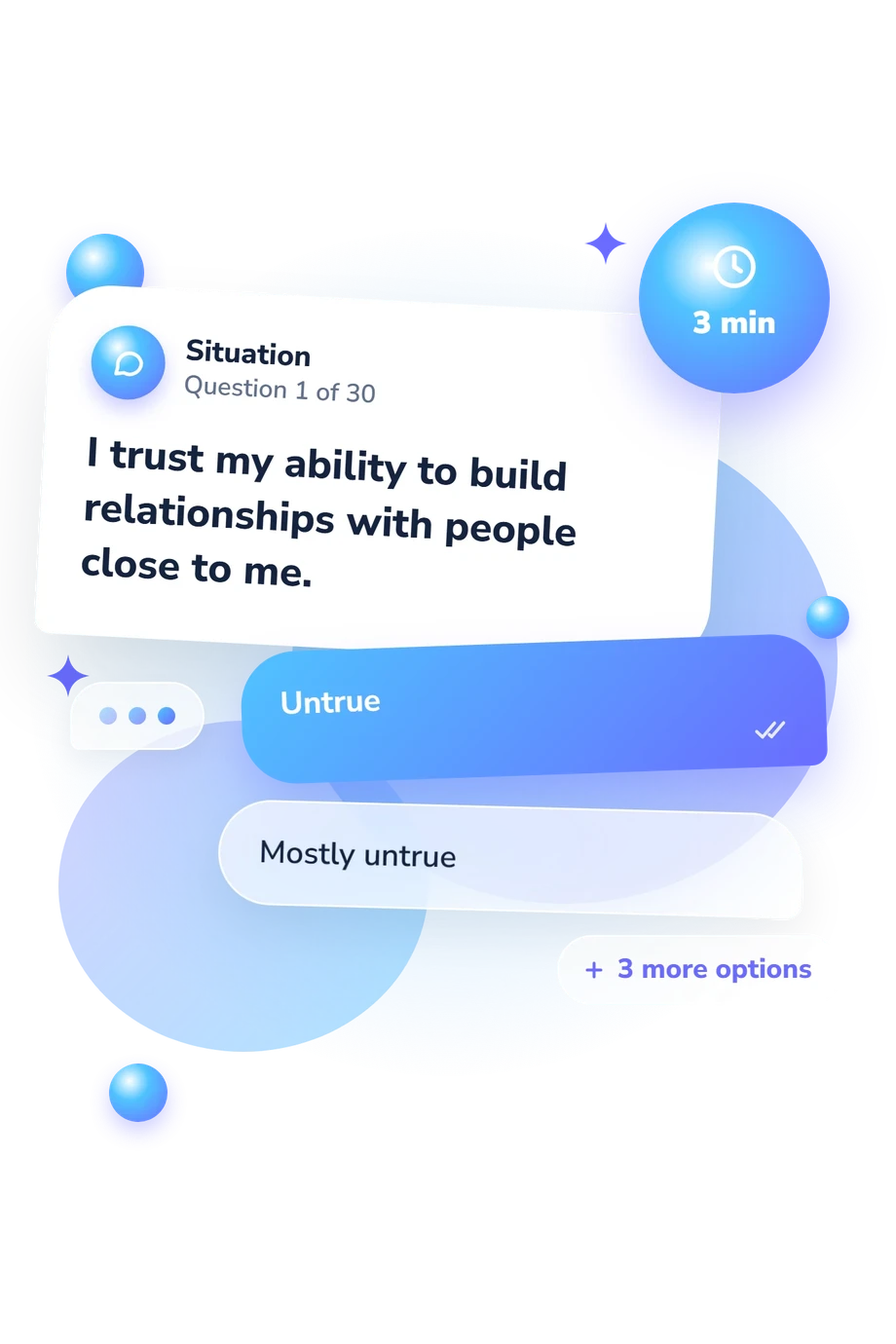
Example Questions From the Test

    • Untrue
    • Rather untrue
    • Partly untrue
    • Rather true
    • True
    • Untrue
    • Mostly untrue
    • Partly untrue
    • Mostly true
    • True
    • Untrue
    • Mostly untrue
    • Partly untrue
    • Mostly true
    • True
WHAT THE TEST MEASURES
About This Assessment
Trust/Distrust of the individual toward the world, oneself, and others Test

Personal Trust/Distrust in the World, Self, and Others Scale Test - Symptoms and Signs

social trust
social attitudes

This brief self-report measure assesses perceived trust and distrust directed toward the world, the self, and other people. The Personal Trust/Distrust in the World, Self, and Others Scale is intended to provide a concise profile of how an individual distributes trust across these domains.

It consists of 15 items and typically takes about 3 minutes to complete. Responses may be used to inform clinical case formulation by identifying relative strengths and vulnerabilities in self-reliance, general expectations about the world, and interpersonal trust.

The Personal Trust/Distrust in the World, Self, and Others Scale is attributed to Julian B. Rotter and is generally interpreted at the domain level, with attention to similarities or discrepancies across the three areas. Results should be considered in the context of the referral question and other assessment data.

Author: Julian B. Rotter
Literature: Rotter, J. B. A new scale for the measurement of interpersonal trust. Journal of Personality. 1967.
Popular tests
Comments
Leave a Comment