
Ego Boundaries Test
How the Scales are Structured
Who Usually Takes This Test?
See How You Compare
Below is a preview of how scores are typically distributed across each scale.
Example Questions From the Test
- Almost always
- Usually
- Sometimes
- Rarely
- Almost never
- Almost always
- Usually
- Sometimes
- Rarely
- Almost never
- Almost always
- Usually
- Sometimes
- Rarely
- Almost never
Ego Boundaries Test - Description and methodology of the test
For people reflecting on how they enter, share, touch, comment, or make decisions in other people’s space, the Ego Boundaries Test offers a structured view of boundary-related habits. It suits anyone who wants to examine everyday interpersonal behavior without reducing it to a single incident. As an ego boundaries questionnaire, it supports a more deliberate look at closeness, privacy, and respect.
What This Assessment Explores
Items present ordinary boundary crossings such as taking belongings, entering without permission, reading messages, arriving unannounced, touching, borrowing, or deciding for someone else. They cover limits around access, privacy, physical contact, time, property, and social conduct.
In this psychological boundaries test, distance is treated as a form of regulation rather than withdrawal. The result highlights recurring habits, not a single action.
The result is reported on the Level of Psychological Distance scale, ranging from 0 to 10. Its displayed bands are:
- Low distance (0-4) indicates difficulty recognizing or protecting personal space and more frequent boundary violations.
- Balanced distance (5-7) reflects an adaptive balance between understanding distance and protecting personal boundaries.
- High distance (8-10) is associated with stronger regulation of psychological space and respect for other people’s boundaries.
Methodology and Evidence Base
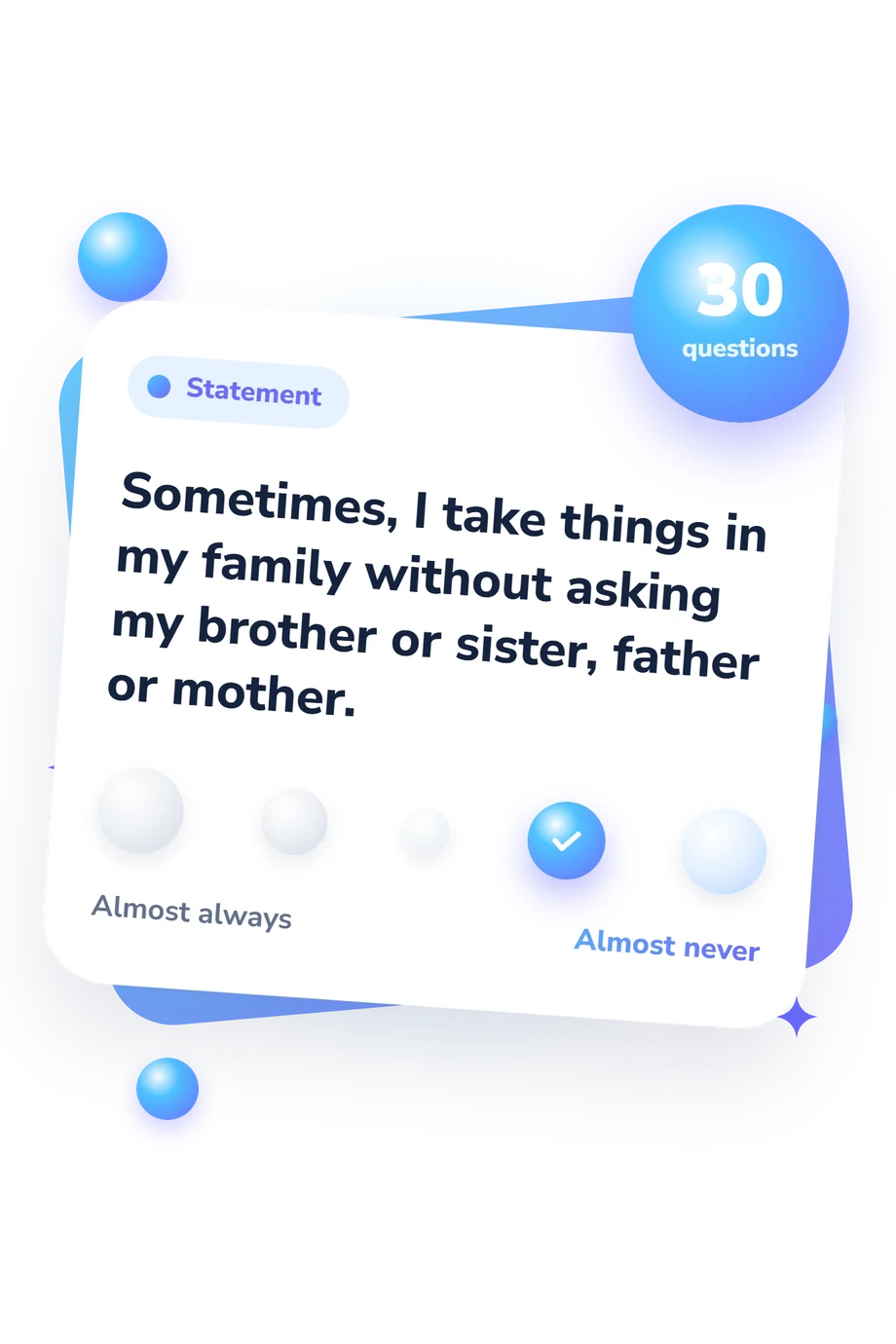
Each item uses five ordered frequency choices, from “Almost always” to “Almost never.” The respondent indicates how often each situation resembles their behavior, so interpretation depends on honest recall and context. Answers are combined into the displayed result; the questionnaire does not specify point-by-point weighting or reversal, so individual values should not be inferred from the scale range.
The questionnaire is conceptually consistent with the Ego Boundaries work discussed by Shamshikova and with Brown’s theoretical work on destructive narcissistic patterns, including intrusion, control, and regard for another person’s separate psychological space. This online version is not a direct reproduction or validated adaptation of the published instrument.
The result functions as a psychological distance assessment of boundary-related tendencies. This online version presents no norms or reliability estimates, and scores may vary with current relationships, mood, social expectations, and self-awareness; its displayed bands are not clinical cutoffs and support reflection rather than a diagnosis.
- Shamshikova, Ekaterina Olegovna. "Adaptation of the Foreign Method 'Ego Boundaries' by N. Brown." World of Science, Culture, and Education, no. 4 (16), 2009, pp. 167-174.
- Brown, Nina W. The Destructive Narcissistic Pattern. Westport, CT and London: Praeger, 1998. ISBN 9780275960179.
- Brown, Nina W. "The Destructive Narcissistic Pattern." Social Behavior & Personality: An International Journal, vol. 24, no. 3, 1996, pp. 263-271. 10.2224/sbp.1996.24.3.263
Updated: