
Hall Emotional Intelligence Test
How the Scales are Structured
Who Usually Takes This Test?
See How You Compare
Below is a preview of how scores are typically distributed across each scale.
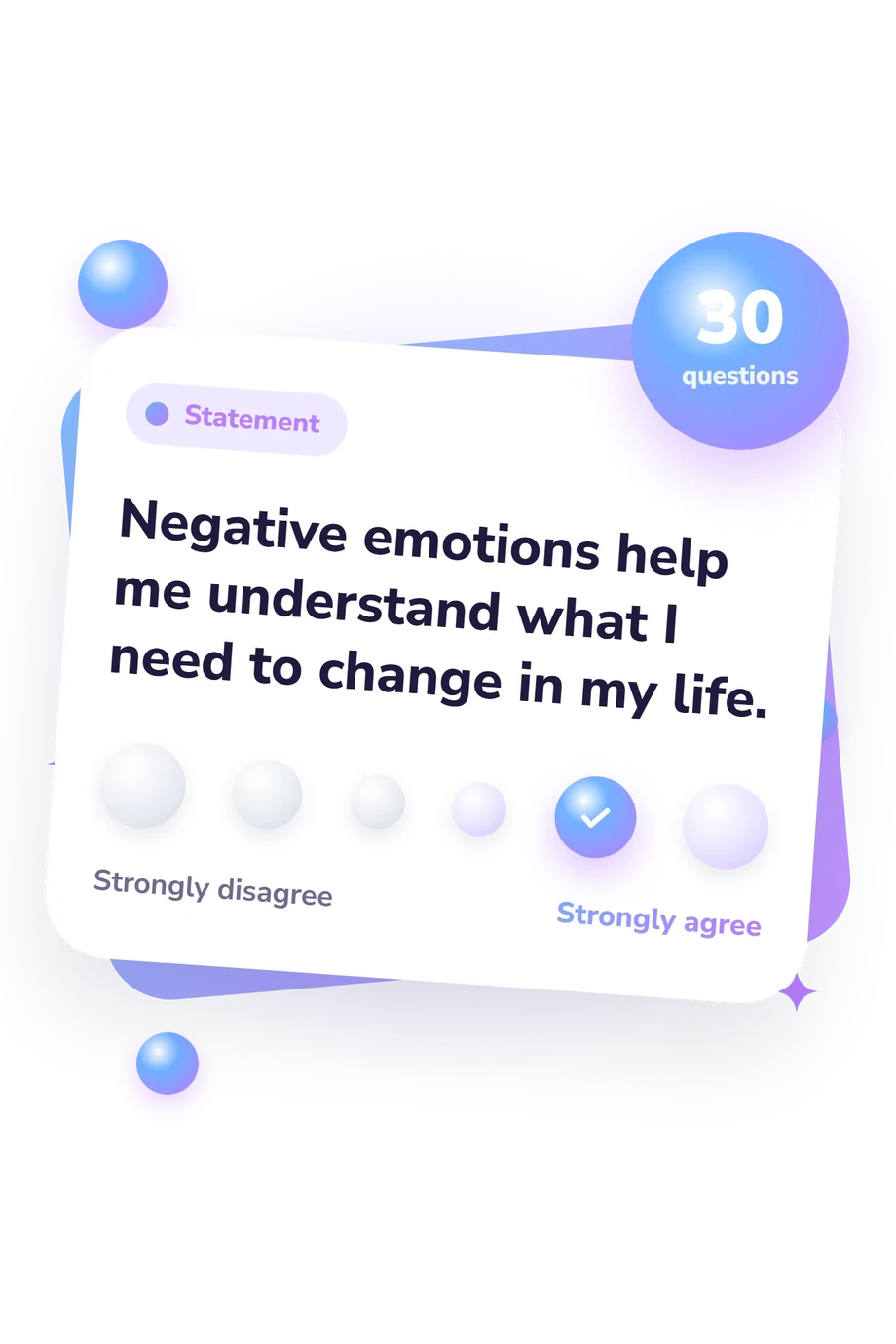
Example Questions From the Test
- Strongly disagree
- Mostly disagree
- Somewhat disagree
- Somewhat agree
- Mostly agree
- Strongly agree
- Strongly disagree
- Mostly disagree
- Somewhat disagree
- Somewhat agree
- Mostly agree
- Strongly agree
- Strongly disagree
- Mostly disagree
- Somewhat disagree
- Somewhat agree
- Mostly agree
- Strongly agree
Hall Emotional Intelligence Test - Description and methodology of the test
People who want to understand how emotions shape decisions, persistence, and relationships can use the Hall Emotional Intelligence Test as a structured starting point. Reflecting on emotional awareness, regulation, motivation, empathy, and influence in everyday situations helps readers use this emotional intelligence assessment to interpret everyday reactions, coping habits, motivation, and interpersonal sensitivity. The result presents several related abilities, making patterns easier to notice and discuss.
What This Assessment Explores
This questionnaire covers emotional awareness, emotional regulation skills, motivation, empathy, and influence. Items address feeling changes, pressure, recovery, persistence, others’ needs, social cues, and attempts to calm or motivate someone. Results form a multidimensional emotional intelligence profile.
The five dimensions below show what each result means:
- Emotional Awareness (-18-18) measures awareness of personal feelings and emotion vocabulary: Lower awareness (-18--1), Moderate awareness (0-9), Higher awareness (10-18).
- Managing One's Own Emotions (-18-18) measures recovery, flexibility, and control: Needs support (-18--7), Developing (-6-6), Strong control (7-18).
- Self-Motivation (-18-18) measures regulating behavior through emotion: Low (-18--1), Moderate (0-9), High (10-18).
- Empathy (-18-18) measures understanding and supporting others’ feelings from social cues: Low empathy (-18--6), Moderate empathy (-5-6), High empathy (7-18).
- Recognition of Others' Emotions (-18-18) measures influencing others’ emotional states: Low (-18--7), Moderate (-6-6), High (7-18).
Methodology and Scientific Basis
Each statement uses a six-point agreement scale: Strongly disagree, Mostly disagree, Somewhat disagree, Somewhat agree, Mostly agree, or Strongly agree. The first-person format asks respondents to rate noticing feelings, calming after upset, persisting through obstacles, reading indirect cues, and helping someone regain motivation. It measures self-described tendencies rather than observed performance.
Responses produce five dimension totals, each shown with a signed range and bands. Because the range does not establish points per answer, interpretation should follow the displayed band and the pattern across dimensions, not an invented conversion rule. This emotional intelligence measure is a structured self-report profile.
Ilyin describes Hall’s Emotional Intelligence Test as a relevant instrument; this online questionnaire is conceptually consistent with it, not a documented adaptation. Its content also aligns conceptually with Salovey and Mayer’s model of appraising, regulating, and using emotion, and with Mayer and Salovey’s account of constructing and regulating feelings. The displayed bands have no accompanying population norms or reliability estimates for this version; current context, self-awareness, and response bias may affect answers.
- Ilyin, E. P. (2001). Emotions and Feelings. Saint Petersburg: Piter, pp. 633-634. ISBN 5-318-00236-6.
- Salovey, P., & Mayer, J. D. (1990). Emotional Intelligence. Imagination, Cognition and Personality, 9(3), 185-211. 10.2190/DUGG-P24E-52WK-6CDG.
- Mayer, J. D., & Salovey, P. (1995). Emotional Intelligence and the Construction and Regulation of Feelings. Applied and Preventive Psychology, 4(3), 197-208. 10.1016/S0962-1849(05)80058-7.
Updated: