
Perceived Political Efficacy Scale Test
How the Scales are Structured
Who Usually Takes This Test?
See How You Compare
Below is a preview of how scores are typically distributed across each scale.
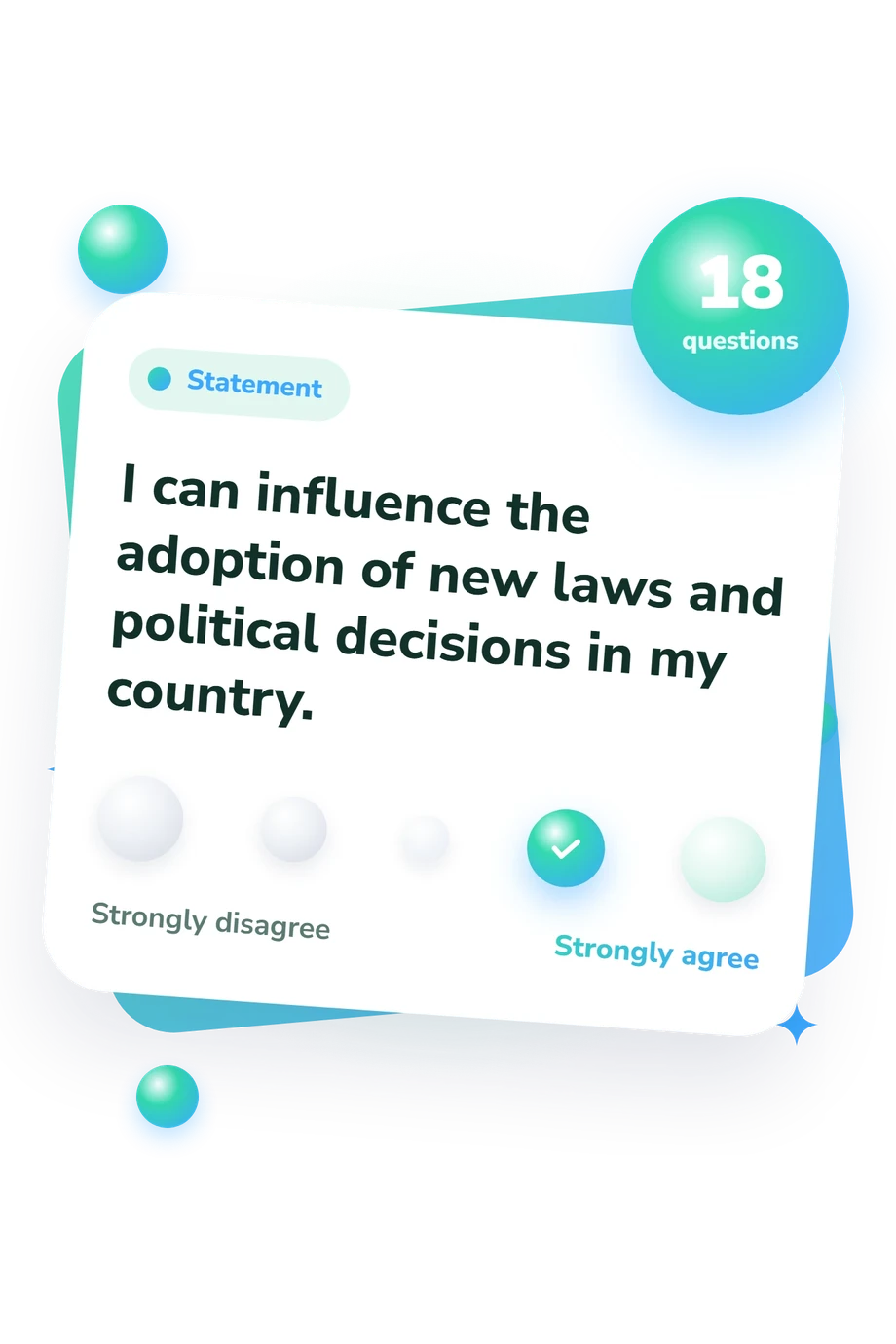
Example Questions From the Test
- Strongly disagree
- Disagree
- Neither agree nor disagree
- Agree
- Strongly agree
- Strongly disagree
- Disagree
- Neither agree nor disagree
- Agree
- Strongly agree
- Strongly disagree
- Disagree
- Neither agree nor disagree
- Agree
- Strongly agree
Perceived Political Efficacy Scale Test - Description and methodology of the test
People who want to understand their sense of civic influence can use the Perceived Political Efficacy Scale Test to reflect on how personal confidence, group capacity, and perceived government responsiveness shape their view of participation. The results are most useful for readers considering why political action feels effective, ineffective, or conditional in their own circumstances. As a political efficacy test, it describes perceptions rather than political knowledge or ideological preference.
What This Assessment Explores
Political efficacy asks whether influence seems possible personally, collectively, and institutionally. Readers using this political efficacy questionnaire can distinguish confidence in their own participation from beliefs about citizens acting together and authorities responding to legitimate demands. Its profile highlights where civic influence feels stronger or weaker.
The three dimensions shown in the result are:
- External (1-5) reflects whether the political system appears open and responsive; Low 1-3.06 indicates more alienation, while High 3.07-5 indicates stronger belief that authorities can be influenced.
- Group Internal Political Efficacy (1-5) measures confidence in the respondent's social group as a political force; Low 1-1.8, Moderate 1.81-4.23, and High 4.24-5 mark increasing perceived collective influence.
- Personal Internal Political Efficacy (1-5) assesses confidence in one's own ability to participate and affect political processes; Low 1-1.32, Moderate 1.33-3.43, and High 3.44-5 indicate increasing personal influence.
Methodology and Evidence Base
Items cover influencing laws, electing leaders, demanding enforcement, collective action, access to information, equal rights, and attention to citizens' demands. Each uses a five-point agreement scale with a neutral midpoint; endpoint wording varies between strongly and completely.
As a civic influence assessment, the questionnaire separates personal and collective influence from questions about leaders' communication, equal political standing, and responsiveness to legitimate demands. Results are organized into the three dimensions, reported separately, and assigned the displayed bands, so the scores form a profile rather than one overall verdict.
The structure is conceptually consistent with Perceived Political Efficacy Scale (Sarieva, 2018), a three-component framework for personal internal, group internal, and external efficacy. It also relates to earlier work by Craig and Maggiotto (1982) and Campbell, Gurin, and Miller (1954), but this online questionnaire is not a verbatim adaptation or revalidation of those works. The displayed bands are the categories used for this questionnaire; current events, personal experience, and self-report candor can shift results, which are best read as a structured snapshot rather than a diagnosis.
- Sarieva, Irena. (2018). How to Measure Perceived Political Efficacy? A Three-Component Scale. Psychology. Journal of the Higher School of Economics, 15(3), 477-490. 10.17323/1813-8918-2018-3-477-490
- Craig, Stephen C., and Michael A. Maggiotto. (1982). Measuring Political Efficacy. Political Methodology, 8(3), 85-109.
- Campbell, Angus, Gerald Gurin, and Warren E. Miller. (1954). The Voter Decides. Evanston, IL: Row, Peterson and Company.
Updated: