
Gallup Q12 Employee Engagement Survey (Q12) Test
How the Scales are Structured
Who Usually Takes This Test?
See How You Compare
Below is a preview of how scores are typically distributed across each scale.
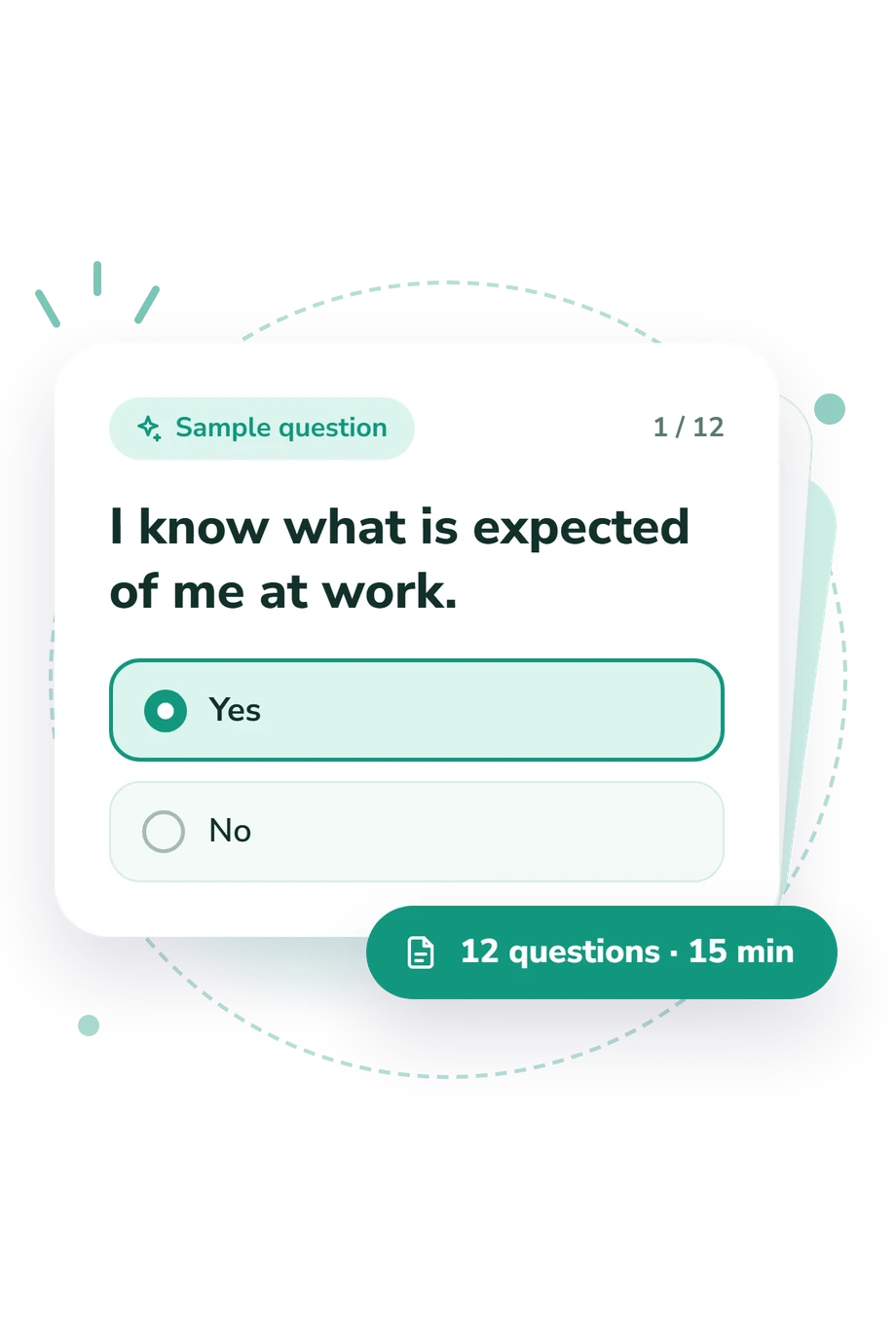
Example Questions From the Test
- Yes
- No
- Yes
- No
- Yes
- No
Gallup Q12 Employee Engagement Survey (Q12) Test - Description and methodology of the test
Managers, team members, and anyone reflecting on their work experience can use the Gallup Q12 Employee Engagement Survey (Q12) Test to consider overall employee engagement through questions about clarity, contribution, recognition, and growth. As an employee engagement questionnaire, it draws on items about supervision, resources, relationships, and development to produce one overall engagement result that can guide practical reflection about involvement at work.
What This Assessment Explores
The assessment measures overall employee engagement through questions about everyday work experiences that can strengthen or weaken connection to work. It suits employees, managers, or anyone considering role clarity, support, and contribution at work.
The questions cover these themes:
- Clarity and resources show whether expectations and essential tools are available.
- Feedback and recognition indicate whether effort and progress are noticed.
- Support and voice reflect supervisor care, growth opportunities, and whether opinions count.
- Teamwork and development capture relationships, shared responsibility, learning, and progress.
Together, these themes describe the work experience covered by the items. The single Engagement Level result reflects overall employee engagement, calculated from the percentage of positive responses across all items, and is scored 0-12; this employee engagement score can help the reader reflect on that experience. Its bands are Low 0-4, Moderate 5-8, and High 9-12.
Methodology and Scientific Basis
Each statement is answered Yes or No and covers role expectations, resources, feedback, supervisor care, employee voice, contribution, relationships, recognition, and learning opportunities. Respondents compare each item with work experience, so the format produces a structured self-report rather than an open-ended account.
The documented scoring logic aggregates Yes/No responses into the displayed result based on the percentage of positive responses; it specifies no additional weighting or conversion.
Published evidence for the Gallup Q12 framework includes a Q12 meta-analysis linking engagement with organizational outcomes and a Gallup management book that presents the Q12 approach. The online questionnaire is conceptually consistent with that framework, but it is not Gallup’s official administration or a validated copy, and it has no stated norms or separate standardization. Current role, workload, context, and response bias can affect self-report, so interpret the result alongside the specific work situation and any broader assessment.
- Harter, James K., Corey E. Tatel, Sangeeta Agrawal, Anthony Blue, Stephanie K. Plowman, Jim Asplund, Sabrina Yu, and Andy Kemp. (2024). The Relationship Between Engagement at Work and Organizational Outcomes: Q12 Meta-Analysis, 11th Edition. Gallup.
- Harter, James K., Frank L. Schmidt, and Theodore L. Hayes. (2002). Business-Unit-Level Relationship Between Employee Satisfaction, Employee Engagement, and Business Outcomes: A Meta-Analysis. Journal of Applied Psychology, 87(2), 268-279. 10.1037/0021-9010.87.2.268
- Gallup and James K. Harter. (2006). 12: The Elements of Great Managing. Gallup Press.
Updated: