
Freudly+971 508685814hello@freudly.ai
Freudly
burnout

Resources and Professional Burnout Assessment Test
Take the online Resources and Professional Burnout Assessment Test - AI psychologist FreudlyYou can take Resources and Professional Burnout Assessment Testhere. Online version of a simple and accurate psychological test with interpretation.en
Understand your burnout risk, resource drains, and reserves in about 6 minutes. Get clear, research-backed insights and practical next steps to restore energy and stay effective.
Start Online Test
Questions: 306 minutes
08:30
October 2, 2025
October 2, 2025
Material has been updated
October 2, 2025
Material has been published
25,985 views
2,582 completions
2,255 likes
Verified by Daniel Hall
Psychologist with 25 years of experience
Share
Scale Explorer

How the Scales are Structured

example score
22/50
Cognitive Exhaustion (CE)
Measures the degree of mental tiredness that reduces attention, memory, and efficiency of thinking during work tasks.
Low
Moderate
High
520: Low | 2139: Moderate | 4050: High
A score of 22 falls in the Moderate range, suggesting noticeable but manageable cognitive tiredness that may slow information processing and increase errors under load.
example score
27/50
Motivational Exhaustion (ME)
Measures the degree of reduced interest and internal drive toward work that can undermine engagement and productivity.
Low
Moderate
High
520: Low | 2139: Moderate | 4050: High
A score of 27 falls in the Moderate range, indicating a noticeable but not severe decrease in work motivation and initiative.
example score
17/50
Physical Exhaustion (PE)
Measures the degree of persistent physical fatigue and reduced energy that can undermine work capacity and overall physical functioning.
Low exhaustion
Elevated exhaustion
High exhaustion
520: Low exhaustion | 2139: Elevated exhaustion | 4050: High exhaustion
A score of 17 falls in the Low exhaustion range, suggesting relatively preserved physical energy with occasional or mild fatigue.
example score
15/50
Reduced Professional Accomplishment (RPA)
This scale measures how strongly you feel a decline in professional competence, effectiveness, and satisfaction with your achievements.
Low reduction
Moderate reduction
High reduction
520: Low reduction | 2139: Moderate reduction | 4050: High reduction
A score of 15 falls in the Low reduction range, suggesting your sense of professional effectiveness and accomplishment is generally preserved.
example score
20/50
Depersonalization (D)
Depersonalization measures emotional distancing and cynical or detached attitudes toward colleagues or clients that can reduce empathy and strain work relationships.
Low
Elevated
520: Low | 2150: Elevated
A score of 20 falls in the Low range, suggesting generally preserved empathy and a limited tendency toward cynical detachment in work interactions.
example score
11/50
Emotional Exhaustion (EE)
Measures the degree of emotional fatigue, inner emptiness, and difficulty coping with day-to-day work stressors.
Low
Moderate
High
520: Low | 2139: Moderate | 4050: High
A score of 11 falls in the Low range, indicating relatively minimal emotional exhaustion at the moment.
example score
218/300
Occupational Burnout Risk Level (OBRL)
Measures the overall level of risk for professional burnout based on signs of exhaustion and resource balance.
Low risk
Moderate risk
High risk
30120: Low risk | 121239: Moderate risk | 240300: High risk
A score of 218 falls in the Moderate risk range, suggesting noticeable strain and reduced resource reserves compared with a well-balanced state.
Start Online Test
just completed the test
DATA-BASED USER COHORTS

Who Usually Takes This Test?

Overloaded knowledge workers
41%OF USERS
People with constant deadlines and high cognitive load who feel tired, detached, or less effective and want to pinpoint where their energy is leaking.
Helping professions under stress
34%OF USERS
Teachers, healthcare, social workers, and support roles who absorb others’ emotions and need clarity on exhaustion, cynicism, and recovery resources.
Managers and team leads
25%OF USERS
Leaders balancing responsibility and people issues who want an early warning check on burnout risk and practical steps to restore motivation and resilience.
BASED ON AGGREGATED, ANONYMIZED DATA FROM TENS OF THOUSANDS OF FREUDLY USERS.
Benchmarking

See How You Compare

Once you complete the test, your results are compared with real-world data from people in your country.
Below is a preview of how scores are typically distributed across each scale.
Cognitive Fatigue (CF)
Average
34.9
Normal range
28.541.4
min.
5
max.
50
This curve shows how scores are typically distributed.
Once you complete the test, your result will appear on the scale so you can see how you compare.
Motivational exhaustion (Me)
Average
18
Normal range
11.424.5
min.
5
max.
50
This curve shows how scores are typically distributed.
Once you complete the test, your result will appear on the scale so you can see how you compare.
Physical Exhaustion (PE)
Average
20.9
Normal range
15.226.6
min.
5
max.
50
This curve shows how scores are typically distributed.
Once you complete the test, your result will appear on the scale so you can see how you compare.
Reduction of professional achievements (Ropa)
Average
16.7
Normal range
9.623.8
min.
5
max.
50
This curve shows how scores are typically distributed.
Once you complete the test, your result will appear on the scale so you can see how you compare.
Depersonalization (D)
Average
20.3
Normal range
11.928.7
min.
5
max.
50
This curve shows how scores are typically distributed.
Once you complete the test, your result will appear on the scale so you can see how you compare.
Emotional exhaustion (Ee)
Average
16.4
Normal range
8.824
min.
5
max.
50
This curve shows how scores are typically distributed.
Once you complete the test, your result will appear on the scale so you can see how you compare.
Professional Burnout Risk Level (PBRL)
Average
203.3
Normal range
168.7238
min.
30
max.
300
This curve shows how scores are typically distributed.
Once you complete the test, your result will appear on the scale so you can see how you compare.
Featured On
SAMPLE QUESTIONS

Example Questions From the Test

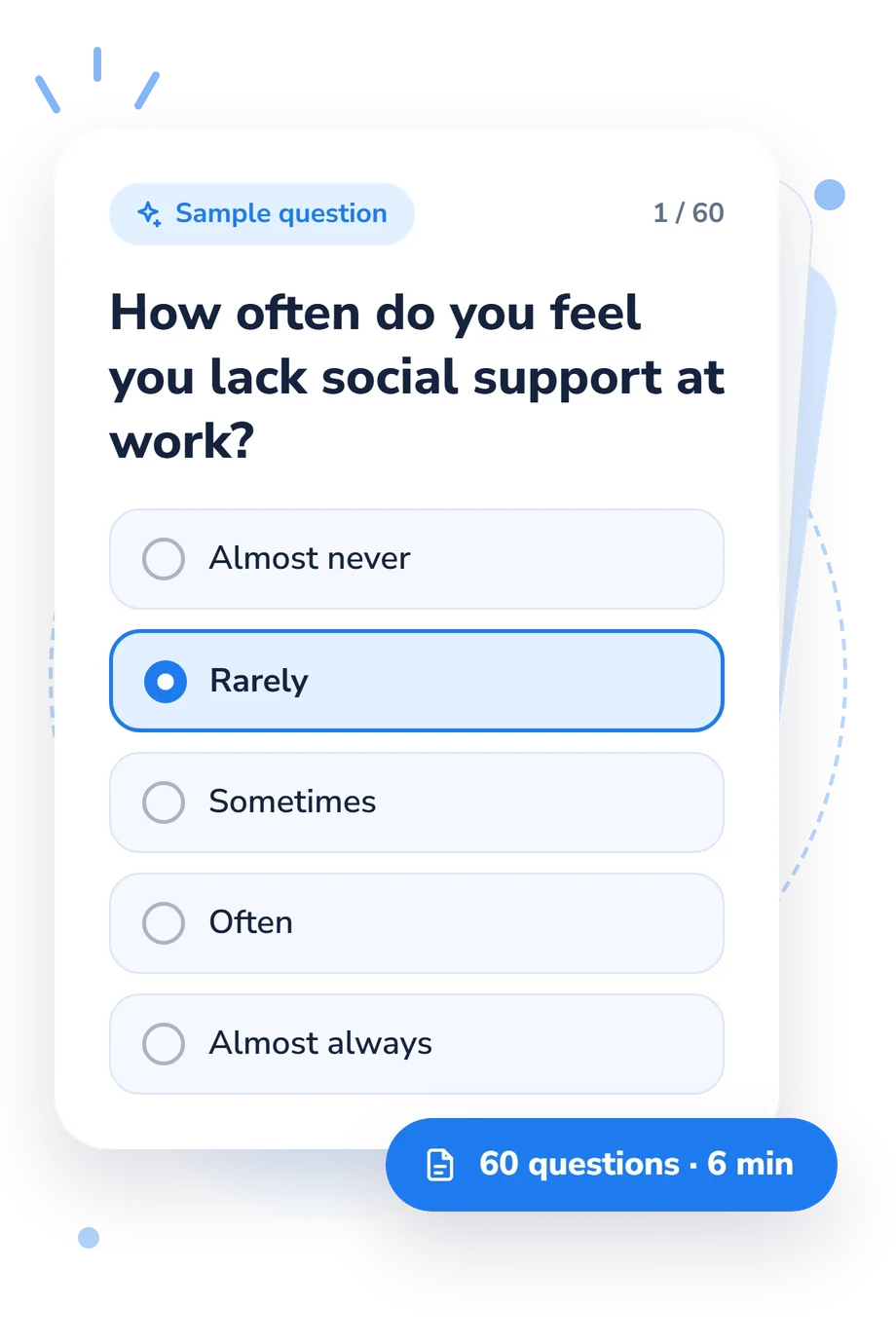
Find a quiet, comfortable place. Ensure that you have approximately 15–20 minutes available. Respond as honestly and openly as possible. Select the response option that most accurately describes your current state. Do not rush. Allow sufficient time to consider each question. Do not compare yourself to others; focus on your own feelings and experiences. Consider the assessment results as a starting point for possible changes.
    • Almost never
    • Rarely
    • Sometimes
    • Often
    • Almost always
    • Almost never
    • Rarely
    • Sometimes
    • Often
    • Almost always
    • Almost never
    • Rarely
    • Sometimes
    • Often
    • Almost always
WHAT THE TEST MEASURES
About This Assessment
Diagnosis of Resources and Professional Burnout Test

Resources and Professional Burnout Assessment Test - Symptoms and Signs

burnout

This measure is designed to screen for work-related burnout symptoms and perceived resources that may buffer occupational stress. The Resources and Professional Burnout Assessment provides a brief self-report snapshot of domains commonly associated with burnout and reduced occupational functioning. It was developed with reference to established burnout research (Christina Maslach; Michael P. Leiter).

The instrument includes 30 items and typically takes about 6 minutes to complete. Items assess subjective experiences such as exhaustion, disengagement or depersonalization, and perceived effectiveness, alongside aspects of personal or contextual resources that may support recovery. Results from the Resources and Professional Burnout Assessment are intended to support clinical or organizational conversations about risk level, potential contributing factors, and areas for targeted follow-up rather than to serve as a stand-alone diagnosis.

Author: Christina Maslach, Michael P. Leiter
Popular tests
Comments
Leave a Comment