
Freudly+971 508685814hello@freudly.ai
Freudly
academic motivation

Schoolchildren's Academic Motivation Assessment Test
Take the online Schoolchildren's Academic Motivation Assessment Test - AI psychologist FreudlyYou can take Schoolchildren's Academic Motivation Assessment Testhere. Online version of a simple and accurate psychological test with interpretation.en
Understand what drives a student’s learning in just 5 minutes. Fast, proven, and flexible for individuals or groups, with results that guide targeted support.
Start Online Test
Questions: 35 minutes
08:30
October 2, 2025
October 2, 2025
Material has been updated
October 2, 2025
Material has been published
28,087 views
2,113 completions
1,785 likes
Verified by Daniel Hall
Psychologist with 25 years of experience
Share
Scale Explorer

How the Scales are Structured

example score
2/4
Learning Content (LC)
Measures interest in the study material and the desire to learn something new (cognitive curiosity).
Low
Moderate
High
01: Low | 23: Moderate | 4: High
A score of 2 suggests a moderate interest in learning content, with curiosity present but not consistently dominant.
example score
2/4
Failure Avoidance (FA)
Measures the extent to which a student is motivated by avoiding mistakes, failure, and negative academic consequences.
Low
Moderate
High
01: Low | 23: Moderate | 4: High
A score of 2 indicates a moderate tendency to avoid failure, suggesting occasional worry about making mistakes that may influence study behavior.
example score
2/4
Achievement Success (AS)
Measures how strongly a student is driven to achieve success through high performance, persistence, and overcoming academic challenges.
Low
Moderate
High
01: Low | 23: Moderate | 4: High
A score of 2 indicates a moderate motivation to achieve success, suggesting the student is somewhat goal-oriented and willing to persist but may not consistently seek challenging tasks.
example score
2/4
Creative Self-Realization (CSR)
Measures how strongly a student is motivated to express creativity and individuality through academic work.
Low
Moderate
High
01: Low | 23: Moderate | 4: High
A score of 2 suggests a moderate drive to use studies as a way to express creativity, which may appear in selected tasks or supportive learning conditions.
example score
2/4
Communicative (C)
Measures how strongly a student is motivated to learn through communication, collaboration, and interaction with others.
Low
Moderate
High
01: Low | 23: Moderate | 4: High
A score of 2 suggests a moderate communicative motive, meaning interaction and collaborative learning are somewhat important but not the primary driver.
example score
2/4
Learning Process (LP)
Measures how much a student is motivated by enjoyment and interest in the learning process itself rather than by outcomes.
Low process interest
Moderate process interest
High process interest
01: Low process interest | 23: Moderate process interest | 4: High process interest
A score of 2 suggests a moderate interest in learning activities, where the process can be engaging at times but is not consistently a primary driver.
example score
1/4
Prestige (P)
Measures how strongly a student is motivated by gaining recognition, respect, and higher status through academic achievement.
Low
Moderate
High
01: Low | 23: Moderate | 4: High
A score of 1 indicates the prestige motive is relatively weak, so social approval and status are not a primary driver of the student's studying.
example score
2/4
Affiliation (A)
Measures how strongly a student is motivated to study by building and maintaining positive relationships with classmates and teachers.
Low
Moderate
High
01: Low | 23: Moderate | 4: High
A score of 2 indicates a moderate affiliation motive, meaning social connection supports learning but is not the primary driver.
example score
1/4
Well-Being (WB)
This scale reflects how strongly a student’s learning motivation is driven by the desire for comfort, stability, and avoiding difficulties.
Low
Moderate
High
01: Low | 23: Moderate | 4: High
A score of 1 suggests the well-being motive is relatively weak, meaning comfort and avoiding difficulties are not a primary driver of the student’s approach to studying.
example score
2/4
Self-Determination and Self-Improvement (SDaSI)
Measures the extent to which a student is motivated to learn for personal growth, self-development, and self-improvement.
Low
Moderate
High
01: Low | 23: Moderate | 4: High
A score of 2 suggests a moderate drive for self-determination and self-improvement, where learning is sometimes connected to personal growth but not consistently a primary motive.
example score
2/4
Sense of Duty and Responsibility (SoDaR)
Measures the extent to which a student is motivated to study by a sense of duty, obligation, and personal responsibility for completing academic tasks.
Low
Moderate
High
01: Low | 23: Moderate | 4: High
A score of 2 indicates a moderate duty-and-responsibility motive, suggesting the student sometimes relies on obligation and discipline to complete academic work but it is not consistently dominant.
Start Online Test
just completed the test
DATA-BASED USER COHORTS

Who Usually Takes This Test?

School Psychologists
41%OF USERS
Use it to quickly identify what motivates a student and choose appropriate support or intervention strategies.
Teachers and Class Tutors
35%OF USERS
Take it to understand what drives their class or individual students and adjust teaching, feedback, and encouragement.
Concerned Parents
24%OF USERS
Use it to clarify why a child studies (or avoids studying) and to plan more effective home support.
BASED ON AGGREGATED, ANONYMIZED DATA FROM TENS OF THOUSANDS OF FREUDLY USERS.
Benchmarking

See How You Compare

Once you complete the test, your results are compared with real-world data from people in your country.
Below is a preview of how scores are typically distributed across each scale.
content of the teaching (cott)
Average
1.7
Normal range
1.22.2
min.
0
max.
4
This curve shows how scores are typically distributed.
Once you complete the test, your result will appear on the scale so you can see how you compare.
avoidance of failure (aof)
Average
2.7
Normal range
2.13.3
min.
0
max.
4
This curve shows how scores are typically distributed.
Once you complete the test, your result will appear on the scale so you can see how you compare.
achievements of success (aos)
Average
2
Normal range
1.32.6
min.
0
max.
4
This curve shows how scores are typically distributed.
Once you complete the test, your result will appear on the scale so you can see how you compare.
creative self-expression (cs)
Average
1.9
Normal range
1.22.6
min.
0
max.
4
This curve shows how scores are typically distributed.
Once you complete the test, your result will appear on the scale so you can see how you compare.
communicative (c)
communicative (c)
Average
1.7
Normal range
12.3
min.
0
max.
4
This curve shows how scores are typically distributed.
Once you complete the test, your result will appear on the scale so you can see how you compare.
learning process (lp)
Average
2.7
Normal range
2.13.3
min.
0
max.
4
This curve shows how scores are typically distributed.
Once you complete the test, your result will appear on the scale so you can see how you compare.
prestige (p)
prestige (p)
Average
2.2
Normal range
1.72.8
min.
0
max.
4
This curve shows how scores are typically distributed.
Once you complete the test, your result will appear on the scale so you can see how you compare.
affiliations (a)
affiliations (a)
Average
1.3
Normal range
0.71.8
min.
0
max.
4
This curve shows how scores are typically distributed.
Once you complete the test, your result will appear on the scale so you can see how you compare.
well-being (w)
well-being (w)
Average
1.9
Normal range
1.32.6
min.
0
max.
4
This curve shows how scores are typically distributed.
Once you complete the test, your result will appear on the scale so you can see how you compare.
self-determination and self-improvement (sas)
Average
2.7
Normal range
2.13.3
min.
0
max.
4
This curve shows how scores are typically distributed.
Once you complete the test, your result will appear on the scale so you can see how you compare.
debt and responsibility (dar)
Average
1.1
Normal range
0.51.6
min.
0
max.
4
This curve shows how scores are typically distributed.
Once you complete the test, your result will appear on the scale so you can see how you compare.
Featured On
SAMPLE QUESTIONS

Example Questions From the Test

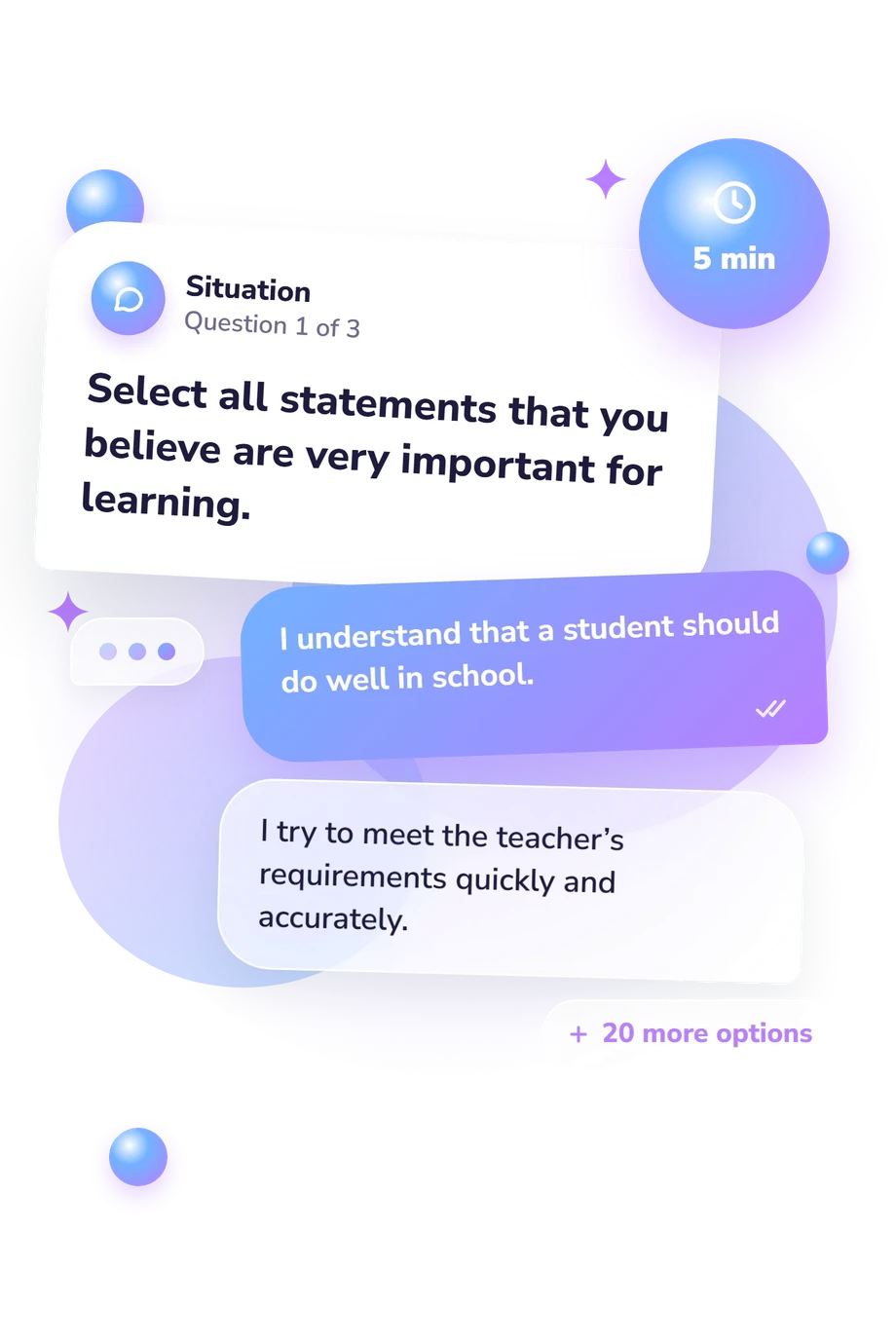
You are presented with a set of statements. In the first step, select the statements that are of very great importance for learning. In the second step, you will need to select only seven statements that you consider especially important for you personally. In the third step, select the three most important statements.
    • I understand that a student should do well in school.
    • I try to meet the teacher’s requirements quickly and accurately.
    • I want to finish school and continue my education.
    • I want to be a cultured and well-rounded person.
    • I want to get good grades.
    • I want approval from teachers and parents.
    • I want my classmates to always think well of me.
    • I want to have many friends in my class.
    • I want to be the best student in the class.
    • I want my answers in class to always be better.
    • I want to avoid being scolded by my parents and teachers.
    • I do not want to get bad grades.
    • I like learning new things.
    • I like it when the teacher talks about something interesting.
    • I like thinking and reasoning during class.
    • I like taking on difficult tasks and overcoming challenges.
    • I am interested in talking with the teacher about different topics.
    • I prefer doing schoolwork in a group rather than alone.
    • I like solving problems in different ways.
    • I like everything new and unusual.
    • I want to get only As and Bs.
    • I want to achieve great success in the future.
    • I understand that a student should study well.
    • I try to meet the teacher’s requirements quickly and accurately.
    • I want to finish school and continue my education.
    • I want to be a cultured and well-rounded person.
    • I want to get good grades.
    • I want approval from teachers and parents.
    • I want my classmates to always think well of me.
    • I want to have many friends in my class.
    • I want to be the best student in the class.
    • I want my answers in class to always be better.
    • I want my parents and teachers not to scold me.
    • I do not want to get bad grades.
    • I like learning new things.
    • I like it when the teacher tells us something interesting.
    • I like thinking and reasoning during class.
    • I like taking on difficult tasks and overcoming challenges.
    • I am interested in talking with the teacher about different topics.
    • I prefer doing schoolwork in a group rather than alone.
    • I like solving problems in different ways.
    • I like everything new and unusual.
    • I want to get only 4s and 5s.
    • I want to achieve great success in the future.
    • I understand that a student should study well.
    • I try to meet the teacher’s requirements quickly and accurately.
    • I want to finish school and continue my education.
    • I want to be a well-educated and well-rounded person.
    • I want to get good grades.
    • I want approval from teachers and parents.
    • I want my classmates to always think well of me.
    • I want to have many friends in class.
    • I want to be the best student in the class.
    • I want my answers in class to always be better.
    • I want to avoid being scolded by my parents and teachers.
    • I do not want to get bad grades.
    • I like learning new things.
    • I like it when the teacher tells us something interesting.
    • I like thinking and reasoning in class.
    • I like taking on challenging tasks and overcoming difficulties.
    • I am interested in talking with the teacher about different topics.
    • I prefer doing schoolwork in a group rather than alone.
    • I like solving problems in different ways.
    • I like everything new and unusual.
    • I want to get only grades of 4 and 5.
    • I want to achieve great success in the future.
WHAT THE TEST MEASURES
About This Assessment

Schoolchildren's Academic Motivation Assessment Test - Symptoms and Signs

academic motivation

This brief self-report measure is used to screen students’ academic motivation and related learning orientations. The Schoolchildren's Academic Motivation Assessment is designed for rapid administration in school or clinical settings to support initial case formulation and planning.

The measure includes 3 items and typically takes about 5 minutes to complete. Item selections are intended to help identify prominent motivational themes (e.g., relatively more internal vs. external reasons for academic engagement) and can be interpreted alongside interview and other collateral information.

The Schoolchildren's Academic Motivation Assessment is attributed in the provided materials to Edward L. Deci and Richard M. Ryan. Results should be considered descriptive and time-limited, and are best used as part of a broader assessment rather than as a standalone basis for high-stakes decisions.

Author: Edward L. Deci, Richard M. Ryan
Literature: Pintrich, P. R., & De Groot, E. V. Motivational and self-regulated learning components of classroom academic performance. Journal of Educational Psychology. 1990.; Eccles, J. S., & Wigfield, A. Motivational beliefs, values, and goals. Annual Review of Psychology. 2002.
Popular tests
Comments
Leave a Comment