
Primary Representational System Test
How the Scales are Structured
Who Usually Takes This Test?
See How You Compare
Below is a preview of how scores are typically distributed across each scale.
Example Questions From the Test
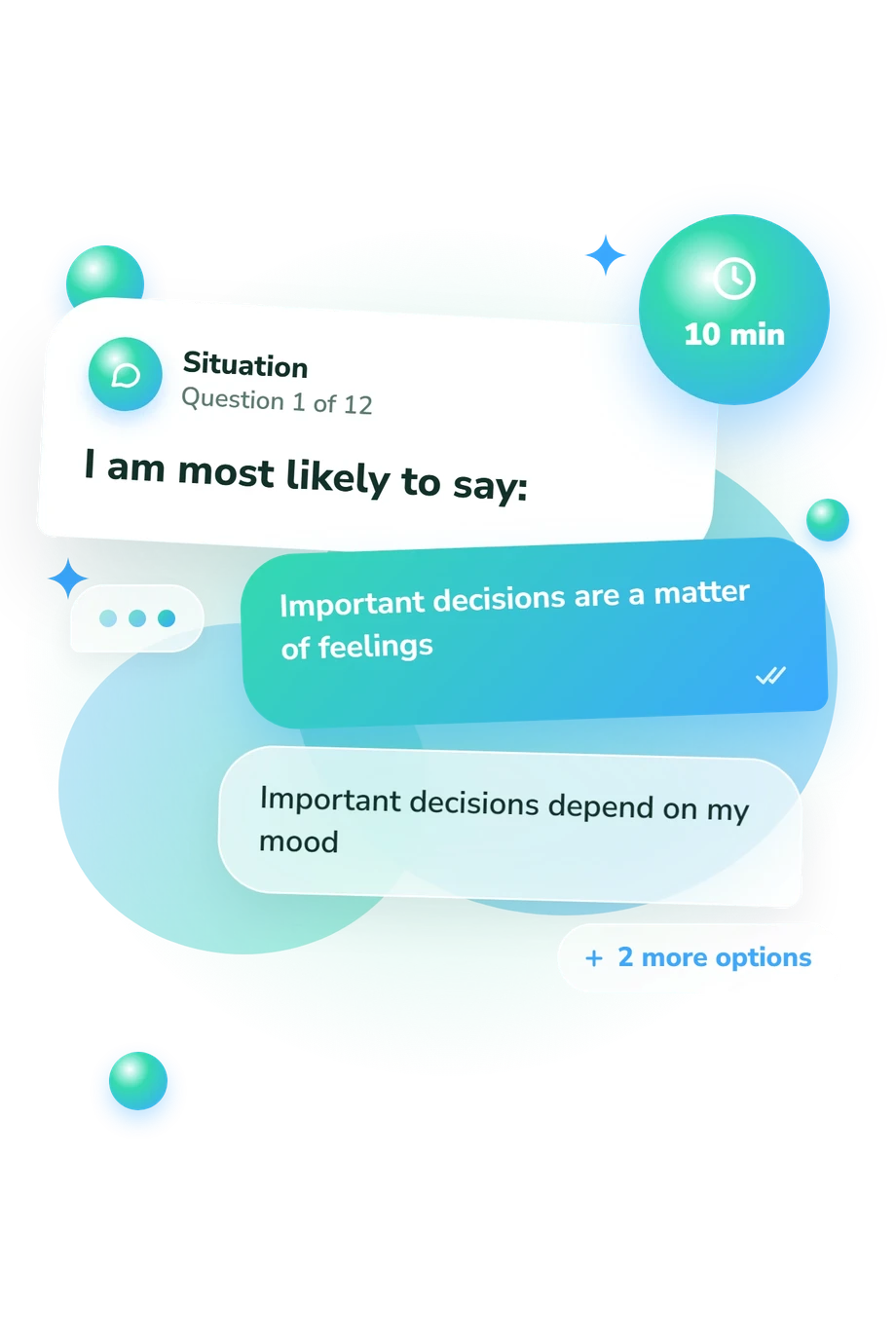
- Important decisions are a matter of feelings
- Important decisions depend on my mood
- Important decisions depend on my point of view
- Important decisions are a matter of logic and reason
- has a pleasant voice
- looks good
- expresses sensible ideas
- leaves me with good feelings
- I look at your appearance
- I check how you feel
- I listen to the sound of your voice
- I pay attention to what you say
Primary Representational System Test - Description and methodology of the test
People who want to understand their habitual way of taking in information can use the Primary Representational System Test as a structured self-reflection tool. It offers a representational system assessment of how visual, auditory, bodily, and logical cues may shape learning, memory, communication, and decisions. The result is most useful when read as a pattern of preferences rather than a fixed description of personality.
What This Assessment Explores
The questionnaire examines preferred routes for noticing, recalling, and evaluating experience. Its prompts contrast visual imagery, sounds and speech, bodily sensations, and logical analysis, using situations involving memory, learning, communication, credibility, and decisions. The result describes a pattern of representational system preferences; a higher score suggests greater preference in the situations represented, not exclusive use of one style. The four dimensions are:
- Digital (12–48) indicates preference for logical reasoning, analysis, and internal dialogue; bands: Low 12–23, Moderate 24–35, High 36–48.
- Visual (12–48) indicates reliance on visual imagery and recall; bands: Low visual 12–23, Moderate visual 24–35, High visual 36–48.
- Auditory (12–48) indicates processing through sounds, speech, intonation, and timbre; bands: Low 12–23, Moderate 24–36, High 37–48.
- Kinesthetic (12–48) indicates attention to bodily sensations, movement, comfort, and tactile experience; bands: Less kinesthetic 12–23, Balanced kinesthetic 24–35, Strong kinesthetic 36–48.
Methodology and Scientific Basis
Each item uses a forced-choice self-report format: four alternatives describe different ways of noticing, remembering, believing, learning, or deciding, and the respondent selects the best fit. The responses are grouped into four separate totals, while the displayed bands organize each result. This shows relative preference; it does not make one style universally better.
Conceptually, the format aligns with NLP representational systems, which describe preferred visual, auditory, kinesthetic, and analytical or digital cues. It is traceable to the Antcliff questionnaire (2010). Dorn (1983) examined methods for assessing preference within this model, and Amirhosseini and Kazemian (2019) studied automated identification of preferred systems. These works provide context; the online questionnaire is conceptually consistent with them, not presented as a direct adaptation of any one.
Interpretation is strongest when scores are compared across the profile and connected with real examples. Because this is an online self-report measure without a stated standardization procedure, clinical norms, or diagnostic thresholds, comparing the four scores can clarify the respondent’s relative pattern, although results may reflect current mood, self-awareness, context, and how each option is understood; treat that pattern as a reflection prompt rather than a fixed label or standalone clinical conclusion.
- Antcliff, Steve. Life Coaching - Made Simple., 2010. ISBN 9781445256986.
- Amirhosseini, Mohammad Hossein, and Hassan Kazemian. "Automating the process of identifying the preferred representational system in Neuro Linguistic Programming using Natural Language Processing." Cognitive Processing 20, no. 2 (2019): 175-193. 10.1007/s10339-019-00912-3
- Dorn, Fred J. "Assessing Primary Representational System (PRS) Preference for Neurolinguistic Programming (NLP) Using Three Methods." Counselor Education and Supervision 23, no. 2 (1983): 149-156. 10.1002/j.1556-6978.1983.tb00599.x
Updated: