
Freudly+971 508685814hello@freudly.ai
Freudly
arrange

Professional Work Motivation Assessment Test
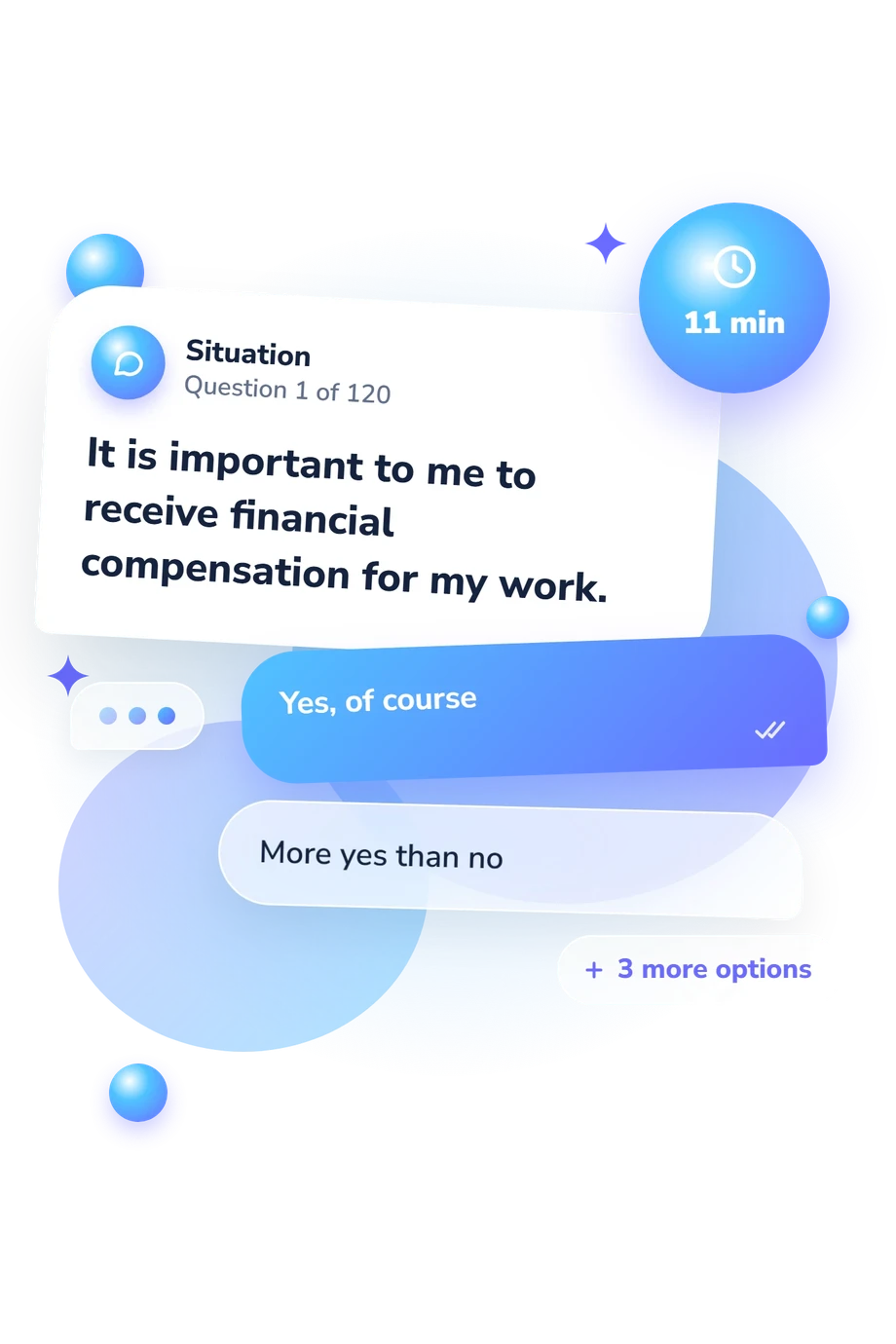
Take the online Professional Work Motivation Assessment Test - AI psychologist FreudlyYou can take Professional Work Motivation Assessment Testhere. Online version of a simple and accurate psychological test with interpretation.en
Understand what truly drives someone at work in about 11 minutes. Get clear insight to boost engagement, prevent burnout, and guide hiring, development, and team fit.
Start Online Test
Questions: 6011 minutes
08:30
October 2, 2025
October 2, 2025
Material has been updated
October 2, 2025
Material has been published
26,679 views
2,467 completions
2,082 likes
Verified by Daniel Hall
Psychologist with 25 years of experience
Share
Scale Explorer

How the Scales are Structured

example score
34/60
Information Regulation (IR)
Measures how effectively a person processes and uses work-related information to support and activate professional motivation.
Low
Moderate
High
1227: Low | 2844: Moderate | 4560: High
A score of 34 falls in the Moderate range, suggesting generally adequate information processing that typically supports motivation, with room to strengthen consistency under higher cognitive load.
example score
45/60
Volitional Regulation (VR)
Measures the extent to which a person can consciously self-regulate work behavior through willpower, autonomy, and initiative.
Low
Moderate
High
1227: Low | 2844: Moderate | 4560: High
A score of 45 indicates high volitional regulation, suggesting strong capacity to maintain self-directed control and initiative in professional tasks.
example score
24/60
Social Regulation (SR)
Social regulation measures how strongly social expectations, approval, and group norms influence a person’s work motivation and choices.
Low social influence
Moderate social influence
High social influence
1227: Low social influence | 2844: Moderate social influence | 4560: High social influence
A score of 24 indicates low social influence, suggesting the person’s professional motivation is shaped more by internal drivers than by external social expectations or approval.
example score
36/60
Emotional Regulation (ER)
Assesses how well a person can manage and use emotions to support and direct motivation in professional activity.
Low
Moderate
High
1227: Low | 2844: Moderate | 4560: High
A score of 36 falls in the Moderate range, suggesting generally stable emotional support for work motivation with occasional fluctuations under pressure.
example score
28/60
Value-Based Regulation (VBR)
Value regulation measures how strongly personal values guide a person’s work motivation and day-to-day professional behavior.
Low
Moderate
High
1227: Low | 2844: Moderate | 4560: High
A score of 28 falls in the Moderate range, suggesting that values influence work motivation and behavior in a noticeable but not dominant way.
example score
32/50
Self-Realization Motive (SRM)
Measures the drive for personal growth, skill development, and realizing creative potential through professional work.
Low
Moderate
High
1023: Low | 2436: Moderate | 3750: High
A score of 32 falls in the Moderate range, suggesting a steady interest in developing abilities and expressing creativity at work without it being the dominant motive.
example score
30/50
Recognition Motive (RM)
Measures how strongly a person is driven by the need for social approval, respect, and positive evaluation of their professional achievements.
Lower need for recognition
Balanced need for recognition
High need for recognition
1023: Lower need for recognition | 2436: Balanced need for recognition | 3750: High need for recognition
A score of 30 falls in the balanced range, suggesting recognition matters but is not the primary driver of professional motivation.
example score
33/50
Activity Motive (AM)
Measures the strength of a person’s internal readiness for self-initiated, purposeful action and engagement with their work environment.
Low
Moderate
High
1023: Low | 2436: Moderate | 3750: High
A score of 33 falls in the Moderate range, suggesting a stable but not strongly pronounced tendency to take initiative and pursue work tasks based on personal interest.
example score
40/50
Cognitive Motive (CM)
Measures the drive to learn, seek new information, and develop professional knowledge and skills in one’s work.
Low
Moderate
High
1023: Low | 2436: Moderate | 3750: High
A score of 40 falls in the High range, suggesting a strong preference for learning, exploring new information, and improving professional expertise through work tasks.
example score
23/50
Interpersonal Interaction Motive (IIM)
Measures the extent to which a person is motivated by building and maintaining supportive, positive relationships with colleagues at work.
Low
High
1026: Low | 2750: High
A score of 23 indicates a relatively low emphasis on seeking workplace interaction and mutual support as a primary work motive.
example score
26/50
Livelihood Motive (LM)
Measures how strongly a person is motivated by material rewards, income, and providing financial security through their work.
Low
Moderate
High
1023: Low | 2436: Moderate | 3750: High
A score of 26 falls in the Moderate range, suggesting livelihood motives are present but not the primary driver of professional activity.
Start Online Test
just completed the test
DATA-BASED USER COHORTS

Who Usually Takes This Test?

HR and Talent Managers
41%OF USERS
They use it to understand what drives employees, improve engagement, and make better hiring, rotation, and development decisions.
Team Leads and Managers
34%OF USERS
They take it to spot what motivates their team members, prevent burnout, and tailor tasks and feedback for stronger performance.
Career and Job Changers
25%OF USERS
They use it to clarify their core work motives and choose roles, teams, or career paths that fit them better.
BASED ON AGGREGATED, ANONYMIZED DATA FROM TENS OF THOUSANDS OF FREUDLY USERS.
Benchmarking

See How You Compare

Once you complete the test, your results are compared with real-world data from people in your country.
Below is a preview of how scores are typically distributed across each scale.
Information Regulation (IR)
Average
45.6
Normal range
36.554.6
min.
12
max.
60
This curve shows how scores are typically distributed.
Once you complete the test, your result will appear on the scale so you can see how you compare.
Volitional regulation (Vr)
Average
37.9
Normal range
29.346.5
min.
12
max.
60
This curve shows how scores are typically distributed.
Once you complete the test, your result will appear on the scale so you can see how you compare.
Social regulation (Sr)
Average
29
Normal range
20.837.1
min.
12
max.
60
This curve shows how scores are typically distributed.
Once you complete the test, your result will appear on the scale so you can see how you compare.
Emotional Regulation (ER)
Average
30.3
Normal range
23.437.1
min.
12
max.
60
This curve shows how scores are typically distributed.
Once you complete the test, your result will appear on the scale so you can see how you compare.
Value Regulation (VR)
Average
47.6
Normal range
39.855.5
min.
12
max.
60
This curve shows how scores are typically distributed.
Once you complete the test, your result will appear on the scale so you can see how you compare.
The motive of self-realization (Tmos)
Average
39.2
Normal range
32.146.3
min.
10
max.
50
This curve shows how scores are typically distributed.
Once you complete the test, your result will appear on the scale so you can see how you compare.
The Motivation for Recognition (TMfR)
Average
22.4
Normal range
17.327.5
min.
10
max.
50
This curve shows how scores are typically distributed.
Once you complete the test, your result will appear on the scale so you can see how you compare.
Motive of activity (Moa)
Average
34.1
Normal range
28.140.1
min.
10
max.
50
This curve shows how scores are typically distributed.
Once you complete the test, your result will appear on the scale so you can see how you compare.
Cognitive motive (Cm)
Average
24.2
Normal range
18.130.3
min.
10
max.
50
This curve shows how scores are typically distributed.
Once you complete the test, your result will appear on the scale so you can see how you compare.
Motivation for interaction (Mfi)
Average
22.9
Normal range
17.528.4
min.
10
max.
50
This curve shows how scores are typically distributed.
Once you complete the test, your result will appear on the scale so you can see how you compare.
The theme of life support (Ttols)
Average
38.7
Normal range
3344.4
min.
10
max.
50
This curve shows how scores are typically distributed.
Once you complete the test, your result will appear on the scale so you can see how you compare.
Featured On
SAMPLE QUESTIONS

Example Questions From the Test

    • Yes, definitely
    • More yes than no
    • Not sure
    • More no than yes
    • No, definitely not
    • Yes, definitely
    • More likely yes than no
    • Difficult to say
    • More likely no than yes
    • No, definitely
    • Yes, of course
    • Rather yes than no
    • Difficult to say
    • Rather no than yes
    • No, of course not
WHAT THE TEST MEASURES
About This Assessment
Diagnosis of a Specialist's Professional Activity Motives Test

Professional Work Motivation Assessment Test - Symptoms and Signs

arrange
work motivation

This measure is used to characterize work-related motivational patterns and the factors that may influence effort, persistence, and engagement in occupational settings. The Professional Work Motivation Assessment provides a structured self-report approach to identifying perceived drivers and preferences relevant to professional activity.

Developed by Victor H. Vroom, it consists of 60 items and typically requires about 11 minutes to complete. Responses can be used to inform case formulation and workplace consultation by describing salient motivational influences and potential areas of mismatch between individual needs and job demands.

In applied contexts, the Professional Work Motivation Assessment may support discussions about role fit, career planning, training needs, and conditions that could contribute to reduced engagement or burnout risk. Results should be interpreted within the broader clinical or organizational assessment context and integrated with collateral information when available.

Author: Victor H. Vroom
Literature: Ryan, R. M., & Deci, E. L. Self-determination theory and the facilitation of intrinsic motivation, social development, and well-being. American Psychologist. 2000.
Popular tests
Comments
Leave a Comment