
Group Reflectiveness Scale Test

See how ready your team is to step back, reflect, and improve in just 4 minutes. With 20 quick items, you get clear signals to strengthen communication and decisions at any stage.
Start Online Test
Questions204 minutes
Hi! My name is Freudly, i am an AI therapist, I will give you an interpretation of the test after you complete it.
08:30
October 2, 2025
October 2, 2025
Material has been updated
26,881 view
1,454 completions
1,193 likes
Verified by Daniel Hall
Psychologist with 25 years of experience
Share
Scale Explorer

How the Scales are Structured

example score
3/5
Innovativeness (I)
Measures how open the team is to new ideas and willing it is to make changes when reflecting on its performance.
Low
Moderate
High
12.4Low2.54.4Moderate4.55High
A score of 3 indicates a moderate level of innovativeness, suggesting the team is somewhat receptive to new ideas and changes but may apply them selectively during reflection.
example score
4/5
Intragroup Relationship Reflection (IRR)
Measures how much the group focuses on discussing intragroup relationships and how they affect collaboration.
Low focus
Moderate focus
High focus
11.9Low focus23.9Moderate focus45High focus
A score of 4 indicates a high focus on reflecting on intragroup relationships and their impact on joint work.
example score
3/5
Metacognitive Awareness (MA)
Measures how well team members understand and keep track of one another’s knowledge and experience through shared reflection.
Low awareness
High awareness
13.3Low awareness3.45High awareness
A score of 3 indicates low metacognitive awareness, suggesting the team only inconsistently recognizes who knows what and where expertise sits during reflection.
example score
4/5
Alignment of Actions With Long-Term Goals (AoAWLTG)
Measures how strongly the team’s reflection focuses on checking whether current actions align with long-term collaborative goals.
Low alignment focus
Moderate alignment focus
High alignment focus
12.9Low alignment focus34.5Moderate alignment focus4.65High alignment focus
A score of 4 indicates a moderate tendency to reflect on whether day-to-day decisions and actions support the team’s long-term goals, with room to make this linkage more consistent.
example score
3/5
Orientation Toward Experience Analysis (OTEA)
Measures how strongly the team tends to review and analyze past experiences to extract lessons and improve how it works together.
Low analysis
Moderate analysis
High analysis
12.9Low analysis34.4Moderate analysis4.55High analysis
A score of 3 indicates a moderate tendency to reflect on past work, with some learning discussions occurring but not yet consistently shaping team practices.
example score
2/5
Joint Discussion of Problems (JDoP)
Measures the team’s readiness to openly discuss current issues and jointly find solutions in real time.
Low
Moderate
High
12.3Low2.34.3Moderate4.35High
A score of 2 indicates a low tendency to bring up and resolve issues together in the moment, with discussions likely happening less often or less openly.
example score
3/5
Group Reflectiveness (GR)
Measures how well a team collectively reflects on its work, interactions, and goals to identify improvements.
Low
Moderate
High
12.9Low34.3Moderate4.45High
A score of 3 indicates a moderate level of group reflexivity, suggesting the team is able to discuss and review its process but may do so inconsistently or with limited depth.
example score
3/5
Analysis of Future Risks and Opportunities (AoFRaO)
Measures how much the team reflects together on potential future risks and opportunities in its work.
Limited outlook scanning
Situational outlook scanning
Proactive outlook scanning
12.6Limited outlook scanning2.64.5Situational outlook scanning4.55Proactive outlook scanning
A score of 3 indicates the team considers future risks and opportunities at times, but this analysis is not yet a consistent part of its joint reflection.
Start Online Test
just completed the test
DATA-BASED USER COHORTS

Who Usually Takes This Test?

Team Leads and Managers
41%OF USERS
They use it to gauge whether the team is ready to openly review work, surface issues, and agree on improvements.
Project and Scrum Teams
34%OF USERS
They take it during or after a project to check how comfortable the group is with retrospectives and changing how they work.
Coaches and HR Partners
25%OF USERS
They use it to quickly spot where a group may resist feedback, avoid difficult conversations, or need support to reflect productively.
BASED ON AGGREGATED, ANONYMIZED DATA FROM TENS OF THOUSANDS OF FREUDLY USERS.
RESULTS YOU CAN ACTUALLY USE

What You’ll See After You Finish the Test

Scale Results
— Explained Clearly
Your scores across each test scale, translated into plain, usable insights. Not just numbers, but what they actually mean for your daily life, emotional state, and overall well-being.
AI-Powered
Interpretation
A structured, clinically grounded explanation. Our AI analyzes patterns and relationships between scales to provide a coherent interpretation — without alarmist language.
Statistical
Comparison
See how you compare to others. Your scores are placed in a statistical context, showing percentiles and trends based on anonymized platform data to help you understand what`s typical.
Practical
Recommendations
Actionable guidance tailored to your profile. Receive clear, realistic suggestions you can apply immediately — focused on coping, self-regulation, and realistic next steps.
AI-Detected
Insights
Key patterns you might not notice on your own. Surfacing subtle connections in your responses that help you better understand what may be driving your current results.
Discuss with
an AI Psychologist
Clarify, reflect, and explore right away. Talk through your outcomes, ask questions, and explore meanings in a calm, non-diagnostic dialogue environment.
Start Online Test
Used in 52+ countries
Benchmarking

See How You Compare

Once you finish the test, your results will be compared with real-world data from people in your country.
Below is a preview of the benchmarks we use to place your score in context.
Innovativeness (I)
Average
3
Normal range
2.33.7
min.
1
max.
5
majority
This curve shows how scores are typically distributed.
Once you complete the test, your result will appear here so you can see where you land.
Reflection on Intragroup Relationships (RoIR)
Average
2.4
Normal range
1.83.1
min.
1
max.
5
majority
This curve shows how scores are typically distributed.
Once you complete the test, your result will appear here so you can see where you land.
Metacognitive Awareness (MA)
Average
2.7
Normal range
2.13.3
min.
1
max.
5
majority
This curve shows how scores are typically distributed.
Once you complete the test, your result will appear here so you can see where you land.
Alignment of actions with long-term goals (Aoawlg)
Average
2.2
Normal range
1.62.9
min.
1
max.
5
majority
This curve shows how scores are typically distributed.
Once you complete the test, your result will appear here so you can see where you land.
Focus on Experience Analysis (FoEA)
Average
2
Normal range
1.32.8
min.
1
max.
5
majority
This curve shows how scores are typically distributed.
Once you complete the test, your result will appear here so you can see where you land.
Joint Discussion of Issues (JDoI)
Average
3.5
Normal range
2.84.2
min.
1
max.
5
majority
This curve shows how scores are typically distributed.
Once you complete the test, your result will appear here so you can see where you land.
Group Reflexivity (GR)
Average
3.3
Normal range
2.64.1
min.
1
max.
5
majority
This curve shows how scores are typically distributed.
Once you complete the test, your result will appear here so you can see where you land.
Analysis of Future Risks and Opportunities (AoFRaO)
Average
2.2
Normal range
1.62.9
min.
1
max.
5
majority
This curve shows how scores are typically distributed.
Once you complete the test, your result will appear here so you can see where you land.
Featured On
CLEAR ANSWERS TO COMMON QUESTIONS

Frequently Asked Questions

What does this assessment measure?
It measures a team’s readiness to examine its joint work from an outside perspective. It focuses on openness to change, willingness to discuss errors, and attention to improvement.
Who should complete it?
It is intended for members of a team working together on shared tasks. It may be used in operational teams, project groups, or cross-functional groups.
When should it be administered?
It can be administered during a project to guide adjustments or after completion to support review. It is suitable at any stage when reflection is required.
How long does it take and how many items are included?
Estimated completion time is about 4 minutes. The questionnaire includes 20 items.
How should results be interpreted?
Higher scores indicate greater readiness for open discussion and process review, while lower scores indicate barriers to reflection. Results are best used to set priorities for communication, learning from errors, and decision-making practices.
WHAT THE TEST MEASURES
About This Assessment
Group Reflexivity Test

Group Reflectiveness Scale Test - Symptoms and Signs
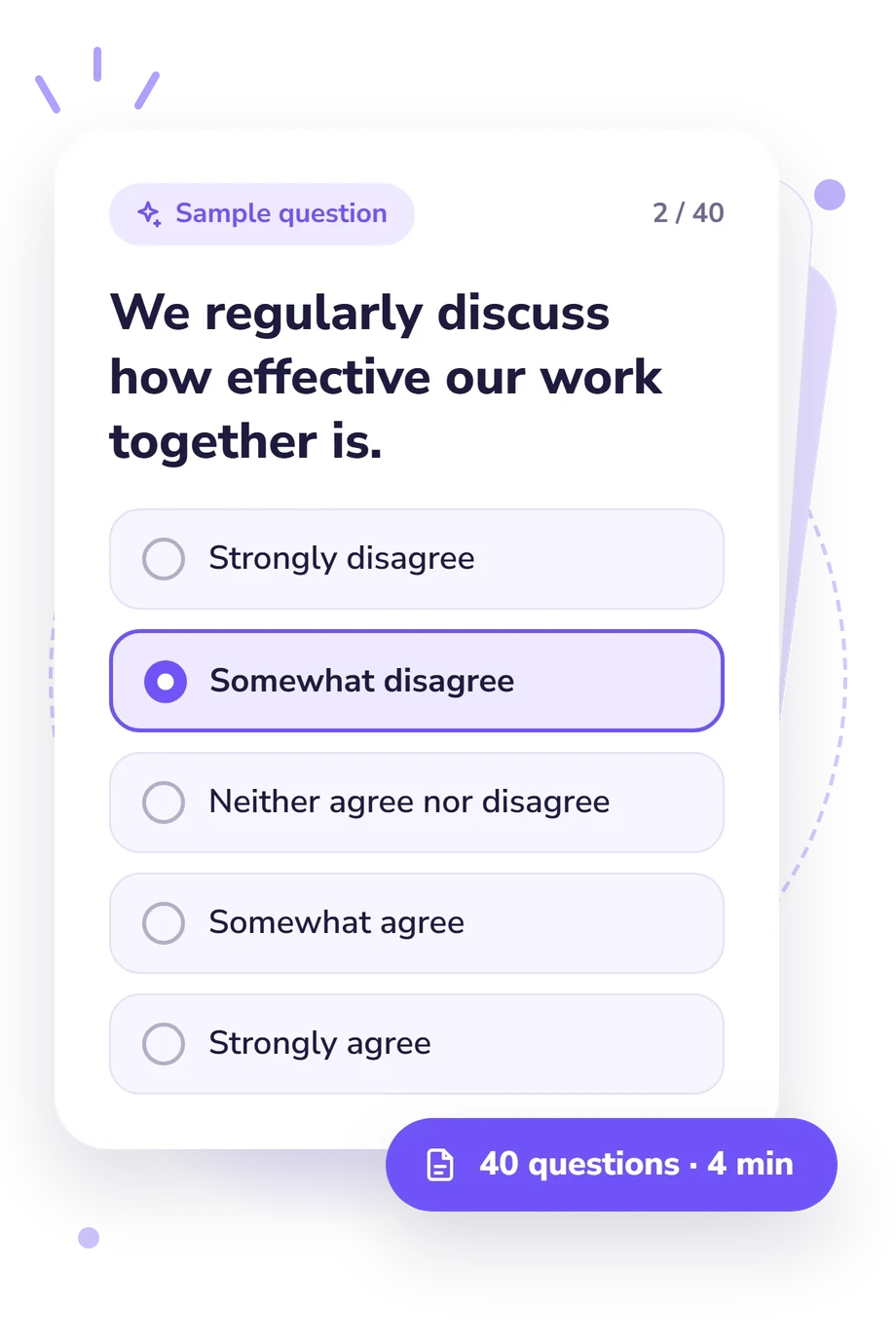
In team-based review and learning contexts, the Group Reflectiveness Scale provides a brief self-report measure of participants’ perceived readiness to step back and evaluate how the group works. Developed by Donald A. Schön and Chris Argyris, it is intended to inform structured discussion of team processes and opportunities for improvement.

The measure consists of 20 items and typically takes about 4 minutes to complete. Items focus on attitudes and openness toward collective reflection, including willingness to examine mistakes, consider alternative approaches, and engage in candid discussion. Results from the Group Reflectiveness Scale are commonly used as a screening snapshot to guide facilitation, coaching, or debriefing by identifying areas where additional support for reflective practice may be indicated.

Author: Chris Argyris, Donald A. Schön
Literature: West, M. A. Reflexivity and work group effectiveness: A conceptual integration. In M. A. West (Ed.), Handbook of work group psychology. John Wiley & Sons. 1996.
Test Question Form
You Might Also Like
Reflectiveness Questionnaire
This self-report measure is designed to assess individual differences in re…
Start Test
Class Group Reflexivity
This measure is used in school and adolescent group settings to examine how…
Start Test
Reflectiveness Questionnaire
Assessment of reflective self-focus and the tendency to monitor and evaluat…
Start Test
Popular tests
Narcissistic Personality Inventory (NPI)
This self-report measure is used to assess narcissism as a personality trai…
Start Test
Yale-Brown Obsessive Compulsive Scale (Y-BOCS)
This measure is used to rapidly quantify the current severity of obsessive…
Start Test
CRAFFT Screening Test (CRAFFT 2.1)
This brief screening measure is designed to identify potential alcohol and…
Start Test
Patient Health Questionnaire-9 (PHQ-9)
This measure is commonly used to quickly screen for the presence and severi…
Start Test
Maslach Burnout Inventory (MBI)
This self-report measure is used to assess occupational burnout symptoms in…
Start Test
Adolescent Anxiety Questionnaire
This measure is designed to support a brief appraisal of anxiety symptoms a…
Start Test
Emotional Creativity Inventory (ECI)
This self-report measure assesses individual differences in the originality…
Start Test
Horne–Ostberg Morningness–Eveningness Questionnaire (MEQ)
Circadian preferences influence typical patterns of alertness and sleep tim…
Start Test
Ambivalent Sexism Inventory (ASI)
This measure is designed to assess attitudes toward women, including both o…
Start Test
Internalized Misogyny Scale (IMS)
This measure is designed to assess internalized negative beliefs and stereo…
Start Test
Perceived Stress Scale (PSS-10)
This self-report measure assesses the degree to which individuals appraise…
Start Test
Impulsive Behavior Scale (SUPPS-P)
Impulsivity is a multidimensional construct that is often assessed with bri…
Start Test
Clinical Institute Withdrawal Assessment for Alcohol, Revised (CIWA-Ar)
This rating scale is used to rapidly assess the severity of alcohol withdra…
Start Test
Positive and Negative Affect Schedule (PANAS)
This measure provides a brief self-report assessment of current or typical…
Start Test
Light Triad Scale (LTS)
This self-report measure assesses prosocial personality tendencies and orie…
Start Test
Suicidal Ideation Scale
In clinical settings, the Suicidal Ideation Scale is used to structure an i…
Start Test
Body Dysmorphic Disorder Scale (BDD-D)
This brief self-report measure is designed to screen for and quantify distr…
Start Test
Beck Anxiety Inventory (BAI)
This measure is a brief self-report inventory used to screen for anxiety sy…
Start Test
Differential Test of Perfectionism
This instrument is used to screen for perfectionism-related attitudes and t…
Start Test
Locus of Control Scale
This measure assesses generalized expectancies regarding the degree to whic…
Start Test
New Apathy Scale
This brief self-report measure is used to screen for apathy-related symptom…
Start Test
Perth Alexithymia Questionnaire (PAQ)
This measure assesses individual differences in alexithymia, including diff…
Start Test
Social Intelligence Scale
This brief self-report measure is designed to support rapid screening of in…
Start Test
Fear Test
This measure is designed to evaluate individual differences in fear-related…
Start Test
Neuroticism Level Scale
The measure is intended for brief screening of an individual’s propensity t…
Start Test
Aggressiveness Indicators Screening Questionnaire
This screening tool is designed to quickly identify behavioral indicators a…
Start Test
Comments
Leave a Comment