
Moral Motivation Assessment Test
How the Scales are Structured
Who Usually Takes This Test?
See How You Compare
Below is a preview of how scores are typically distributed across each scale.
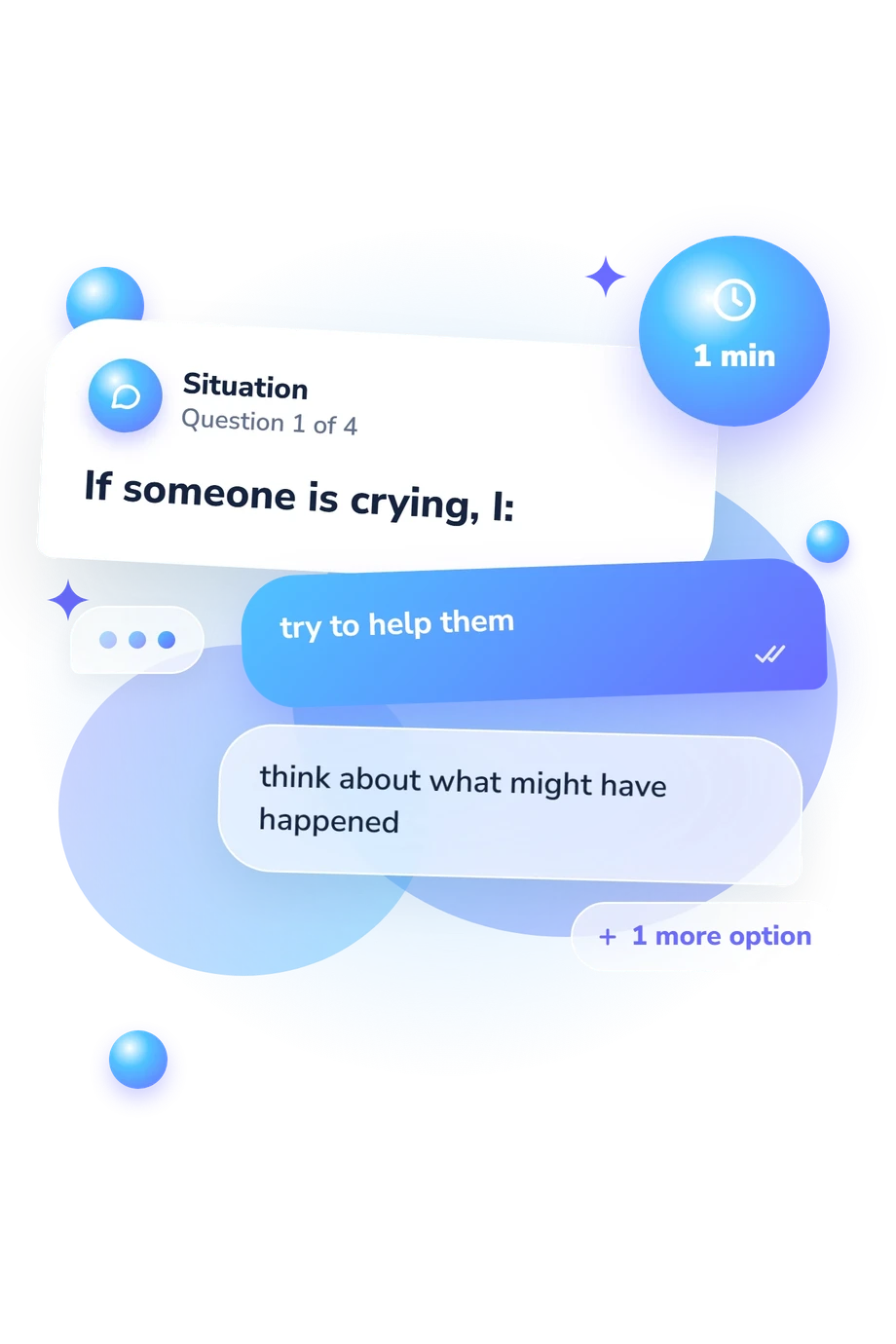
Example Questions From the Test
- try to help them
- think about what might have happened
- do not pay attention
- I will tell him to stop bothering me.
- I will say that I cannot help him.
- c) I'll tell him to ask his parents to buy him a game like that
- I will promise that he can come with a friend and play.
- I would not pay attention.
- b) I'll say he's a softie
- I would explain that it is not a big deal.
- I would say they need to get better at that game.
Moral Motivation Assessment Test - Description and methodology of the test
People who want to examine how moral considerations enter social choices may find the Moral Motivation Assessment Test useful for brief self-reflection. It focuses on responses to another person’s distress, disappointment, or request for help, indicating whether conduct tends to be guided by moral principles and accepted values. As a moral motivation quiz, this assessment prompts reflection on everyday decisions.
What This Assessment Explores
The items cover four situations: someone is crying, a young child asks to join a game, someone is upset after losing, and a classmate is upset with the respondent. Choices involve attention, help, dismissal, reciprocal upset, or self-defence, showing contexts in which moral principles may guide conduct.
Anyone seeking a quick picture of moral orientation in ordinary decisions can use this questionnaire. As a moral values assessment, this questionnaire considers whether accepted values influence conduct when another person’s needs require a response.
Moral Motivation Level is the 0-4 scale. It measures how strongly moral principles guide behavior and decisions, including moral attitudes and orientation toward generally accepted values. Its bands are:
- Low (0-1) is the lower displayed band.
- Moderate (2-3) is the middle displayed band.
- High (4-4) is the highest displayed band.
Methodology and Scientific Basis
Each item presents one of four social situations: a crying person, a young child asking to join a badminton game, someone upset after losing, or a classmate upset with the respondent. Choices range from attention or help to dismissal, reciprocal upset, or self-defence. The respondent chooses the action that most closely matches them, making this moral motivation questionnaire a behaviorally framed self-report rather than a test of abstract knowledge.
The questionnaire is conceptually consistent with Shilova’s work on moral motivation and with moral-education studies by Antasheva and by Kotsenko, Pavlova, and Sorokopud. These works provide context for principles and values in conduct, but do not establish that this four-item version was adapted or validated.
Results are reported on the single displayed scale and assigned one of its bands. The item-to-score mapping is not stated for this version. It has no stated standardization evidence, so the result is best used to examine response tendencies.
Self-report can be shaped by social desirability, mood, and self-awareness; the result describes these choices without proving the same response in every conflict.
- Shilova, Maria Ivanovna. Theory and Practice of Improving the Process of Educating Ideological and Moral Qualities in the Adolescent Personality: Dissertation Abstract. Leningrad State Pedagogical Institute, 1985.
- Antasheva, Yu. Primary School: Lessons in Morality. Social Pedagogy, no. 3, 2011, pp. 97-104.
- Kotsenko, V. N., Pavlova, E. I., and Sorokopud, Yu. V. Organization of Moral and Ethical Education of College Students in Modern Conditions. European Proceedings of Social and Behavioural Sciences, 2020, pp. 551-555. 10.15405/epsbs.2020.08.02.72
Updated: