
Workplace Aggression Scale (WPAS) Test
How the Scales are Structured
Who Usually Takes This Test?
See How You Compare
Below is a preview of how scores are typically distributed across each scale.
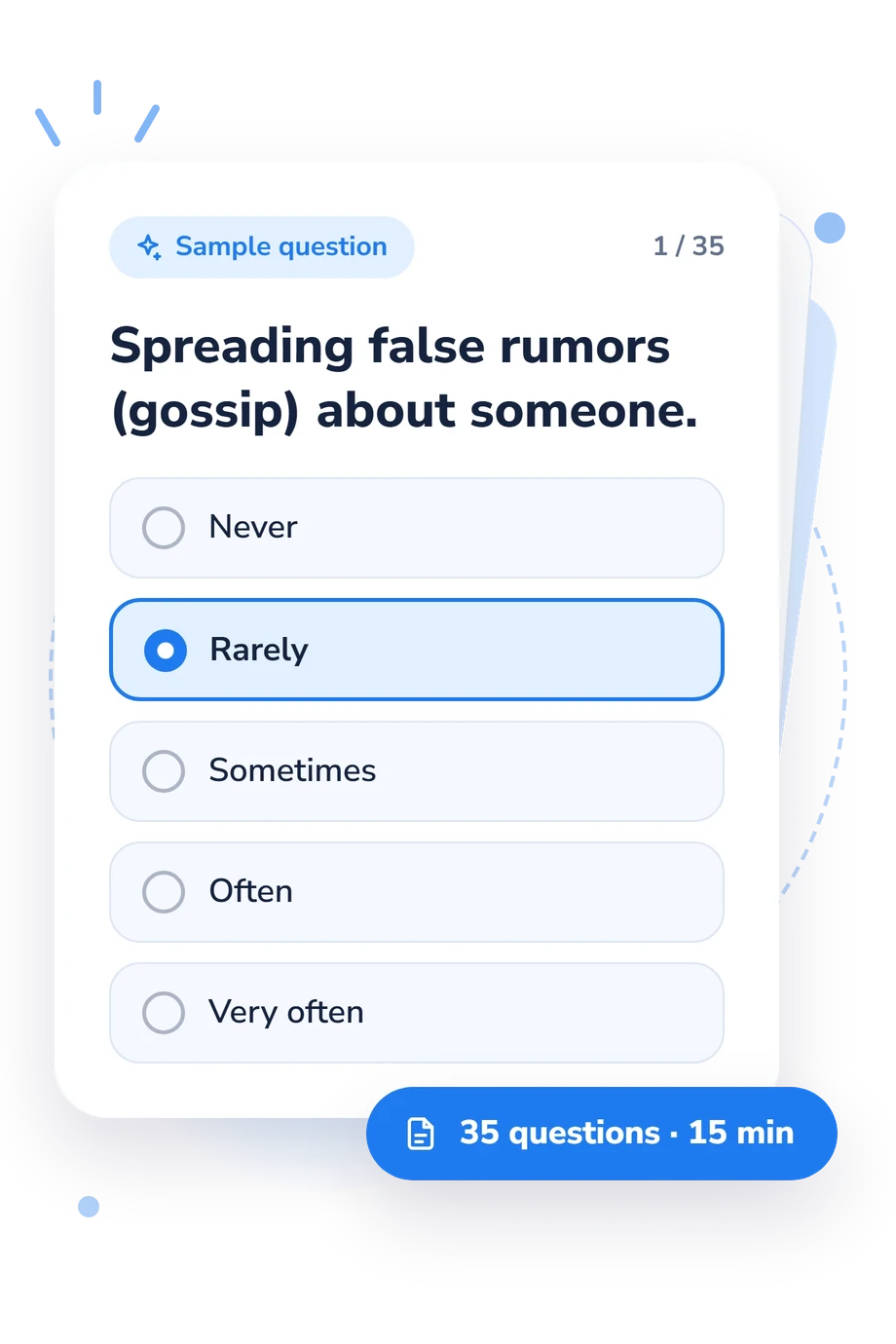
Example Questions From the Test
- Never
- Rarely
- Sometimes
- Often
- Very often
- Never
- Rarely
- Sometimes
- Often
- Very often
- Never
- Rarely
- Sometimes
- Often
- Very often
Workplace Aggression Scale (WPAS) Test - Description and methodology of the test
People who want to examine hostility, exclusion, sabotage, or intimidation in professional relationships can use the Workplace Aggression Scale (WPAS) Test as a structured self-report exercise. It organizes experienced or observed workplace behaviors into one interpretable profile, helping readers use this workplace aggression questionnaire to notice patterns that may otherwise be minimized, normalized, or difficult to discuss.
What This Assessment Explores
Physical violence is only one part of what the questionnaire examines. The items sample social undermining, contemptuous communication, interference with work, resource obstruction, property damage, threats to safety, and physical attacks. Respondents can consider conduct they experienced, observed, or enacted through this questionnaire, keeping the result focused on recurring patterns rather than one isolated event.
The Workplace Aggression scale totals 0-140, with Low (0-46), Moderate (47-93), and High (94-140) bands. The main themes represented by the items are:
- Interpersonal disparagement reflects rumors, belittling, hostile looks, and unfair accusations.
- Verbal hostility covers insults, raised voices, interruptions, sexual comments, and intimidation.
- Work obstruction captures withheld information, delayed tasks, denied equipment, and undermined projects.
- Material and physical aggression includes damage, theft, assaults, weapons, and safety interference.
Methodology and Scientific Basis
Each item asks how often a described act occurs, with responses from Never to Very often. This format captures repeated exposure or conduct rather than a yes-or-no judgment. The workplace aggression assessment is a behavioral pattern profile, not a label for character.
The scale sums item scores across all WPAS items to produce the displayed total. Since the points assigned to response options are not specified, reconstructing a formula from the range alone would be misleading.
Methodologically, the questionnaire is conceptually consistent with Workplace Aggression Scale (Neuman & Baron, 1998), which organizes workplace aggression by specific forms and targets. It is not presented as a verbatim adaptation of that published instrument. The 1999 study by Baron, Neuman, and Geddes also links workplace aggression with perceived injustice and Type A characteristics.
These labels are descriptive bands and should not be treated as clinical thresholds. Self-report scores may shift with current conflict, memory, self-awareness, and willingness to disclose, so interpret the result alongside the workplace context and any broader assessment needed to understand it.
- Baron, R. A., Neuman, J. H., & Geddes, D. (1999). Social and personal determinants of workplace aggression: Evidence for the impact of perceived injustice and the Type A Behavior Pattern. Aggressive Behavior, 25(4), 281-296. 10.1002/(SICI)1098-2337(1999)25:4<281::AID-AB4>3.0.CO;2-J
- Neuman, J. H., & Baron, R. A. (1998). Workplace violence and workplace aggression: Evidence concerning specific forms, potential causes, and preferred targets. Journal of Management, 24(3), 391-419. 10.1177/014920639802400305
Updated: