
Teacher-Student Questionnaire Test
How the Scales are Structured
Who Usually Takes This Test?
See How You Compare
Below is a preview of how scores are typically distributed across each scale.
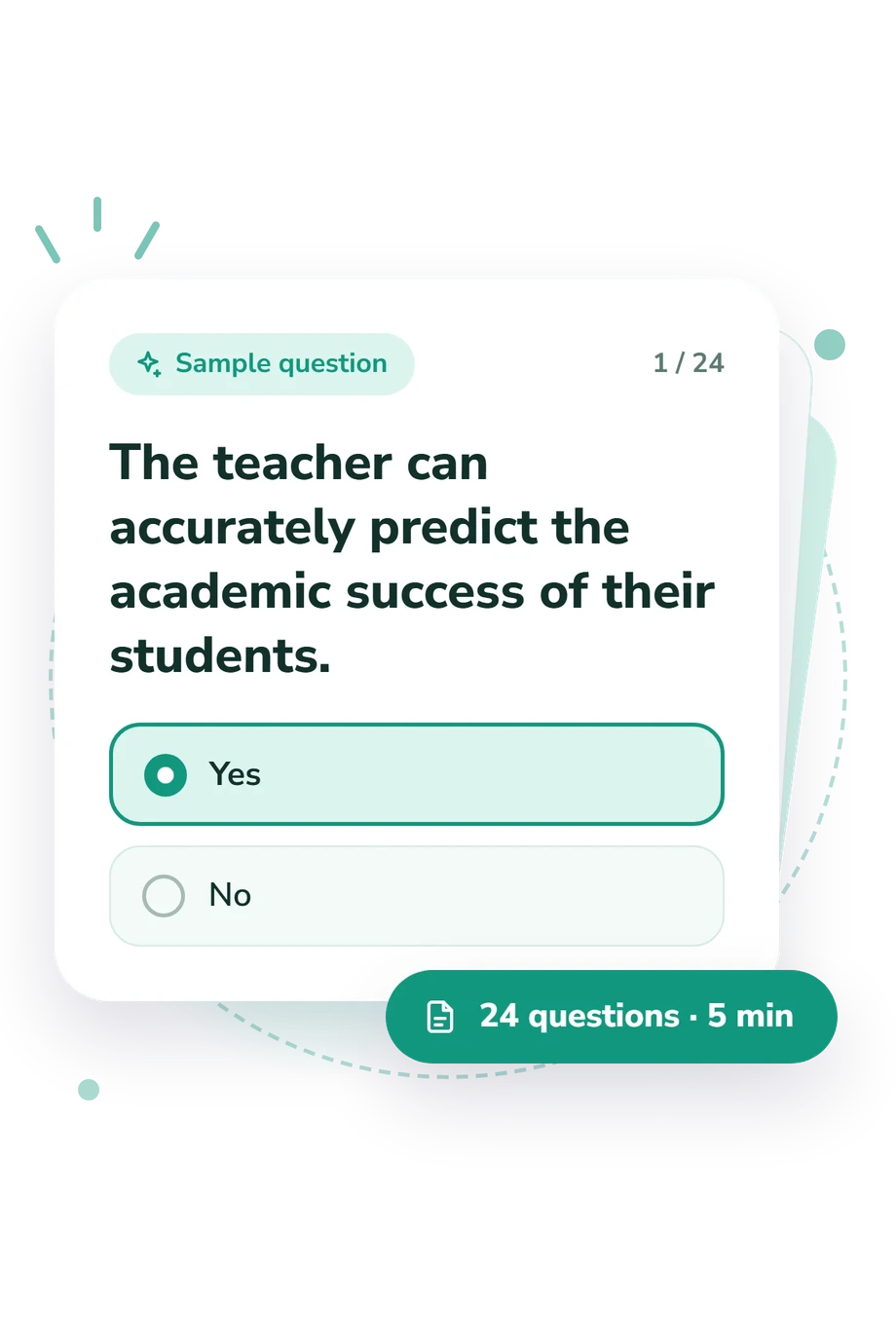
Example Questions From the Test
- Yes
- No
- Yes
- No
- Yes
- No
Teacher-Student Questionnaire Test - Description and methodology of the test
Students who want to understand why a classroom relationship feels supportive, distant, or difficult can use the Teacher-Student Questionnaire Test to organize their impressions. This teacher-student relationship test focuses on the student’s view of actual interaction quality, emotional liking or positive attitude and trust, and recognition of the teacher’s professional competence. It is suited to reflective use when a clearer profile could help explain cooperation, comfort, and communication.
What This Assessment Explores
Students can use this teacher-student relationship questionnaire to reflect on a relationship when cooperation or communication is difficult to interpret. It separates the student's report of actual interaction quality, liking or positive attitude and trust, and recognition of the teacher's professional competence. Higher results indicate constructive interaction, greater warmth and trust, or recognition of the teacher's competence.
The dimensions are:
- Behavioral (0-8) describes actual interaction quality as reported by the student: Low engagement (0-2), Mixed engagement (3-5), or Constructive engagement (6-8).
- Emotional (0-8) reflects the student's liking, positive emotional attitude, and trust toward the teacher: Low warmth/trust (0-2), Mixed feelings (3-5), or High warmth/trust (6-8).
- Cognitive (0-8) shows the student's recognition of the teacher's professional competence: Low recognition (0-2), Moderate recognition (3-5), or High recognition (6-8).
Together, these dimensions indicate whether a concern centres on interaction, emotional attitude and trust, or recognition of competence.
Methodology and Scientific Basis
Responses use yes-or-no choices and address fairness, attention, advice, trust, teaching methods, punishment, and awareness of strengths. Since both favorable and unfavorable wording appears, answer each statement as written; “yes” is not automatically positive. The result screen organizes responses into the displayed dimensions. The questionnaire does not provide a point-by-point weighting rule, so the score ranges alone cannot show how each yes-or-no answer contributes.
Conceptually, the domains parallel published relational models that distinguish behavioral, emotional, and cognitive aspects; this questionnaire is not presented as an adaptation of those instruments. Ivanova and Dimitrov provide a related coach-athlete application, while Jowett and colleagues connect comparable relational dimensions with teaching and learning effectiveness. These sources support the choice of domains but do not establish the same standardization or psychometric evidence for this online questionnaire.
In practice, this teacher relationship assessment is most useful for organizing self-reflection and discussion. Results may shift with recent conflict, classroom context, response bias, or limited self-awareness, so the profile represents a current personal perspective rather than a standalone diagnosis.
- Hanin, Yuri L. (1980). Psychology of Communication in Sport. Moscow: Physical Culture and Sport Publishers.
- Ivanova, Vesela, and Vasil Dimitrov. (2020). Relationships Between Coaches and Athletes in Rhythmic Gymnastics. CBU International Conference on Innovations in Science and Education 2020: Social Sciences, 98-103. 10.12955/pss.v1.54
- Jowett, Sophia, Victoria E. Warburton, Lee C. Beaumont, and Luke Felton. (2023). Teacher-Student Relationship Quality as a Barometer of Teaching and Learning Effectiveness: Conceptualization and Measurement. British Journal of Educational Psychology, 93(3), 842-861. 10.1111/bjep.12600
Updated: