
Types of Personal Role Self-Efficacy Test
How the Scales are Structured
Who Usually Takes This Test?
See How You Compare
Below is a preview of how scores are typically distributed across each scale.
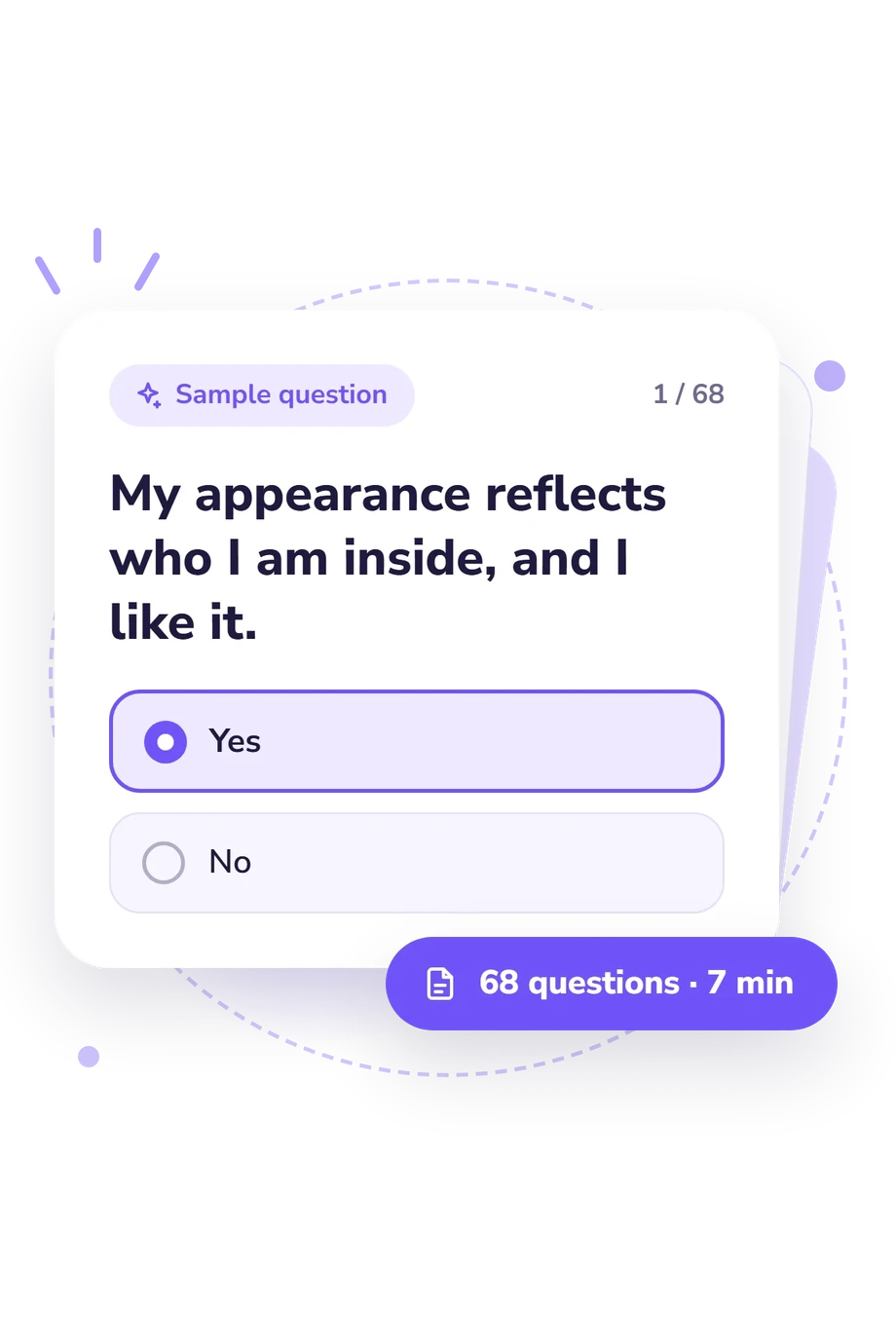
Example Questions From the Test
- Yes
- No
- Yes
- No
- Yes
- No
Types of Personal Role Self-Efficacy Test - Description and methodology of the test
People considering this questionnaire may benefit from comparing confidence across role demands rather than relying on a single overall impression. The Types of Personal Role Self-Efficacy Test can show where perceived capability feels consistent and where a role-specific difference deserves closer attention. A personal role self-efficacy perspective may help reflective readers connect their answers with recent choices, responsibilities, and expectations.
What This Assessment Explores
These items examine perceived role self-efficacy across three domains rather than observed skill. They cover self-expression, values, emotional control, work performance, setbacks, conflict, and flexible decisions, asking how confidently a person expects to act when roles or situations change.
The displayed scales are:
- Situational Role (0-10) measures situational role self-efficacy: confidence in effective action and adaptation across changing interpersonal situations: Low 0-3; Moderate 4-6; High 7-10.
- Professional Role (0-12) measures confidence in performing professional duties in line with socially approved standards and beliefs about professional capabilities: Low confidence 0-4; Moderate confidence 5-8; High confidence 9-12.
- Personal Role (0-12) measures confidence in pursuing self-defined goals and standards consistent with self-concept: Low 0-4; Moderate 5-8; High 9-12.
Higher results indicate stronger perceived capability in that domain; lower results mark a topic for reflection, not a fixed label.
Methodology and Evidence Base
Each statement is answered Yes or No. This role self-efficacy questionnaire groups responses into three role scores. Results are presented as three scale totals with displayed bands; the contribution of each Yes/No response is not defined.
Enin's 2025 development and validation study of Types of Role Self-Efficacy provides the closest published evidence. The online questionnaire is conceptually consistent with that study, not presented as an adaptation of it. It is not standardized and has no population norms.
Bandura’s self-efficacy theory offers a compatible framework: perceived capability can influence persistence, strategy choice, and responses to obstacles. The role-focused construct is compatible with this framework; the questionnaire is not presented as a formal application of the theory. The result is a self-reflection profile, not a diagnostic conclusion.
Interpretation is strongest when the three results are compared with recent experience and the situations behind the answers. Current mood, limited self-observation, and the wish to present oneself favorably can affect self-report scores, so the profile is best used as a structured starting point for reflection rather than a fixed description of ability.
- Enin, Victor V. (2025). Development and Validation of the Questionnaire “Types of Role Self-Efficacy”. Social Psychology and Society, 16(1), 175-192. 10.17759/sps.2025160110
- Enin, Victor V. (2025). Types of Role-Based Self-Efficacy: A Set of Data. RusPsyData: A Repository of Psychological Research and Tools. 10.48612/MSUPE/xgp1-uuke-k1h3
- Bandura, Albert. (1977). Self-efficacy: Toward a unifying theory of behavioral change. Psychological Review, 84(2), 191-215. 10.1037/0033-295X.84.2.191
Updated: