
Situational Motivation Scale (SIMS) Test
How the Scales are Structured
Who Usually Takes This Test?
See How You Compare
Below is a preview of how scores are typically distributed across each scale.
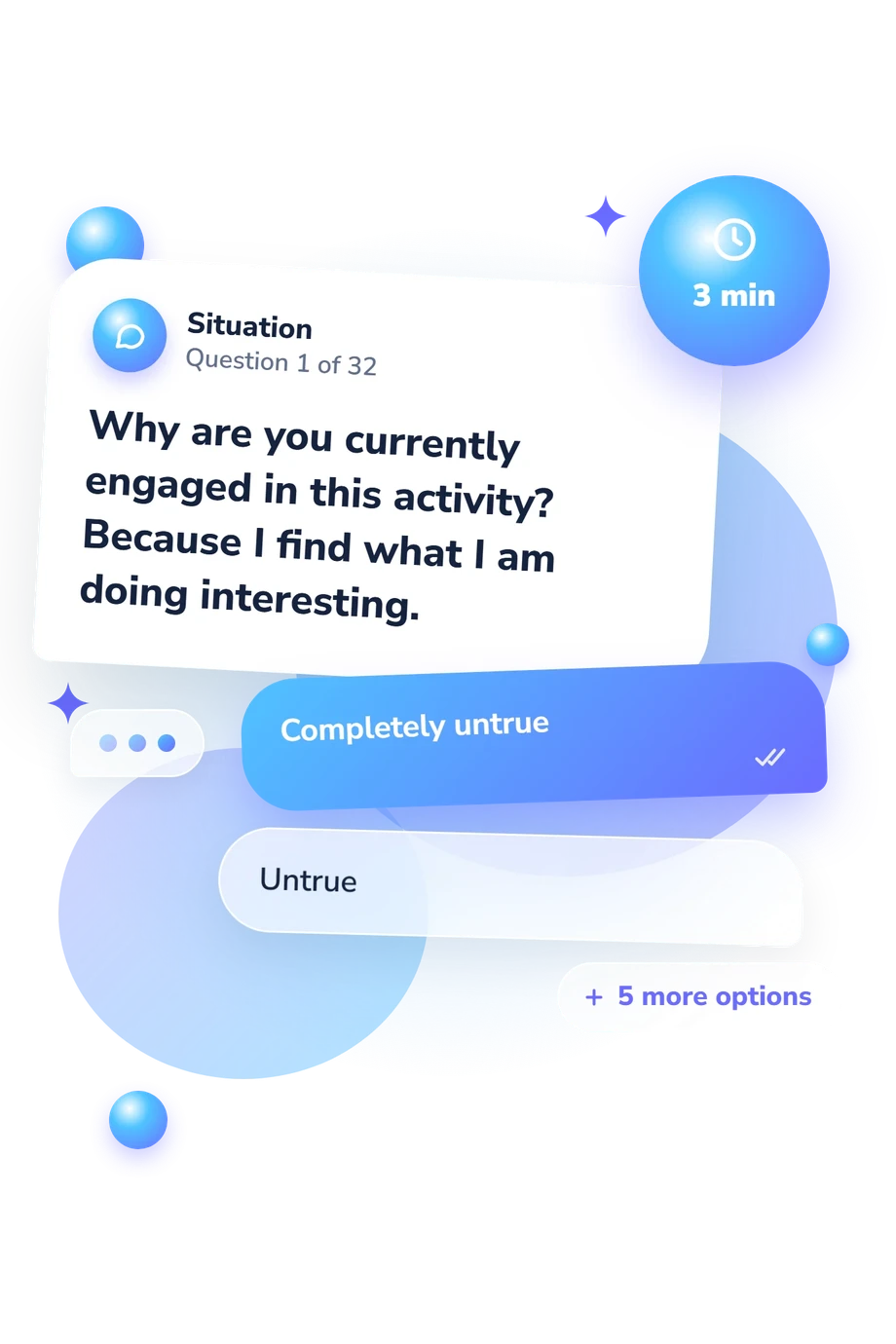
Example Questions From the Test
- Not at all true
- Untrue
- Rather untrue
- Neither true nor untrue
- Rather true
- True
- Exactly true
- Not at all true
- Not true
- Somewhat not true
- Neither true nor false
- Somewhat true
- True
- Completely true
- Not at all true
- Untrue
- Somewhat untrue
- Neither true nor untrue
- Somewhat true
- True
- Exactly true
Situational Motivation Scale (SIMS) Test - Description and methodology of the test
People who want to understand why they persist with, avoid, or comply with a current activity can use this situational motivation questionnaire for focused self-reflection. The Situational Motivation Scale (SIMS) Test describes whether engagement is rooted in enjoyment, personal value, outside demands, or a sense that the activity is pointless. It suits anyone examining motivation in a specific task rather than seeking a permanent personality label.
What This Assessment Explores
Motivation is not treated as one quality. The SIMS motivation scale separates reasons for engaging in a particular activity: personal meaning, external pressure, perceived futility, and inherent enjoyment. Read the profile as situation-specific, since motives may differ across work, study, exercise, and other tasks.
The four displayed dimensions are:
- Amotivation (4-28) measures absent intention or perceived futility; Low 4-11, Moderate 12-19, and High 20-28 indicate increasing levels.
- External Regulation (4-28) measures engagement shaped by demands, rewards, or punishment; Low external regulation 4-12, Moderate external regulation 13-20, and High external regulation 21-28 show the result band.
- Identified Regulation (4-28) measures whether the activity’s outcome feels personally important; Low 4-12, Moderate 13-20, and High 21-28 describe increasing endorsement.
- Intrinsic Motivation (4-28) measures interest and enjoyment in the activity itself; Low 4-12, Moderate 13-20, and High 21-28 mark the displayed levels.
Methodology and Evidence Base
Each item asks how well a reason for the activity fits the respondent, using a seven-point scale from low to high endorsement. Wording varies from “not at all true” to “untrue,” but each response indicates agreement. Themes include enjoyment, importance, obligation, choice, and perceived value.
The 16 items form four domains. Responses are grouped by motive, so results are reported separately rather than combined. Different motives can coexist: an activity may feel important while pursued under pressure.
The questionnaire’s item content and four-domain structure correspond to the published Situational Motivation Scale (SIMS), linking results to enjoyment, valued outcomes, external pressure, and low perceived meaning. Its interpretation follows self-determination theory associated with Ryan and Deci, which distinguishes enjoyment, valued outcomes, external contingencies, or low perceived meaning.
This situational motivation assessment is a snapshot of the selected context, not a fixed trait measure. Displayed bands are descriptive ranges in this questionnaire and should not be read as clinical cutoffs. Self-report may shift with mood, context, self-awareness, and interpretation, so read results alongside the circumstances.
- Guay, F., Vallerand, R. J., & Blanchard, C. (2000). On the Assessment of Situational Intrinsic and Extrinsic Motivation: The Situational Motivation Scale (SIMS). Motivation and Emotion, 24(3), 175-213. 10.1023/A:1005614228250
- Ryan, R. M., & Deci, E. L. (2000). Intrinsic and Extrinsic Motivations: Classic Definitions and New Directions. Contemporary Educational Psychology, 25(1), 54-67. 10.1006/ceps.1999.1020
- Deci, E. L., & Ryan, R. M. (1985). Intrinsic Motivation and Self-Determination in Human Behavior. New York: Plenum Press. 10.1007/978-1-4899-2271-7
Updated: