
Zung Self-Rating Depression Scale (SDS) Test
How the Scales are Structured
Who Usually Takes This Test?
See How You Compare
Below is a preview of how scores are typically distributed across each scale.
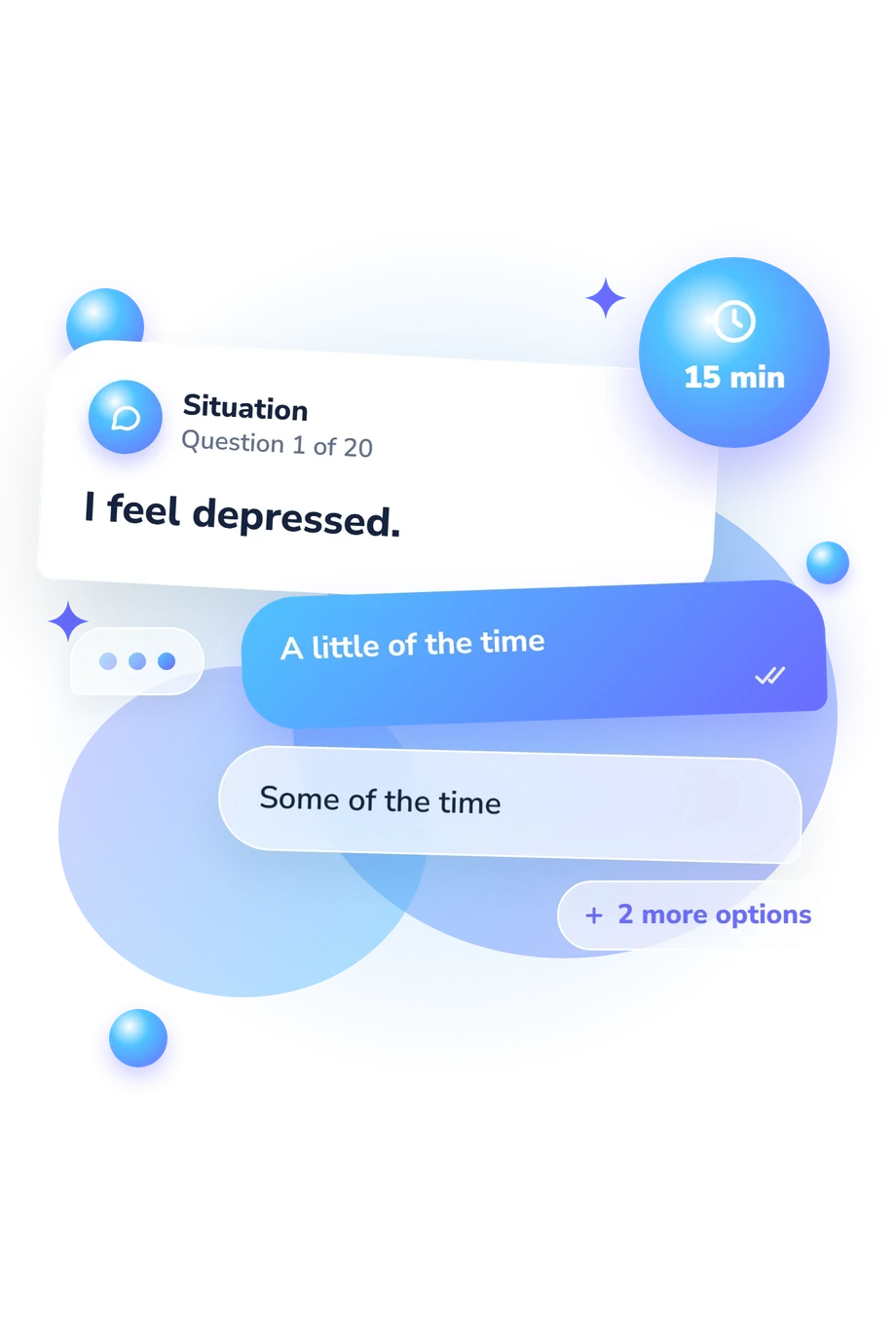
Example Questions From the Test
- A little of the time
- Some of the time
- Good part of the time
- Most of the time
- A little of the time
- Some of the time
- Good part of the time
- Most of the time
- Very rarely
- Rarely
- Often
- Most of the time or constantly
Zung Self-Rating Depression Scale (SDS) Test - Description and methodology of the test
People who want a structured way to reflect on changes in mood and everyday functioning may use the Zung Self-Rating Depression Scale (SDS) Test to organize recent experiences. This self-rating depression scale considers emotional, physical, cognitive, and social signs through frequency-based responses, giving the reader a severity-oriented result rather than a narrative interpretation. It suits personal check-ins when a clear starting point is useful.
What This Assessment Explores
The questionnaire examines depressive symptoms as a pattern affecting emotion, the body, thinking, motivation, and daily functioning. It suits people who want a consistent way to review recent experiences rather than rely on one overall impression.
Across its items, this Zung depression scale questionnaire brings together:
- Mood and outlook show sadness, crying, irritability, hope, and whether life feels worthwhile.
- Physical changes capture sleep, appetite, weight, constipation, heartbeat, and unexplained fatigue.
- Mental functioning reflects clarity, decision-making, restlessness, and completing manageable tasks.
- These items cover pleasure, social connection, usefulness, and thoughts about death, allowing the overall result to reflect depressive symptom burden across these areas.
The displayed Depression Level scale spans 20-80. Low is 20-39, Moderate is 40-59, and High is 60-80. The result represents the overall level of depressive symptomatology indicated by the responses.
Methodology and Scientific Basis
Each statement uses one of four ordered frequency choices spanning low to high frequency. The respondent judges how closely each statement matches recent experience, and the item responses are combined into one total. No separate weighting rule is specified for this questionnaire, so no particular point value should be assumed for any answer.
Its structure is conceptually consistent with the published Zung Self-Rating Depression Scale (SDS), introduced by William W. K. Zung in 1965. Zung, Richards, and Short later examined the instrument in an outpatient clinic, while Dunstan and Scott (2019) showed why cutoff interpretation can vary across populations and assessment purposes.
In practice, the result functions as a depression severity assessment, with a higher displayed band indicating greater reported symptom burden within the questionnaire's scoring framework. Current mood, recall, willingness to disclose, and personal interpretation can affect self-report. Published studies concern the SDS and particular study populations; they do not establish new norms for this online presentation. The result is therefore a structured indicator for reflection rather than a clinical diagnosis or a substitute for broader assessment.
- Zung, W. W. K. (1965). A Self-Rating Depression Scale. Archives of General Psychiatry, 12(1), 63-70. 10.1001/archpsyc.1965.01720310065008
- Zung, W. W. K., Richards, C. B., and Short, M. J. (1965). Self-Rating Depression Scale in an Outpatient Clinic: Further Validation of the SDS. Archives of General Psychiatry, 13(6), 508-515. 10.1001/archpsyc.1965.01730060026004
- Dunstan, D. A., and Scott, N. (2019). Clarification of the Cut-Off Score for Zung’s Self-Rating Depression Scale. BMC Psychiatry, 19, 177. 10.1186/s12888-019-2161-0
Updated: