
Wender Utah Rating Scale (WURS) Test
How the Scales are Structured
Who Usually Takes This Test?
See How You Compare
Below is a preview of how scores are typically distributed across each scale.
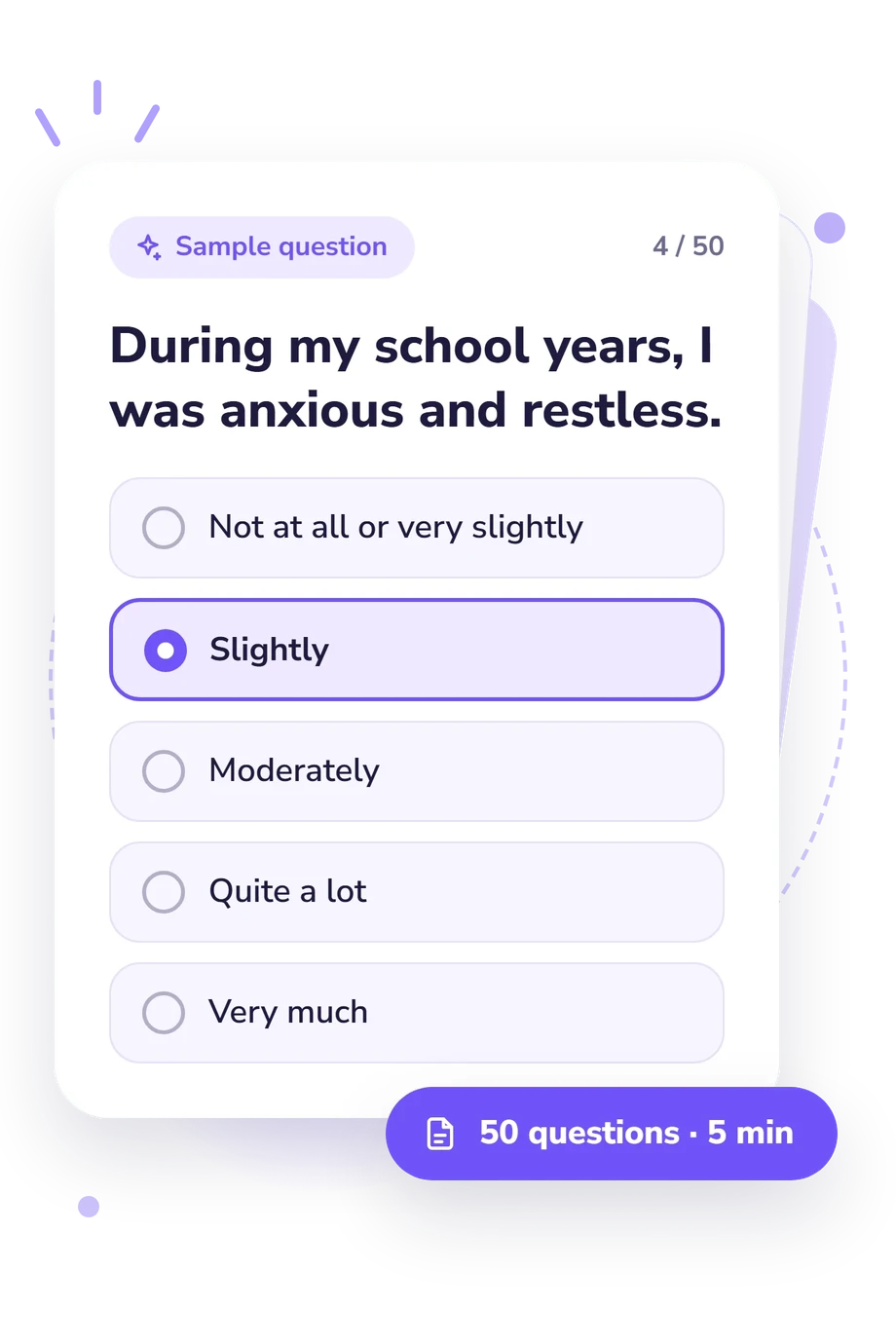
Example Questions From the Test
- Not at all or very little
- Slightly
- Moderately
- Quite a lot
- Very much
- Not at all or very slightly
- Slightly
- Moderately
- Quite a lot
- Very much
- Not at all or very slightly
- Slightly
- Moderately
- Quite a bit
- Very much
Wender Utah Rating Scale (WURS) Test - Description and methodology of the test
Adults who are trying to understand whether childhood patterns may relate to present-day attention difficulties can use the Wender Utah Rating Scale (WURS) Test as a structured reflection. The questions focus on school-age memories, mood, behavior, and learning, making this adult ADHD test a way to organize retrospective experiences that may otherwise feel scattered. The result shows the dimensions represented in the profile and the bands reached within each scale.
What This Assessment Explores
The items cover distractibility, daydreaming, persistence, school performance, mood, anger, impulsivity, rule-following, and peer relationships. Adults can therefore review childhood functioning across possible childhood ADHD symptoms, while the result shows each dimension and its band rather than comparing scales.
Four displayed scales organize that profile:
- Self-Esteem and Negative Mood (0–20) captures childhood worry, depressed mood, and low self-regard: Low 0–6; Moderate 7–13; High 14–20.
- Inattention and School Problems (0–28) captures concentration and learning difficulties: Low 0–9; Moderate 10–18; High 19–28.
- Impulsivity and Behavioral Problems (0–52) captures impulsivity, anger outbursts, childhood behavior, self-control, and rule violations: Low 0–17; Moderate 18–34; High 35–52.
- ADHD Symptom Scale (0–100) assesses adult ADHD symptoms retrospectively; Low likelihood 0–35, Elevated likelihood 36–45, and High likelihood 46–100 indicate likelihood of childhood ADHD; scores of 46 or higher have greater diagnostic specificity.
Methodology and Evidence Base
The questionnaire uses retrospective self-report. Each item asks how characteristic a school-age experience was, offering five ordered choices from not at all or very little to very much. Responses record degree rather than yes/no judgments and are combined into displayed scale totals. The online version is not established as reproducing the source instrument's recoding, norms, or administration conditions, so interpretation is limited to its displayed totals and named bands.
This questionnaire is a 25-item WURS-25; the WURS described by Ward et al. (1993) is its parent instrument, not the exact online form. McCann et al. (2000) examined the WURS factor structure and discriminant validity in adults seeking ADHD evaluation. Gift et al. (2021) reported that the WURS-25 covers attention, academic, emotional, social, and behavioral features. Those publications support conceptual comparison, not proof that this online presentation reproduces their standardization.
Memory is a central limitation: current mood, recall accuracy, family reports, and personal interpretation can influence answers. Alongside current functioning, the Wender Utah scale highlights patterns for further assessment; its ADHD-related signal may overlap with depression or other explanations.
- Ward, Mark F., Paul H. Wender, and Fred W. Reimherr. “The Wender Utah Rating Scale: An Aid in the Retrospective Diagnosis of Childhood Attention Deficit Hyperactivity Disorder.” American Journal of Psychiatry 150, no. 6 (1993): 885–890. 10.1176/ajp.150.6.885.
- McCann, Barbara S., Leonard Scheele, Nicholas Ward, and Peter Roy-Byrne. “Discriminant Validity of the Wender Utah Rating Scale for Attention-Deficit/Hyperactivity Disorder in Adults.” The Journal of Neuropsychiatry and Clinical Neurosciences 12, no. 2 (2000): 240–245. 10.1176/jnp.12.2.240.
- Gift, Thomas E., Matthew L. Reimherr, Barrie K. Marchant, Tammy A. Steans, and Frederick W. Reimherr. “Wender Utah Rating Scale: Psychometrics, Clinical Utility and Implications Regarding the Elements of ADHD.” Journal of Psychiatric Research 135 (2021): 181–188. 10.1016/j.jpsychires.2021.01.013.
Updated: