
Junior Eysenck Personality Inventory (JEPI) Test
How the Scales are Structured
Who Usually Takes This Test?
See How You Compare
Below is a preview of how scores are typically distributed across each scale.
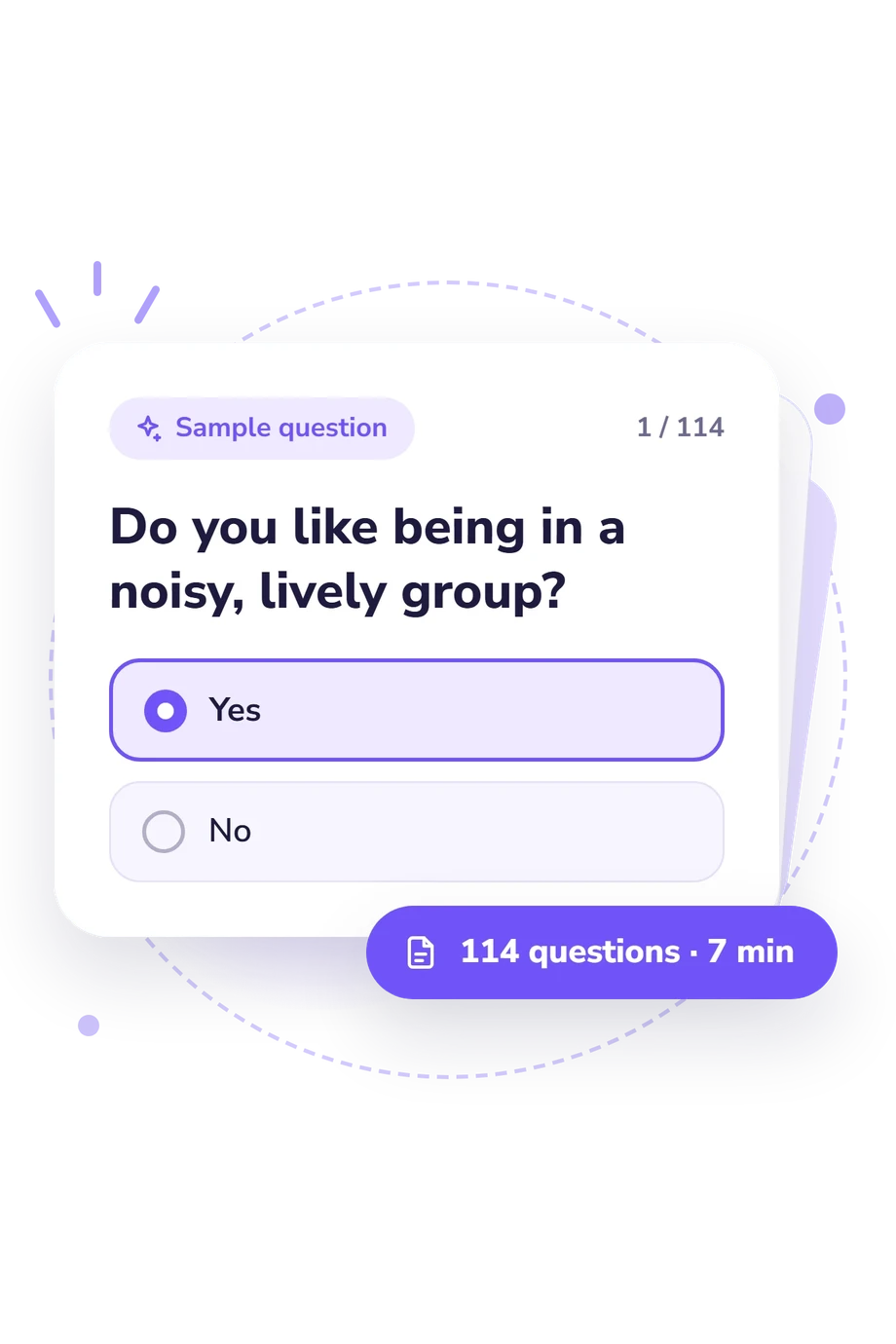
Example Questions From the Test
- Yes
- No
- Yes
- No
- Yes
- No
Junior Eysenck Personality Inventory (JEPI) Test - Description and methodology of the test
Readers who want a structured way to reflect on temperament can use the Junior Eysenck Personality Inventory (JEPI) Test to examine everyday patterns in sociability, mood, and emotional reactivity. The JEPI personality test is intended for younger respondents or adults answering about a child, with items about parents, homework, playmates, and children's groups. Its result offers a compact profile of tendencies rather than a fixed description of character.
What This Assessment Explores
Items cover sociability, activity, mood changes, worry, irritability, sleep-related thoughts, distractibility, loneliness, and sensitivity to criticism. These themes connect outward engagement with emotional steadiness and stress reactivity.
The Junior Eysenck questionnaire presents three displayed scales: a validity scale and two personality dimensions:
- Validity Scale (0–11) indicates response credibility: Credible responding (0–5) supports reliable interpretation, while Possible impression management (6–11) may reflect distortion or social desirability.
- Neuroticism (0–24) reflects emotional stability: Low (0–6) suggests steadiness, Moderate (7–13) an intermediate pattern, and High (14–24) greater anxiety, mood lability, or stress sensitivity.
- Extraversion-Introversion (0–24) reflects social energy: More introverted (0–8) suggests reserve and planning, Balanced (9–15) a middle pattern, and More extraverted (16–24) greater sociability and spontaneity.
Readers can use the pattern to reflect on how they approach groups, decisions, emotions, and pressure in ordinary situations. Together, the profile describes tendencies in self-report, not fixed character or guaranteed behavior.
Methodology and Scientific Basis
Methodologically, the questionnaire uses yes-or-no responses to short statements about everyday experiences. The questionnaire produces separate displayed scale scores, but its exact item-weighting rule is not specified. The displayed maximums show score ranges, not the weighting of individual answers, so no additional point rule should be inferred.
The online format is conceptually consistent with the published Junior Eysenck Personality Inventory, without being that published instrument itself. Its manual and S. B. G. Eysenck's 1965 paper describe the junior inventory's personality structure. Waters' study addresses the response-credibility dimension, and Bennett's later re-evaluation supports caution about treating early findings as universal.
This Eysenck personality assessment is best read as a structured self-report profile that describes response style, emotional stability, and social orientation. Mood, memory, reading comprehension, social desirability, and self-presentation can affect answers. The credibility score adds context to interpretation but cannot establish the accuracy of every answer. The response format also asks about everyday social activity, mood shifts, worry, distractibility, and reactions to criticism. The bands organize interpretation for this questionnaire; they are not a diagnosis or a prediction of conduct.
- Eysenck, S. B. G. (1965). Manual of the Junior Eysenck Personality Inventory. London: University of London Press.
- Eysenck, S. B. G. (1965). A new scale for personality measurements in children. British Journal of Educational Psychology, 35(3), 362–367. 10.1111/j.2044-8279.1965.tb01824.x
- Waters, T. J. (1968). The validity of the Junior Eysenck Personality Inventory Lie Scale. Educational and Psychological Measurement, 28(4), 1197–1206. 10.1177/001316446802800422
- Bennett, S. N. (1973). A re-evaluation of the Junior Eysenck Personality Inventory. British Journal of Educational Psychology, 43(2), 131–139. 10.1111/j.2044-8279.1973.tb00749.x
Updated: