
Eight-Item Gambling Questionnaire (EIGHT) Test
How the Scales are Structured
Who Usually Takes This Test?
See How You Compare
Below is a preview of how scores are typically distributed across each scale.
Example Questions From the Test
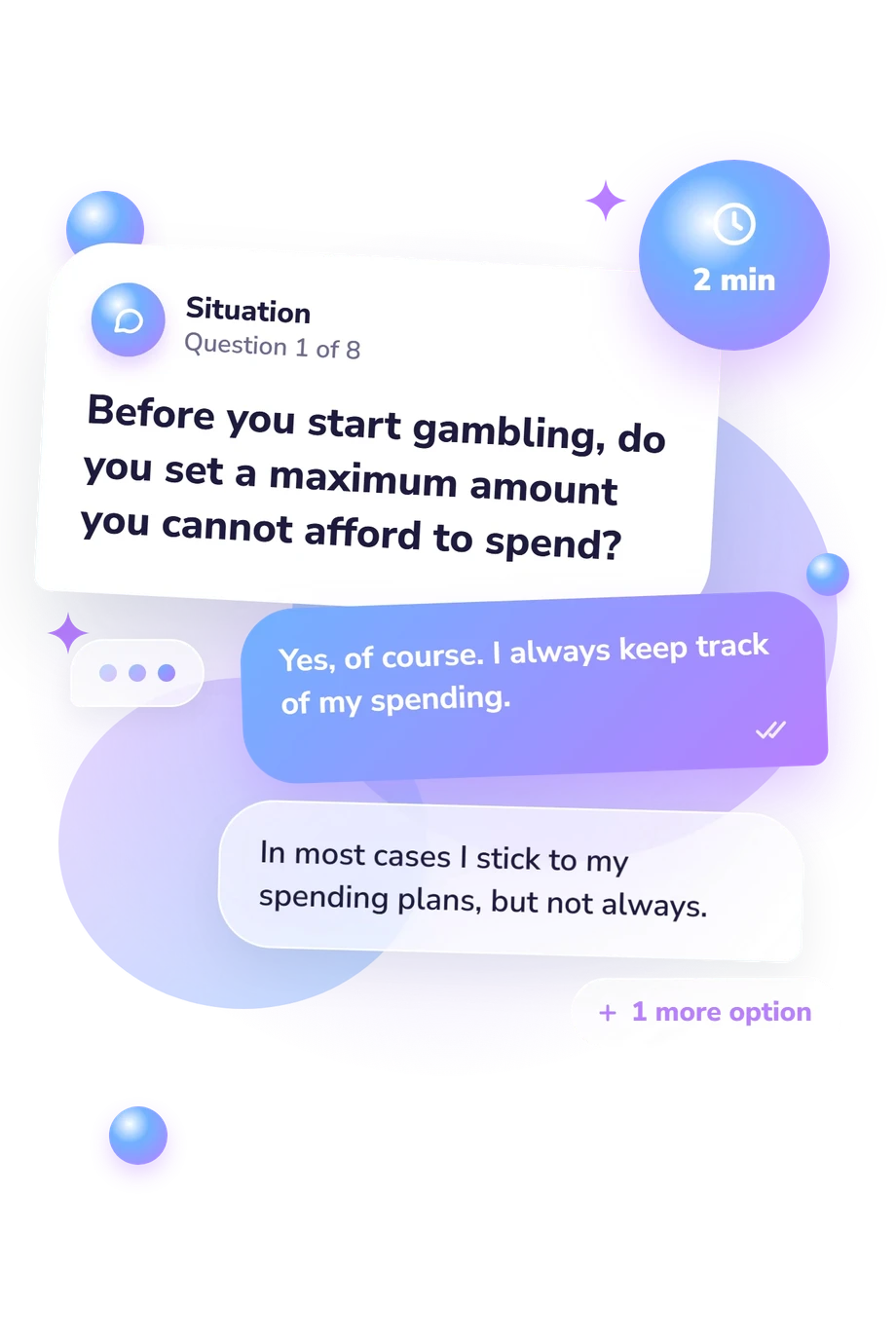
- Yes, of course. I always keep track of my spending.
- In most cases I stick to my spending plans, but not always.
- No. Limits are not for me!
- Yes, without hesitation.
- Sometimes, when I feel like it.
- No, that is my personal business.
- Yes, more often than I would like.
- Sometimes I borrow, but I always pay it back quickly.
- No, I consider gambling on credit is not for me.
Eight-Item Gambling Questionnaire (EIGHT) Test - Description and methodology of the test
People who want a structured look at their gambling habits may use the Eight-Item Gambling Questionnaire (EIGHT) Test to consider control, money management, coping, and reactions to loss. It is intended for people reflecting on their own gambling, including anyone noticing stronger urges or difficulty keeping play within chosen limits. This gambling risk assessment organizes gambling-related patterns into a band that helps identify which habits deserve closer attention.
What This Assessment Explores
Rather than treating gambling as one habit, this gambling addiction test examines how a person manages money, responds to urges, uses gambling emotionally, and interprets chance. The result describes involvement and possible vulnerability to gambling addiction, not an identity or diagnosis.
These themes show what the questionnaire asks about:
- Spending limits show whether gambling is kept within a chosen financial boundary.
- Urge resistance indicates how easily a person can pause when the desire to gamble becomes strong.
- Coping motives show whether gambling is used to escape stress or personal problems.
- Losses and control beliefs reveal responses to chasing money and assuming chance can be mastered.
The catalogue reports one Gambling Addiction Scale, ranging from 0–40, which assesses gambling involvement and risk of developing gambling addiction. Its bands are Problematic gambling (0–12), Elevated risk/abnormal attitudes (13–29), and Healthy gambling habits (30–40).
Methodology and Scientific Basis
Each prompt offers three graded response choices. The choices range from controlled or transparent behaviour to stronger urges, borrowing money to gamble, gambling for relief, chasing losses, or confidence in outsmarting chance. They address concrete decisions, so answers are most useful when they reflect usual behaviour.
The online gambling questionnaire produces a combined score on the displayed scale. Responses are combined into the displayed total, but the per-response weights are not stated; interpret the total through the displayed bands rather than infer points from the score range.
Its evidence base is the EIGHT Screen and Sullivan’s 2007 validation study. This questionnaire is conceptually consistent with that work, but its online format may not reproduce the original administration, sample, or validation procedures. As a self-report format, it focuses on spending control, urges, coping, disclosure, borrowing, chasing losses, and beliefs about controlling chance.
Interpretation depends on honest reporting, current circumstances, and self-awareness. A result outside the healthy range can identify patterns worth examining, while a result within that range cannot rule out relationship, work, or emotional consequences outside these prompts.
- Sullivan, S. (1999). GPs take a punt with a brief gambling screen: Development of the Early Intervention Gambling Health Test (EIGHT Screen). In A. Blaszczynski (Ed.), Culture and the gambling phenomenon: Proceedings of the 12th annual conference of the National Association for Gambling Studies (pp. 384–393). Sydney: National Association for Gambling Studies.
- Sullivan, S. (2007). Don't let an opportunity go by: Validation of the EIGHT Gambling Screen. International Journal of Mental Health and Addiction, 5(4), 381–389. 10.1007/s11469-007-9064-x
Updated: