
Moral Development Assessment Test
How the Scales are Structured
Who Usually Takes This Test?
See How You Compare
Below is a preview of how scores are typically distributed across each scale.
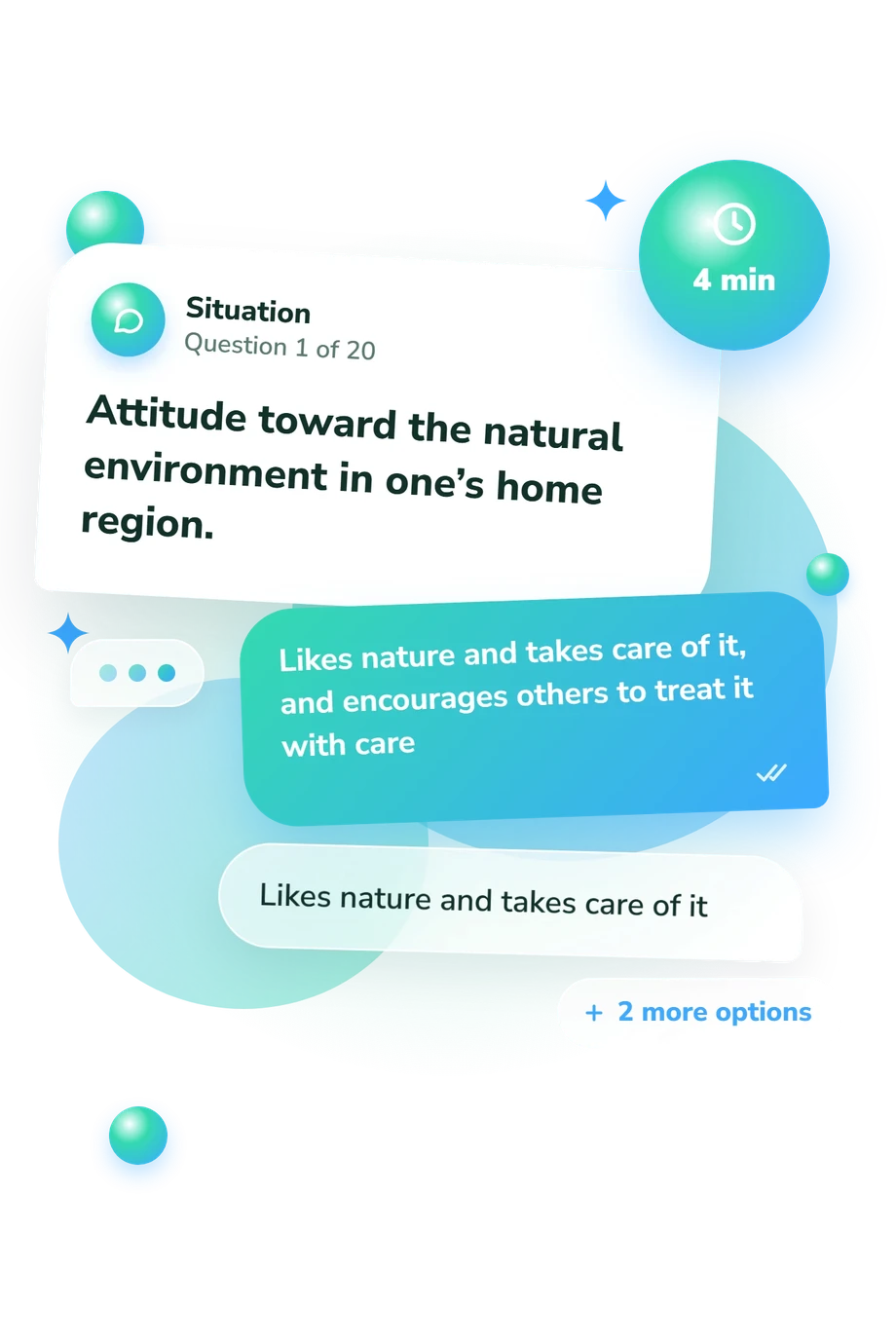
Example Questions From the Test
- Likes nature and takes care of it, and encourages others to treat it with care
- Likes nature and takes care of it
- Takes part in nature protection activities under the teacher’s guidance
- Does not value nature and does not take care of it
- Interested in and proud of the country’s history; talks about it to others
- Interested in the country’s history
- Looks into the country’s history when encouraged by adults
- Not interested in the country’s history
- strives to do as well as possible, helps others
- strives to do as well as possible
- studies when supervised
- performs poorly at school even when supervised
Moral Development Assessment Test - Description and methodology of the test
People who want to examine how responsibility and prosocial habits are developing can use the Moral Development Assessment Test as a structured reflection on everyday conduct. It is suited to an educational context where a learner’s choices, effort, self-control, and relationships are considered together. As a moral development questionnaire, it turns these observations into a profile of strengths and areas that may need encouragement.
What This Assessment Explores
The assessment links moral qualities with self-management, relationships, work, learning, and social participation. Conduct ranges from prompted to independent. A moral development test is a profile, not a label. These dimensions are:
- Attitude Toward Self (0-12) measures self-respect, organization, and self-regulation: Low 0-4; Moderate 5-8; High 9-12.
- Attitude Toward Others (0-12) measures empathy, respect, cooperation: Low 0-4; Moderate 5-8; High 9-12.
- Attitudes Toward Physical Labor (0-12) covers work effort and discipline: Low 0-4; Moderate 5-8; High 9-12.
- Attitude Toward Intellectual Work (0-12) covers learning motivation and growth: Low 0-4; Moderate 5-8; High 9-12.
- Attitude Toward Society (0-12) measures responsibility, cooperation, engagement: Low 0-4; Moderate 5-8; High 9-12.
- Moral Development Level (0-40) summarizes autonomy and prosocial participation: Low 0-20; Medium 21-30; High 31-40.
Methodology and Evidence Base
Each item presents a behavior or attitude with four ordered choices scored from 0 to 3. Options move from absent, prompted, or inconsistent conduct toward independent, constructive behavior. Items cover environmental care, civic and school involvement, curiosity, work habits, relationships, honesty, self-control, and personal standards. Five domain results and one overall result are displayed; the 0-3 choices do not establish how item responses are combined. This is an ordinal profile, not a clinical measurement.
Conceptually, the questionnaire aligns with Shilova’s 1982 work on observing upbringing through everyday conduct, but is a separate online tool, not created by Shilova. Lunkova and colleagues’ 2021 study addresses patriotic and environmental education, overlapping with some themes but offering no validation evidence for this questionnaire. The result is a moral development profile showing strengths and areas where independence or encouragement may be needed.
Because items describe conduct, scores depend on the rater’s perspective, behavioral interpretation, and current context; the displayed bands are descriptive labels. The assessment helps discuss patterns that can change with experience and practice.
- Shilova, Maria Ivanovna. (1990). For Teachers on the Upbringing of Schoolchildren. Moscow: Pedagogika, 144 pp. ISBN 5-7155-0244-6.
- Shilova, Maria Ivanovna. (1982). Studying the Upbringing of Schoolchildren. Moscow: Pedagogika, 104 pp.
- Lunkova, Elizaveta; Gorelik, Victor; Khorosheva, Tatiana; Demeshev, Igor; Voronkova, Elena; and Ponomareva, Natalia. (2021). Role of patriotic education of adolescents in present-day green society. E3S Web of Conferences, 244, 11057. 10.1051/e3sconf/202124411057.
Updated: