
Worry Questionnaire Test
How the Scales are Structured
Who Usually Takes This Test?
See How You Compare
Below is a preview of how scores are typically distributed across each scale.
Example Questions From the Test
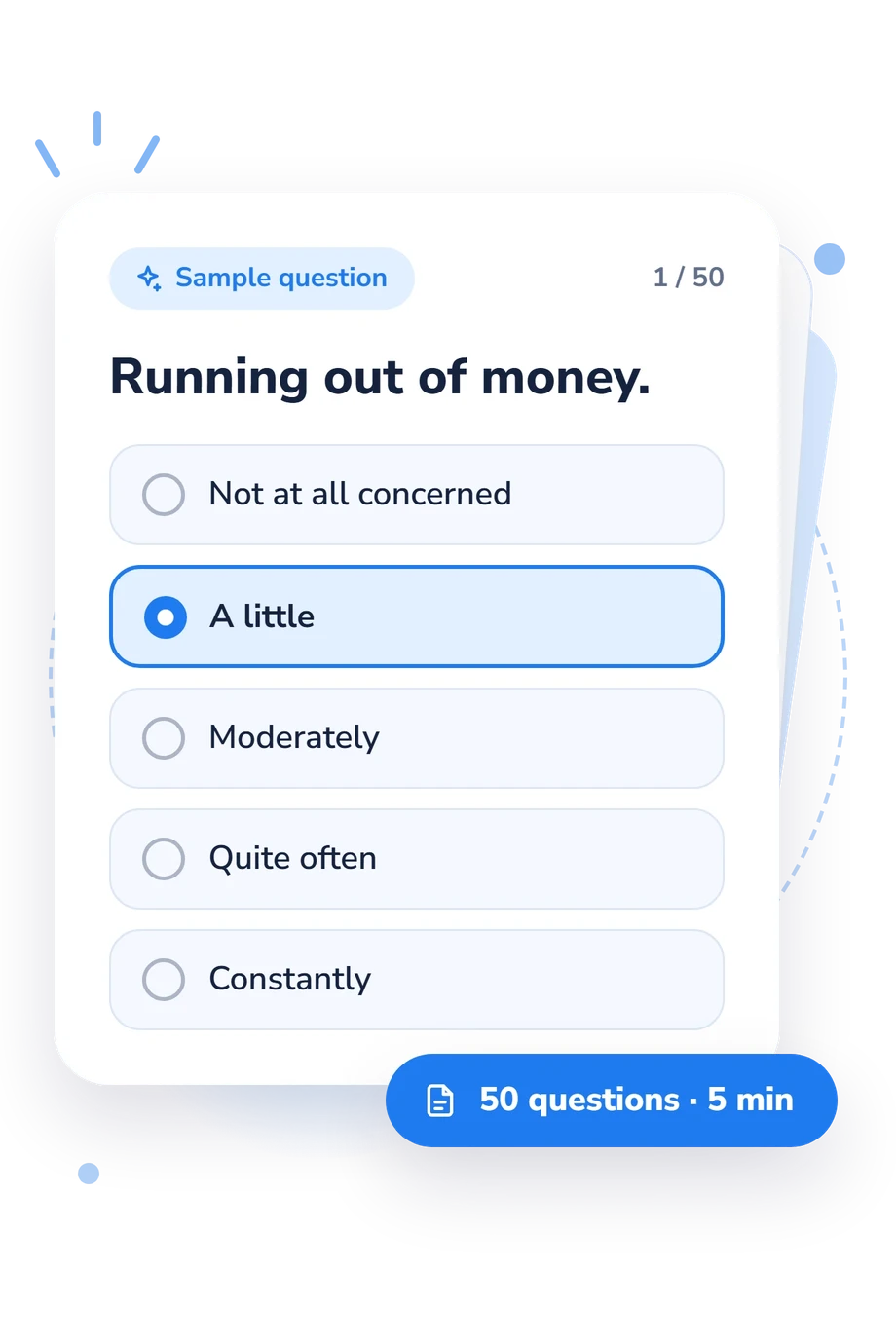
- Not at all concerned
- A little
- Moderately
- Quite often
- Constantly
- Not concerned at all
- A little
- Moderately
- Quite often
- Constantly
- Not concerned at all
- A little
- Moderately
- Fairly often
- Constantly
Worry Questionnaire Test - Description and methodology of the test
People who notice persistent concern about money, work, relationships, trust, or future prospects can use the Worry Questionnaire as an anxiety tics test to organize those experiences into a readable profile. It is intended for anyone seeking a structured starting point for self-reflection. As an online anxiety questionnaire, it reports worry levels for each domain alongside a total score, while leaving interpretation connected to the respondent’s own context.
What This Assessment Explores
Questions cover concerns about money, work demands, approval, relationships, trust, insecurity, and the meaning of the future. Together, they describe domain-specific worry levels, including anxiety connected with perceiving the future as meaningless and a pessimistic outlook on future prospects.
Interpret the worry assessment using recent experience. The result dimensions are:
- Finances (0-20) shows money-related anxiety as Low 0-6 or Elevated 7-20.
- Work (0-20) shows work worry as Low 0-7, Moderate 8-8, or High 9-20.
- The Future Seems Meaningless (0-20) measures anxiety about seeing the future as meaningless and a pessimistic outlook: Low 0-8 or Elevated 9-20.
- Lack of Trust (0-20) reflects distrust-related worry as Low distrust 0-9 or Elevated distrust 10-20.
- Interpersonal Relationships (0-20) shows relationship worry as Low 0-5 or Elevated 6-20.
- Total Score (0-100) summarizes overall worry as Lower worry 0-39 or Elevated worry 40-100.
Methodology and Evidence Base
Each item describes a worry, such as financial loss, work mistakes, disapproval, or relationship difficulty. The respondent selects one of five ordered options from no concern to constant concern, with minor wording changes such as a little or slightly. This format captures perceived intensity rather than asking for explanations.
Results provide domain scores and a total score. The ranges define output bands, but the questionnaire does not document how answers become points; no point-by-point rule should be inferred. These bands describe displayed results, while findings from related published instruments should not be transferred automatically to this online version.
It is conceptually consistent with the Worry Domains Questionnaire (Tallis, Davey, & Bond, 1994), but is not presented as an adaptation of that instrument. Tallis, Eysenck, & Mathews (1992) and McCarthy-Larzelere et al. (2001) add evidence about worry measurement and factor structure in those published instruments, but they do not establish properties of this online version.
The result, used as an anxiety self-assessment, can vary with current stress, self-awareness, and response style. Treat it as a snapshot of recurring concerns and compare it with everyday experience.
- Tallis, F., Davey, G. C. L., & Bond, A. (1994). The Worry Domains Questionnaire. In G. C. L. Davey & F. Tallis (Eds.), Worrying: Perspectives on Theory, Assessment and Treatment (pp. 285-297). Chichester: Wiley.
- Tallis, F., Eysenck, M. W., & Mathews, A. M. (1992). A questionnaire for the measurement of nonpathological worry. Personality and Individual Differences, 13(2), 161-168. 10.1016/0191-8869(92)90038-Q
- McCarthy-Larzelere, M., Diefenbach, G. J., Williamson, D. A., Netemeyer, R. G., Bentz, B. G., & Manguno-Mire, G. M. (2001). Psychometric Properties and Factor Structure of the Worry Domains Questionnaire. Assessment, 8(2), 177-191. 10.1177/107319110100800206
Updated: